Influencer Contract Template (Free Download, 2026)
Free influencer contract template (Word + PDF) covering payment, content rights, exclusivity, FTC disclosure, kill fees, and 2026's most-missed clause: AI training rights.

Founder & CEO, Superdeal
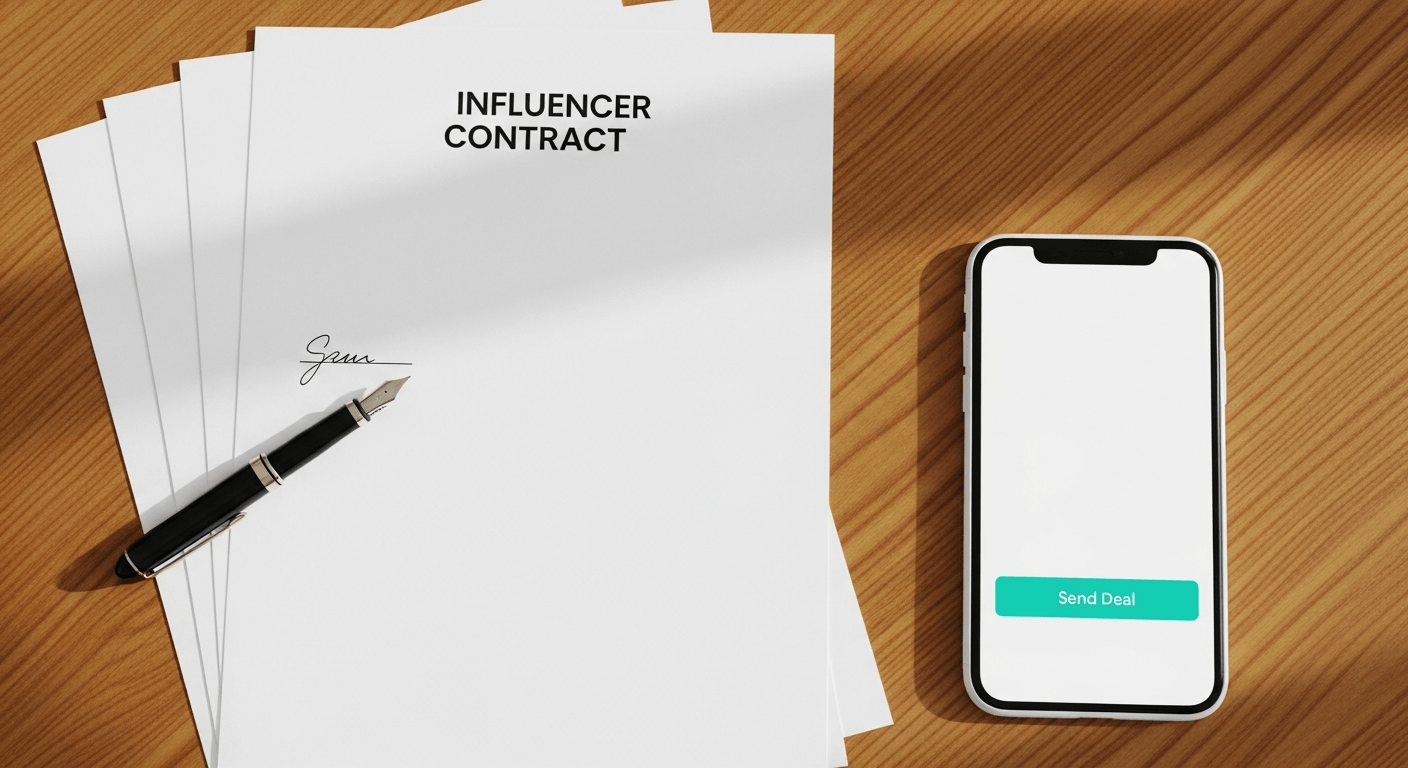
TL;DR. Free influencer contract template (Word + PDF) covering the 10 clauses every brand–creator deal needs in 2026, including the AI training rights clause most templates skip.
Get the template: Download Word or Download PDF → covers payment, content rights, exclusivity, kill fees, FTC disclosure, AI training rights.
Skip the template entirely: Send a deal in 30 seconds with Superdeal → — every deal ships with our standard contract built in, payment held in escrow, released on delivery.
Still hand-rolling contracts? The 5 mistakes that blow up small deals (vague deliverables, missing usage rights, no exclusivity window, no revision cap, payment-on-delivery) are detailed below.
An influencer contract is a written agreement between a brand and a creator that locks in deliverables, deadlines, payment, and content rights. You need one for every paid deal — including paid product gifting. US influencer marketing spending crossed $10 billion in 2025, and eMarketer projects $13 billion+ by 2027 — but a meaningful share of that money still moves on DM screenshots and verbal handshakes. That's how deals blow up. Our free template (Word + PDF) covers the 10 clauses every influencer contract should include in 2026, including a clause most templates miss: AI training rights. It mirrors the standard contract Superdeal uses on every deal in our marketplace. Download it below — or skip the paperwork entirely and send a deal through Superdeal in 30 seconds.
👉 Download the Template — Word (.docx) · PDF 👉 Skip the template — send a deal in 30 seconds →
When You Need an Influencer Contract (And When You Don't)
Every paid deal needs a written contract. "Paid" includes free product if the creator is required to post — that's still consideration in the eyes of the FTC and most state contract law. The deciding question is always the same: is value being exchanged for something the creator has to do? If yes, write it down.
Always — for any paid deal
If money is changing hands, even $50, write it down. The smaller the deal, the easier it is to skip the paperwork — and the easier it is for the deal to fall apart on the first edge case (a missed deadline, a usage-scope disagreement, a creator going dark). The creators with the best track records insist on contracts even at $100. The ones who say "let's just figure it out" are the ones who later argue about scope.
Probably — for product gifting with a posting requirement
If you're sending a $300 skincare set in exchange for an Instagram Story, that's a paid deal in everything but the cash transfer. The IRS treats it as taxable income for the creator at fair market value, and the FTC treats it as an endorsement requiring disclosure. Write it down. Include the gift's value, the deliverable, and the disclosure obligation explicitly.
Optional — for unconditional seeding
If you're seeding a product with no posting requirement — "here's a free thing, no strings, post if you want" — a contract is overkill. A short email with the disclaimer "no posting obligation, no expectation of coverage" is enough. Most legitimate seeding programs work this way.
What to Include in an Influencer Contract (10 Required Clauses)
Every solid influencer contract has the same backbone. The 10 clauses below are the ones I've seen blow up small deals when missing, and the ones that protect both sides on bigger ones. Here's what each clause does and why it matters:
Parties + effective date — Exact legal entity names and the date the contract takes effect. Why it matters: The most common error is using the brand's marketing-team name instead of the parent company's legal entity.
Scope of work — Exact deliverables, format, length, posting platforms. Why it matters: Vague scope is the #1 cause of contract disputes. "A few stories" is not a scope.
Timeline — Content delivery dates, revision deadlines, posting dates. Why it matters: Build in revision deadlines; otherwise revisions stretch indefinitely.
Payment terms — Amount, milestones, payment method, late-payment terms. Why it matters: Lump-sum on delivery hands all bargaining power to whoever controls the file.
Content rights — Who owns the content, who can use it, where, for how long. Why it matters: Default: creator owns; brand gets a license. The license terms are where the money is.
Exclusivity — Category, duration, geography. Why it matters: The brand pays extra to lock the creator out of competitors for a window.
Approval rights and revision cap — Who signs off on the content and how many revision rounds are included. Why it matters: Two rounds standard; cap explicitly.
FTC disclosure — The creator must disclose the material connection clearly and conspicuously per FTC Endorsement Guides. Why it matters: Not optional.
Termination and kill fees — What happens if either side walks away. Why it matters: 25–50% kill fee is standard.
AI training rights — Can the brand (or the creator) use the content to train AI models? Why it matters: The 2026 clause everyone forgets. Default to "no" unless explicitly granted.
The rest of this section explains each clause in detail.
1. Parties and effective date
Identify the exact legal entities on both sides. If the brand operates under a parent company, name the parent — not the consumer-facing brand name. The same applies to creators operating through an LLC or S-corp: name the entity, not just the individual. The effective date is when the contract takes force, which may be different from the signing date.
2. Scope of work and deliverables (be specific)
This is where most contracts fall apart. "Three Instagram posts" is not a scope. The right specification answers all of: format (Reel, static post, Story, carousel), length (in seconds for video, in slides for carousel), aspect ratio, platform (Instagram, TikTok, YouTube Shorts), required hashtags, required @-mentions, required CTAs, raw-file delivery vs. published-only.
A clean line item reads like: "Two 30-second vertical Reels (9:16, MP4 + raw .mov), one carousel post with 5 slides, both posted to creator's Instagram main feed between June 10–14, 2026, with #ad disclosure in the first line of caption and @brandhandle tag."
3. Timeline and review rounds
Set deadlines for: first draft delivery, brand feedback, revisions, final delivery, posting date. Cap revisions at two rounds with a definition of what counts as a "round." Most disputes come from open-ended revision creep. If the brand misses the feedback deadline, content auto-approves at the next milestone. This protects creators from indefinite hold.
4. Payment terms (amount, schedule, milestones)
The structure that protects both sides: 50% on signing, 50% on delivery. Some brands prefer 30/70 (30% on signing, 70% on posting); some prefer milestones tied to draft delivery and final approval. The principle: no creator should deliver final content with 0% paid, and no brand should pay 100% before they've seen anything.
In the US, payment to a creator (treated as an independent contractor) is reported on Form 1099-NEC. The reporting threshold is $600 in calendar year 2025; for payments made after December 31, 2025, the IRS threshold rises to $2,000 per the One Big Beautiful Bill Act, with annual inflation indexing starting in 2027. A creator hitting that threshold gets a 1099 from the brand; either way, the income is taxable from dollar one. Don't let the threshold confuse anyone. Every creator owes tax on every dollar regardless of whether they receive a form.
5. Content rights and usage windows
Default ownership rule: the creator owns the copyright in what they make; the brand gets a license to use it. The contract spells out the license. Three knobs to set:
Where: paid social ads, organic social, brand website, paid search, OOH, TV, email, retail signage. List explicitly.
How long: 30 days, 90 days, 1 year, perpetual. Default is 30 days for paid social usage on top of organic posting.
Where geographically: US-only, North America, worldwide.
The price tag scales with each knob. A 30-day US-only paid-social license is 1× the base. Perpetual worldwide on every channel is 3–5× the base. Under 17 U.S.C. § 101 and § 201, the only way the brand owns the copyright outright (rather than licensing it) is a "work made for hire" arrangement that requires a written agreement specifying that exact term — and influencer content typically does not qualify as a statutory work-for-hire category. If the brand wants ownership, the contract has to assign it explicitly; otherwise the creator keeps the copyright and the brand has a license.
6. Exclusivity (category and duration)
Brands pay creators extra to not work with direct competitors during and after the campaign. The standard structure: category + duration. "Skincare brands" is a category; 30 days post-publication is a duration. Industry pricing in 2025 puts a 30-day category exclusivity at +20–35% of the base rate, 90 days at +50–75%, and 6-month exclusivity at +75–100%. Anything broader (full vertical lockout, full year, multiple categories) gets expensive fast and most creators won't take it.
The trap brands fall into: defining the exclusivity category too broadly. "All beauty brands" excludes more than the brand likely intends. "Direct competitors in the prestige skincare category" is the right specificity.
7. Approval rights and revisions
Two revision rounds is standard. Define what counts as a round: a single round of consolidated feedback, sent within 5 business days of draft delivery. After two rounds, content is final. If the brand wants a third round, they pay an additional fee per round. This is the single clause that prevents 80% of timeline disputes.
8. FTC disclosure requirements
Federal law. Not optional. Per the FTC's Endorsement Guides (revised June 2023), creators must disclose any "material connection" — financial, family, employment — when endorsing a brand. The disclosure must be "clear and conspicuous": placed with the endorsement (not buried in profile bio or behind "more" links), readable on any device, and visible in any clip the post might be republished as. The FTC's Disclosures 101 for Social Media Influencers is the operating standard — keep a copy in the contract appendix.
The contract should specify the exact disclosure language ("#ad" or "Paid partnership with [Brand]" placed in the first line of caption and on every Story slide), and require the creator to indemnify the brand if they fail to disclose. Both sides should care: the FTC has historically gone after brands more than creators, but the risk has expanded to consumer class actions targeting both brands and influencers, and the Lord & Taylor settlement is the canonical example of why brands enforce disclosure in writing.
9. Termination and kill fees
Two scenarios to plan for: (1) the brand cancels the campaign, (2) the creator backs out. The kill fee covers the brand-side cancellation. Industry standard is 25–50% of the total fee, scaling with project stage: 25% if cancelled before production starts, 50% if cancelled mid-production, 100% if cancelled after delivery and approval. For creator-side cancellation, the standard is full refund of any deposit plus a clause requiring the creator to deliver any work-in-progress.
10. AI training rights (the 2026 clause everyone misses)
This is the clause that wasn't in any standard template two years ago and now belongs in every one. Default rule: silence in a contract about AI training rights is legally ambiguous and trending against creators. Once content is in the wild, downstream platforms may train on it under their own terms of service. The fix is explicit language. The Authors Guild publishes a model clause prohibiting AI training without express written permission, and the same template applies to influencer content.
Three positions to pick from in your contract:
Brand grant only. The brand may use the content to train its own internal AI tools (e.g., a product-photo classifier) but may not sublicense to third-party AI training operations.
Mutual prohibition. Neither side may use the content for AI training, and both sides will mark the content with a machine-readable opt-out signal where possible.
Carve-out. AI training is permitted for specific named purposes (analytics, A/B testing) and prohibited for everything else (generative model training, content synthesis).
Pick one explicitly. Don't leave the clause out.
Influencer Contract Template — Free Download
Our free template covers all 10 clauses above, in plain language, with two versions: a Word .docx you can edit and a PDF for sharing. It mirrors the standard contract Superdeal uses on every deal in our marketplace, with optional clauses for whitelisting, Spark Ads / Partnership Ads, and category exclusivity. The template is provided as-is and does not constitute legal advice — see the disclaimer at the bottom.
👉 Download the Template — Word (.docx) · PDF Free. Email gate only — we'll add you to brand-side product updates. Unsubscribe anytime.
What's inside:
10-clause boilerplate covering everything in the section above
Optional whitelisting addendum (Spark Ads / Partnership Ads grant)
Optional category exclusivity rider (30 / 90 / 180-day variants)
Optional AI training rights addendum with three preset positions
FTC disclosure language ready to drop into any post
Plain-English glossary for first-time signers on both sides
If a Word doc isn't what you want — see the next section. Most brands running 5+ deals per month are better off skipping templates entirely.
The 5 Most Common Influencer Contract Mistakes
Across thousands of deals on Superdeal and 14 years of influencer marketing before the platform existed, the same five contract mistakes blow up small deals over and over. All five are preventable with a single solid template.
1. Vague deliverables ("a few Stories")
The most common contract failure mode. "A few Stories" is not a deliverable. The fix: spell out exact format, count, length, and platform. Write the exact line: "three Instagram Stories on creator's main account, each 15 seconds, posted within 24 hours of brand approval, with #ad disclosure on every slide."
2. Missing or vague usage rights
The brand pays $1,500 for a UGC video, runs it as a Meta ad for 30 days successfully, then wants to extend the campaign. Without a usage-rights clause, the brand has to renegotiate from a position of weakness, because the creator now knows the video is performing. The fix: include 30-day paid usage by default in the base rate, and lock in option pricing for 90-day and 1-year extensions at the time of original signing.
3. No exclusivity window
Creator posts a stellar Reel for Brand A on Tuesday, posts the same product-category Reel for Brand A's direct competitor on Friday. Both deals were technically valid because neither contract had exclusivity. The fix: even a 14-day post-publication exclusivity in the same product category eliminates 95% of this risk for almost no premium.
4. No revision cap
Brand asks for tweak after tweak; campaign window closes; content never airs. The creator is owed full payment but gets stuck arguing for it. The fix: cap revisions at two rounds with auto-approval at day 5 if no consolidated feedback arrives.
5. Payment-on-delivery (no deposit)
Creator delivers content; brand drags feet on payment; creator threatens to pull the post; everyone loses. The fix: 50% deposit on signing, 50% on delivery. Or use Superdeal's built-in escrow: brand funds the deal at signing, money releases automatically on delivery.
Skip the Template — Send a Deal in 30 Seconds
A free Word template is fine for one-off deals. But if you're running more than five deals a month, the template is the slow path. Superdeal's standard contract is built into every deal-send, payment is held in escrow until delivery, and content rights are platform-enforced. No copy-paste, no per-deal lawyer review, no payment chase.
Here's how the two paths compare across the dimensions that actually matter:
Time to deal. Free template: 1–3 days to negotiate clauses on each deal. Superdeal: 30 seconds — fill the deal form, send.
Lawyer review. Free template: per-deal cost (or you skip review and accept risk). Superdeal: built in — every deal ships on a single counsel-reviewed standard contract.
Payment hold-and-release. Free template: manual escrow you set up yourself, or wire-after-delivery (creator carries the risk). Superdeal: automatic escrow at deal-send, automatic release on delivery.
Content rights enforcement. Free template: trust-based — if the creator violates the rights clause, you sue. Superdeal: platform-enforced via deal terms.
Cost. Free template: free in dollars, expensive in your time. Superdeal: free to browse 50,000+ creators; flat per-deal fee on contracted deals.
Best for. Free template: one-off deals, unusual structures. Superdeal: brands running 5+ deals per month, repeat creator relationships.
👉 Send your first deal in 30 seconds with Superdeal → — browse 50,000+ creators free, contracts auto-generated, payment held in escrow until delivery.
Influencer Contract Template FAQ
Do I need a contract for a $200 influencer post?
Yes, even more so. Small deals get sloppy because the dollar amount feels low, but the legal exposure is the same. FTC disclosure rules apply at any spend level. A one-page contract takes 10 minutes and prevents 90% of disputes that derail small deals.
What's the difference between an influencer contract and a UGC contract?
A UGC contract pays for content the brand uses on its own channels, typically with no posting requirement. An influencer contract pays for both content and audience access (the creator posts to their followers). Influencer deals add posting platform, posting date, and FTC disclosure. See our UGC creator guide.
Can I use this template internationally?
The template is drafted for US jurisdiction. Most clauses translate to other common-law jurisdictions (UK, Canada, Australia) with small edits, but tax reporting, copyright defaults, and disclosure rules differ. For EU deals, swap FTC references for the local authority and add GDPR language. Ask local counsel.
Who owns the content after the contract ends?
Default rule under US copyright law: the creator owns the content; the brand gets a license. The contract spells out where the brand can use it, for how long, on what channels. To shift ownership to the brand, the contract must include explicit assignment language. Most deals use a license, not assignment.
What's a typical exclusivity window?
For paid posts, 30 days post-publication in the creator's category is the most common minimum, costing 20–35% on top of base rate. Ninety days runs 50–75%. Six months runs 75–100%. For unpaid seeding deals, exclusivity is rarely worth negotiating. Match duration to campaign value.
What's a "kill fee"?
A kill fee compensates the creator if the brand cancels mid-flight. Industry standard is 25% of total fee if cancelled before production starts, 50% if cancelled mid-production, and 100% if cancelled after content delivery and approval. Kill fees protect creator time on deals pulled for reasons outside their control.
Do I need a lawyer to review every deal?
No. Templates exist precisely so brands and creators can run repeat deals without per-deal legal cost. Have counsel review your template once, then use it as-is on standard deals. Bring counsel back only for unusual structures: equity, multi-territory, perpetual rights, or deals above $25,000.
What about AI training rights?
New in 2026, and the single most-skipped clause in older templates. If your contract is silent, the creator's content may end up in third-party AI training pipelines under platform terms neither side controls. The fix is explicit language: grant, deny, or carve-out. Pick one and write it down.
About this template (legal disclaimer)
This template is provided as-is and does not constitute legal advice. It reflects general US influencer-contract practice as of May 2026 and has been reviewed by counsel with reference to the FTC Endorsement Guides, US copyright law (17 U.S.C. § 101 and § 201), and current industry pricing benchmarks. It is created from public legal sources and mirrors Superdeal's standard platform contract practices. For jurisdiction-specific requirements, edge-case structures (equity, perpetual rights, cross-border deals), or any contract above $25,000 in total value, consult your own counsel before signing. Nothing in this article or the template creates an attorney-client relationship between you and Superdeal, MightyJoy, or any of their counsel.
For brands: Browse 50,000+ creators free → For creators: Find brands actively looking for UGC creators on Superdeal — see our guide on where to find UGC brand deals →.