What Is a UGC Creator? The Complete 2026 Guide for Brands & Creators
UGC creators make authentic content for brands without needing an audience. What UGC is, how rates work in 2026, the top platforms, and how to start (or hire one).

Founder & CEO, Superdeal
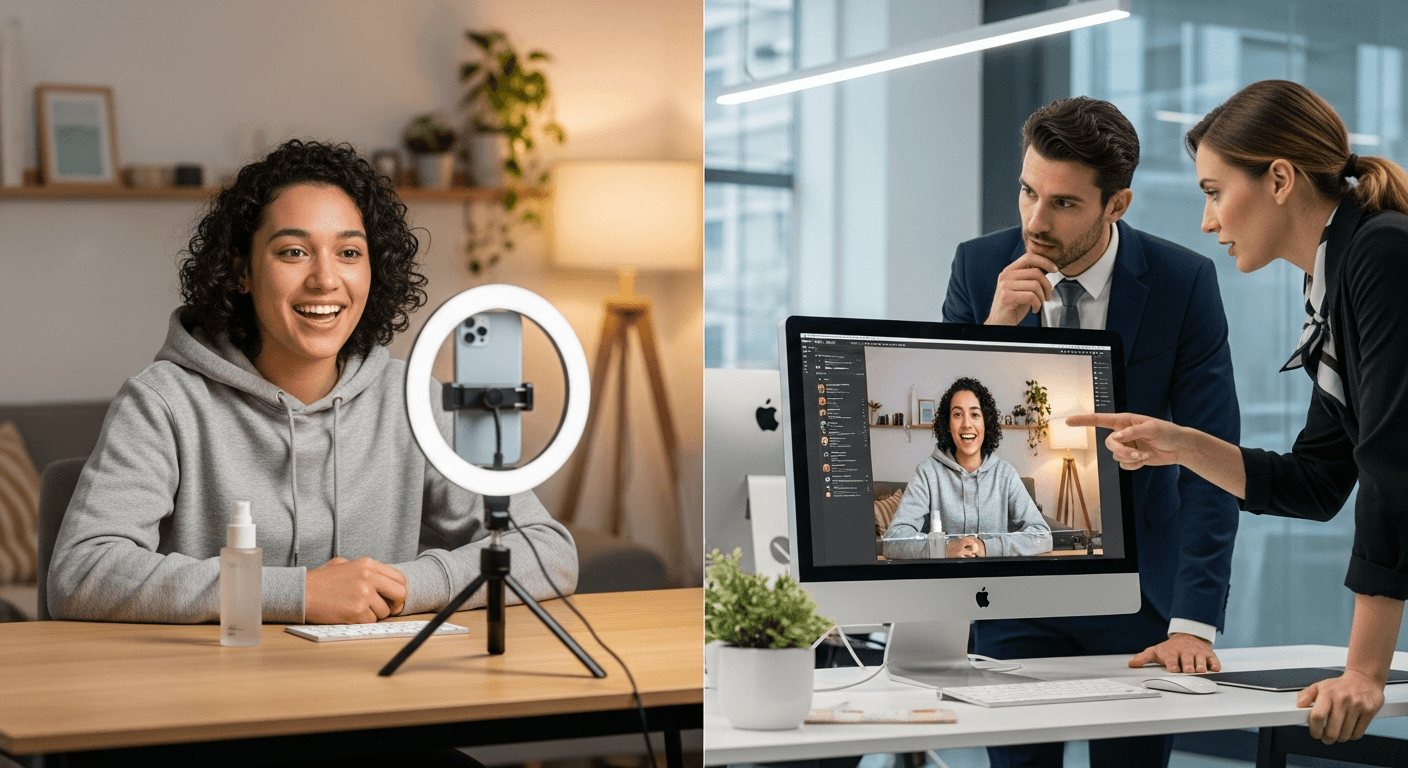
A UGC creator is someone who makes authentic, branded content — usually short videos — for companies to use in their ads, on their websites, and on social channels. Unlike influencers, UGC creators don't need a big audience. They get paid for the content itself, not for posting it to their followers. In 2026, US-based UGC creators charge $150–$500 per video on average, with experienced creators earning $5K–$15K/month working with multiple brands. This guide covers what UGC is, how creators get paid, the best platforms to find (or list as) a UGC creator, and how to hire one in under five minutes.
👉 Browse 50,000+ UGC creators free — search by niche, vet portfolios, send a deal in 30 seconds.
What Is a UGC Creator? (Definition)
User-generated content (UGC) traditionally meant any content made by users — reviews, social posts, photos — without a brand asking. The modern usage in 2026 is much narrower. A UGC creator is a paid contractor who produces user-generated-style content for a brand to use however the brand chooses.
The "user-generated style" matters. UGC creators shoot in their kitchens, bedrooms, and cars. They speak directly to camera. They don't use studio lighting or scripted brand voice. The content looks like a real person genuinely using the product — because, technically, it is. They're paid to be that real person on camera.
Brands then use this content in three main places: paid social ads (where UGC consistently outperforms polished brand creative for direct-response categories), product detail pages, and email/SMS. We'll cover each in detail below.
The term itself is barely a decade old in this commercial sense, but the practice exploded between 2022 and 2026 as TikTok and Reels rewarded "real-person" creative and penalized anything that looked like a traditional ad.
UGC creator vs. influencer — the key difference
The single line that separates a UGC creator from an influencer: the influencer rents you their audience; the UGC creator sells you the content itself.
An influencer agreement says "post this on your TikTok at 7pm Tuesday so your 200K followers see it." A UGC creator agreement says "deliver three 30-second vertical videos by Friday and grant me usage rights — I'll run them as ads on accounts your audience will never know about."
This distinction shapes everything else: rates, follower requirements, content rights, exclusivity, and how brands measure success. An influencer campaign is measured in impressions and engagement on the influencer's own posts. A UGC campaign is measured in cost-per-acquisition on the brand's own ad accounts.
UGC creator vs. content creator — when each term applies
"Content creator" is the umbrella. Anyone who makes content for any platform is technically a content creator: YouTubers, TikTokers, podcasters, newsletter writers, streamers.
A UGC content creator is a specific subset: someone who makes branded content for brands' commercial use, not their own audience. The labels "UGC creator" and "UGC content creator" are interchangeable — most creators on Superdeal use them as synonyms in their profiles, and brands use both terms in briefs.
UGC creator vs. influencer vs. brand creative team — at a glance:
UGC creator — no audience required; paid for the content itself; typical rate $150–$500 per video; brand owns the content after rights are granted; best for paid ads, product detail pages, and email.
Influencer — needs an audience (typically 1,000+ followers minimum); paid for reach; typical rate $200–$10,000+ per post; creator retains content ownership; best for awareness campaigns.
Brand creative team — in-house, no audience required; paid hourly or salaried; typical cost $5,000–$25,000/month per role; brand owns everything; best for brand-controlled flagship work.
How Much Do UGC Creators Make in 2026?
Rates vary widely by experience, niche, and add-ons. In 2026, a beginner UGC creator with no existing brand work charges $75–$200 per video; an experienced creator with a strong portfolio in a competitive niche (beauty, fitness, food) regularly clears $5,000–$15,000 per month working with three to five brands at a time.
Here's the breakdown.
Per-video rates (TikTok, Instagram Reels, YouTube Shorts)
Most UGC is delivered as a 15–60 second vertical video, deliverable as a raw clip the brand can edit, post, or run as an ad. Per-video pricing has stabilized in 2026 after wild swings during the 2023–2024 creator-economy gold rush.
Typical UGC rates in 2026 (US-based creators):
Beginner tier (under 6 months experience, fewer than 50 videos completed): $75–$200 per 30-second video. Independent UGC educator Kristian Larsen documents the same range — beginner rates of $75–$150 for 15-second clips and $100–$200 for 30-second clips, with sub-$100 rates common in the first 5–10 deals.
Mid tier (6–18 months experience, 50–200 videos completed): $200–$500 per video. Industry pricing guides put the median single UGC video at roughly $175 in 2025, with mid-tier creators clustering in the $200–$500 band as their portfolio matures.
Pro tier (18+ months experience, 200+ videos, niche specialist): $500–$1,500+ per video. Vertical specialists in competitive categories (beauty, fitness, food) command the upper end, and top-tier creators with proven ad performance can reach $3,000+ for a single 30-second testimonial.
Add-on — paid social usage rights: typically +20–30% per month for 30-day paid ad usage; 6-month rights add 25–40%, 12-month rights 30–50%, and perpetual or unlimited rights add 100–150%.
Add-on — whitelisting (Spark Ads / Partnership Ads): +30% per month is the standardized rate, with a common range of 30–100% depending on platform and exclusivity.
Add-on — category exclusivity: typically +20–50% per locked category, with 30–90 days post-publication being the most common duration. Longer or stricter terms cost more.
The per-video number isn't the full picture. Most experienced creators bundle: three videos for the price of 2.5, or a "starter pack" of one talking-head, one product demo, and one lifestyle clip at a flat rate. Bundling is how creators move the average deal value up without scaring brands with sticker shock on a single line item.
Monthly retainer ranges
The most profitable structure for both sides is a monthly retainer. Brand pays a fixed fee, creator delivers a set number of videos per month. Common structures in 2026:
Starter retainer: $1,500–$3,000/mo for 4 videos
Standard retainer: $3,000–$6,000/mo for 8–10 videos
Senior retainer: $6,000–$12,000/mo for 12+ videos with priority turnaround and expanded usage rights
Retainers favor creators who can produce consistently and brands who burn through ad creative fast. Brands running scaled paid social — anyone spending $50K+/month on Meta or TikTok — typically need 8–15 fresh creative variants per month per platform to stay ahead of ad fatigue. UGC retainers are how they keep up without exploding in-house creative headcount.
On Superdeal, a typical four-brand retainer stack ends up paying creators between $8,000 and $14,000 a month — usually one mid-tier retainer ($3,000–$4,000) plus three starter retainers ($1,500–$2,500), with per-video add-ons stacked on top for extended usage rights and whitelisting. Creators clearing $15,000+ a month are almost always running one senior retainer plus two to three additional brand relationships at the mid tier. The pool of buyers keeps expanding — US influencer marketing spend crossed $10 billion in 2025 and is on track to exceed $13.7 billion by 2027, growing 15.7% year-over-year through 2026, per eMarketer's forecast — and a meaningful share of that is UGC ad spend going directly to non-influencer creators.
Add-ons: usage rights, exclusivity, whitelisting
Per-video rates assume 30 days of paid-ad usage rights. Anything beyond that adds to the bill — and for experienced creators, this is where the deal value compounds.
30-day usage rights — included by default in most 2026 UGC contracts
90-day or 1-year usage rights — typical add-on of 25–50% on top of base rate
Perpetual usage rights — usually 100%+ of base rate; some experienced creators won't grant perpetual at any price
Whitelisting / Spark Ads / Partnership Ads — letting brands run paid ads from the creator's TikTok or Meta handle. Adds 20–40% to the rate; gives the brand a much higher-trust ad surface.
Category exclusivity — creator agrees not to work with competing brands in the same vertical for X months. Adds 50–100% per category locked.
Two creators with identical per-video rates can have very different annual income depending on how well they negotiate rights. The clauses that move money most are spelled out in our influencer contract template guide.
What Do Brands Use UGC For?
UGC isn't a marketing channel — it's a creative asset that runs through multiple channels. By 2026, UGC has become the default ad creative for direct-to-consumer brands spending $50K+/month on Meta and TikTok, replacing studio-shot creative for most placements.
Paid ads (the #1 use case)
Most brand spend on UGC goes to paid social, and the reason is performance. Sprout Social's research shows 81% of marketers say visual UGC has a more significant impact than professionally shot photos or content from influencers, and HubSpot's 2025 Social Media Marketing Report finds 55% of social users are more likely to trust brands publishing human-generated content over AI-generated material — rising to two-thirds among Gen Z and Millennials. Users on TikTok and Reels penalize anything that "looks like an ad" — and the data follows behavior.
The math is simple. A creative team producing one polished hero video might spend $15K–$25K over four weeks. The same brand can buy 30–50 UGC variants for the same money, A/B test all of them, and learn which hooks, claims, and openings actually drive conversions. The creative-volume thesis — more variants beats higher production value — is the operating principle of every scaled DTC ad account in 2026.
Organic social
UGC works as supplementary organic content — "real customer" testimonials, product setups, day-in-the-life clips. Brands often repost UGC on their own organic feeds (with permission and proper credit) to fill the gap between flagship campaign content. The cost-per-post is a fraction of original organic production, and the engagement is often higher.
Product detail pages and email
This is the underused use case. UGC video on a product detail page (PDP) is one of the highest-leverage places to add it: PowerReviews research shows conversion rates more than double — a 102.4% lift — when shoppers actually engage with UGC on the page, and Shopify's enterprise team reports 40% of shoppers say UGC is "extremely" or "very" important to their purchase decision. Email and SMS use UGC clips as social proof — short clips of "real customers" using the product slot into welcome sequences, abandoned-cart recovery, and post-purchase upsells with very little additional creative cost.
Whitelisting / Spark Ads / Partnership Ads
When a brand runs UGC as an ad through the creator's own social handle (with explicit permission), the ad inherits the creator's account credibility. TikTok calls this Spark Ads; Meta calls it Partnership Ads. Brands pay creators an additional fee — typically 20–40% on top of the base UGC rate — for the right.
The data on whitelisting is consistent and comes straight from the platforms themselves. On TikTok, official case studies on TikTok for Business show Spark Ads delivering CTR lifts of 24–25% and CVR lifts of 24% over non-Spark formats, with CPM and CPC each cut by roughly two-thirds versus other social channels. On Meta, eMarketer reports that Partnership Ads deliver an average 19% lower CPA and 13% higher CTR than business-as-usual ads, per Meta's own performance data — and 53% higher CTR when Partnership Ads run alongside BAU campaigns. That gap is large enough that many scaled brands have made whitelisting a default request on every UGC contract, even when they don't end up using it.
How to Hire a UGC Creator (For Brands)
The 2026 hiring flow is fundamentally different from the 2022 flow. Free indexable databases mean you don't need to email an agency to get a list. You can find, vet, and contract a UGC creator in under an hour for the cost of one mid-tier creative test.
Step 1 — Define your brief
Before you look at a single creator, write down:
Product / category
Hero benefit (one sentence)
Three competitor brands whose ads you respect
Two reference clips (links to TikTok / Reels you'd want yours to feel like)
Required deliverables (e.g., 3 videos × 30 seconds, vertical, talking-head + product demo)
Usage rights needed (30 days paid? Whitelisting? Both?)
Budget per video (or total)
Deadline
A brief like this saves 80% of back-and-forth. Without it, every creator gives you a generic quote and the conversation stalls. With it, the right creator says "yes, here's a portfolio piece exactly like this," and you're contracting in two messages.
Step 2 — Find creators (free databases, marketplaces, agencies)
You have three options:
Free indexable databases (Superdeal, others). Browse profiles directly, filter by niche, location, prior brand work. Free to search; you pay only when you contract.
Closed marketplaces (Insense, Trend.io, billo). Curated talent pools; usually a per-deal fee or platform subscription.
Agencies and managed services. Higher cost ($5K–$25K/mo retainers) but you offload the sourcing and management. Worth it for brands without an internal creative ops person.
For most brands at most stages, an indexable database is the right starting point. Browse Superdeal's free UGC creator database →
Step 3 — Vet portfolios and match brand fit
Look for three things in a creator's portfolio:
Consistency. Do their previous brand pieces look like a finished, deliverable product? Or only their personal posts?
Range. Can they do talking-head, product-demo, and lifestyle clips? Single-trick creators are fine for narrow asks but hard to retain on a multi-video deal.
Brand-fit. Do their personal aesthetic and prior brand work overlap with your category? Beauty creators rarely shine on heavy industrial products — and vice versa.
Watch one full sample video at 1× speed (not skimming). If it makes you forget you're watching an ad, you've found a strong match. If it doesn't, keep scrolling.
Step 4 — Send the deal (contract, payment, deliverables)
The four pieces of every UGC contract:
Scope — exact deliverables, format, deadline
Rights — what the brand can do with the content, for how long
Payment — total, milestones, payment method
Usage — paid ads y/n, whitelisting y/n, exclusivity y/n
👉 Send your first deal in 30 seconds with Superdeal — contracts auto-generated, payment held in escrow until delivery, releases on creator submission.
For the full contract template with the exact clauses that protect both sides, see our influencer contract template guide.
How to Become a UGC Creator (For Creators)
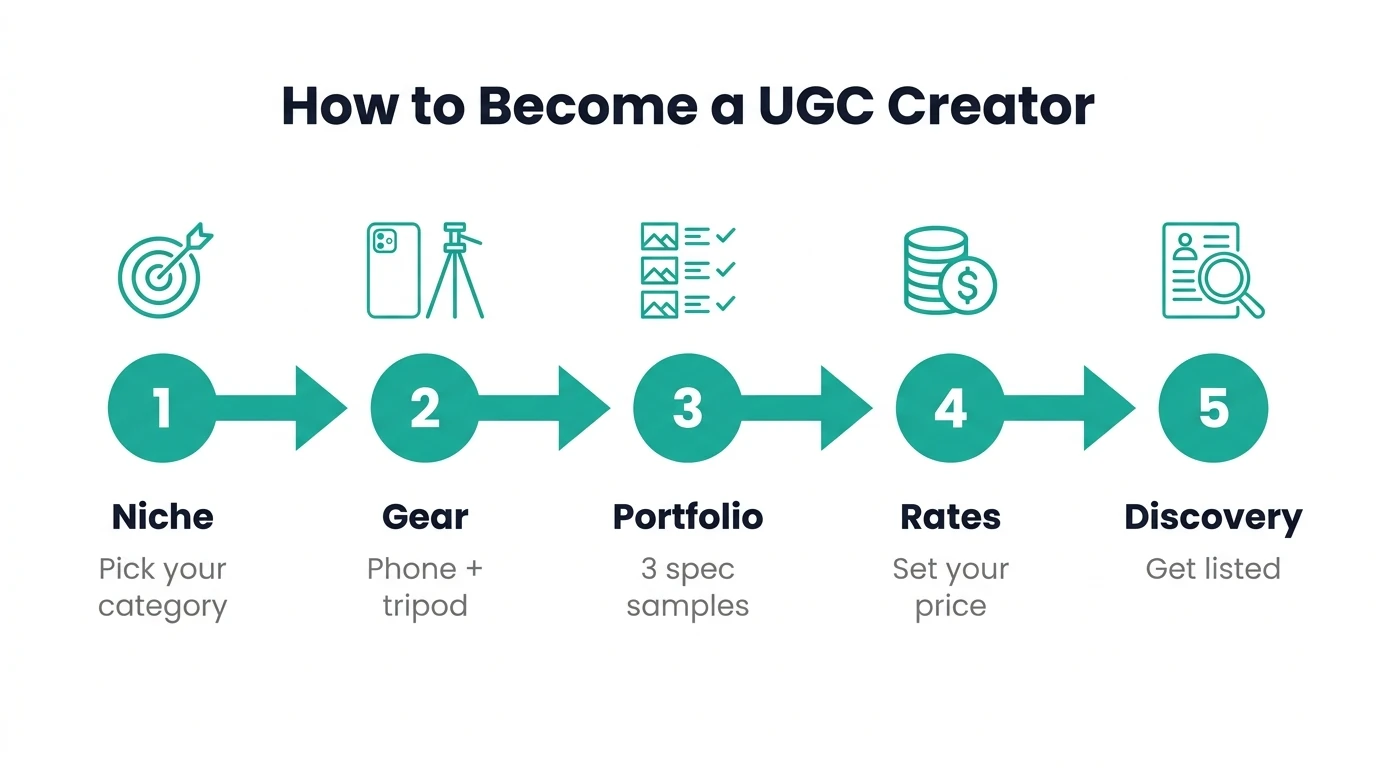
The job is real, the income is real, and the barrier to entry is low. You can land your first paid UGC deal in under 30 days with a phone, decent natural light, and a portfolio of three sample clips.
Pick one niche first
Brands hire creators who look like their customers. A protein brand wants someone who clearly trains, not a general "lifestyle" creator. Pick the category where you already use five products you would recommend to a friend: skincare, fitness, home and kitchen, food, pets, parenting or tech.
One niche also makes your portfolio stronger. Three skincare samples get a skincare brand's attention faster than one skincare clip, one gadget clip and one recipe.
What you need (gear, samples, portfolio)
Phone: any iPhone or Android from the last three years. Camera quality is no longer the differentiator that brands care about.
Light: a $30 ring light or a window during golden hour. Bad light kills clips faster than bad audio.
Audio: a $25 lavalier mic plugged into your phone. The single biggest cheap upgrade you can make.
Editing: CapCut (free), InShot (free), or Premiere Pro if you already know it.
Portfolio: 3–5 sample clips. Shoot them with products you actually own — toothpaste, your favorite snack, that supplement subscription. Pretend you're being paid; deliver as if you were.
How to make your first 3 sample videos
A sample (or spec) video is a clip you film as if a brand hired you, using a product you already own. You don't need the brand's permission to put it in your portfolio, as long as you don't present it as a paid partnership.
Pick three products from your niche that you genuinely like.
Open with a hook in the first two seconds. "I've used this every morning for 30 days and..." Our UGC scripts post has 8 templates and 15 hooks.
Show the product in use, close up, in your real kitchen, bathroom or car.
Keep it 30 to 45 seconds and add captions. Many people watch with the sound off.
Mix formats: one talking-head review, one product demo, one unboxing or before-and-after, so brands see your range.
Put the three clips in one place: a Google Drive folder, a Beacons or Linktree page, or your Superdeal profile. Add your niche, the formats you offer and an email. Full walkthrough: how to build a UGC portfolio with no clients.
How to land your first 3 brand deals
List on free databases. Superdeal is free, browse-able by brands, indexable by Google, and discoverable by AI agents. Setup takes 10 minutes. List there first.
Apply directly. Pick five brands you genuinely use, find their marketing email or DM their creator partnerships handle on Instagram. Pitch with one specific clip idea, not a generic "love your brand" message.
Use the brand-side databases. Many brands now publish open creator briefs. See live briefs from brands looking for UGC creators →
The pattern most often works like this: a creator with no prior brand work shoots three sample clips on a Sunday, lists their Superdeal profile Monday morning, applies to ten open brand briefs by Wednesday, and lands their first paid deal — usually $100–$200 for a single video — within 10–14 days. The second and third deals follow within the same month, typically through a mix of one inbound match (a brand finds them via search) and one outbound application. Creators who beat that timeline tend to specialize early — picking one vertical (skincare, fitness, kitchen tools, pet products) and shooting their sample clips inside that niche so brands instantly see fit on the profile.
Setting your rates as a beginner
Don't undercharge. Brands distrust $30/video creators — it signals quality risk. Don't overcharge either. Beginner reasonable:
$75–$150 per 30-second talking head
$100–$200 per product demo
Bundle of 3 videos at $250–$400
Raise rates 10–15% every five completed brand deals. By the time you have 25 deals under your belt, you should be charging mid-tier rates ($200–$500/video) without negotiating defensively.
Where to list yourself (free)
List yourself on Superdeal — free →. You'll be searchable to thousands of brands, indexable by Google (your profile becomes your portfolio), and discoverable by AI agents searching for creators in your niche — a channel that barely existed 18 months ago and is the fastest-growing source of inbound deals on the platform.
Best Platforms to Find UGC Creators (2026)
Not every platform fits every brand. Here are the most-used options as of 2026, with what each is best for and how pricing typically works.
Superdeal — free to browse, 50,000+ creators across 40+ verticals, AI-powered search, and the only platform with an agent-friendly REST API and MCP server (so AI agents can find and contract creators directly). Best for: brands of any size, creators wanting to be discoverable by both humans and AI agents.
Insense — invite-only creator marketplace, ~$200/mo platform fee, focuses on TikTok and Meta UGC. Best for: brands that want a curated talent pool and don't mind paying for filtering.
Trend.io — flat-fee per-video model ($300+/video). Curated network. Best for: brands doing one-off UGC tests without committing to a platform subscription.
Collabstr — open marketplace, no platform fee for browsing. Best for: smaller brands and one-off projects.
billo — focus on iPhone-shot product UGC, free to brand-side, simple per-video pricing. Best for: e-commerce brands needing high volumes of basic product clips.
Direct outreach (Instagram/TikTok) — manually messaging creators whose work you like. Best for: brands targeting a very specific aesthetic or niche where databases are thin.
For most brands and creators, the right answer is a combination: list/browse on a free indexable platform like Superdeal as the default, and supplement with paid marketplaces for specific needs.
UGC Creator Contracts: What to Include
Every UGC deal — even a $200 one-off — needs a written agreement. The four non-negotiable sections:
Scope of work: exact deliverables, file format, length, deadline
Usage rights: where the brand can use the content (paid ads, organic, PDP, email), for how long, in which territories
Payment terms: amount, milestones, method, late-payment terms
Ownership and exclusivity: who owns the raw files, exclusivity windows by category
For the complete contract checklist with red-flag clauses to avoid on both sides, read our influencer contract template guide. The template is a free Word/PDF download and covers every clause Superdeal's legal team has seen blow up a deal.
Common Mistakes to Avoid (Both Sides)
Brand mistakes
Hiring on follower count. Audience size doesn't predict UGC quality. Many of the highest-performing UGC creators on Superdeal have under 5,000 followers.
Vague briefs. "Make it feel authentic" is not a brief. Every minute spent specifying saves an hour in revisions.
Skipping usage rights. Default to including 30-day paid usage in the base rate — going back later to add rights is awkward and expensive.
Penny-pinching on the first deal. A creator who feels respected on a $200 first deal is the same creator who'll prioritize you on a $5K retainer six months later. The second deal is the actual margin; the first deal is the hiring decision.
Creator mistakes
Underpricing. $30 videos signal low quality and attract the worst clients. Match the market.
Saying yes to perpetual rights for free. Always charge for usage beyond 30–90 days. Perpetual rights with no cap is the single most common rookie mistake.
Ignoring the brief. Read it twice. Reference it in your delivery. The 5% of creators who do this get 80% of the repeat work.
No contract. Even small deals need writing. Verbal "we'll figure it out" agreements fall apart on the first edge case — usage scope, revisions, or late payment.
Frequently Asked Questions
1. What is a UGC creator? A UGC creator is a paid contractor who produces authentic, user-generated-style content (usually short videos) for a brand to use in ads, on their website, and on social channels. Unlike influencers, they're paid for the content itself rather than for posting it to their own audience.
2. What's the difference between a UGC creator and an influencer? The influencer is paid for their audience and reach; the UGC creator is paid for the content itself. UGC creators don't need a large following — they're delivering creative assets, not distribution. Many top UGC creators have fewer than 5,000 followers.
3. How much do UGC creators make? Beginner: $75–$200 per video. Mid-level (10–50 brand deals completed): $200–$500 per video. Pro/niche specialist: $500–$1,500 per video. Experienced creators on retainer regularly earn $5,000–$15,000/month across 3–5 brand relationships.
4. Do UGC creators need a big following? No. Most successful UGC creators have under 10,000 followers. Brands hire UGC creators for the content itself, not the distribution. Audience size is mostly relevant when whitelisting (running ads through the creator's handle) is part of the deal.
5. What gear do you need to start as a UGC creator? A modern phone, a $30 ring light or natural window light, a $25 lavalier microphone, and a free editing app like CapCut. Total starter kit under $100 if you already own the phone.
6. How do brands find UGC creators? The fastest 2026 path is searching a free indexable creator database like Superdeal, filtering by niche, vetting portfolios, and sending a deal directly. You can go from search to signed contract in under an hour.
7. Are UGC creators replacing influencers? No — they serve different jobs. Influencers drive awareness through their existing audience; UGC creators provide creative ad assets. Most modern brand programs use both, often hiring the same person for different deal types.
8. How do I become a UGC creator with no experience? Shoot three sample clips with products you already own, list yourself on a free creator database, pitch five brands directly with a specific clip idea, and price modestly ($75–$150 per video) until you have 5–10 completed deals. Most creators land their first paid deal within 30 days of going live.
9. What niche should I choose as a UGC creator? Pick a category where you already buy and use the products: beauty, fitness, home, food, pets, parenting or tech. Brands hire creators who look like their customers, and a portfolio inside one niche gets more replies than a mixed one.
Sources and further reading
HubSpot — 2025 Social Media Marketing Report: Data from 1,100+ Global Marketers
Sprout Social — User-Generated Content (UGC): What It Is and Why It Matters for Your Brand
eMarketer / Insider Intelligence — Meta Expands Partnership Ads to Turn Creator Content into Performance
eMarketer — Influencer Marketing Set to Surpass $13 Billion by 2027
TikTok for Business — Spark Ads 101: Turn TikToks into Ads
Meta for Business — Marketing Partners Case Studies and Success Stories
PowerReviews — How User-Generated Content Impacts Conversion (2023 Edition)
Shopify Enterprise — 8 Best UGC Examples and Tips for Ecommerce
Xolo — Top UGC Creator Pricing Guide: With Rate Examples and UGC Whitelisting Explained: Rates, Risks & Pricing Formula
Kristian Larsen — UGC Rates: What to Charge for User-Generated Content
For brands: Browse 50,000+ UGC creators free → For creators: List yourself on Superdeal — free →