Influencer Contract Audit Checklist (15 Clauses, 2026)
Before you sign: a 15-point audit of every influencer contract, including the 5 clauses brands forget most and what each one costs when it goes wrong.

Founder & CEO, Superdeal
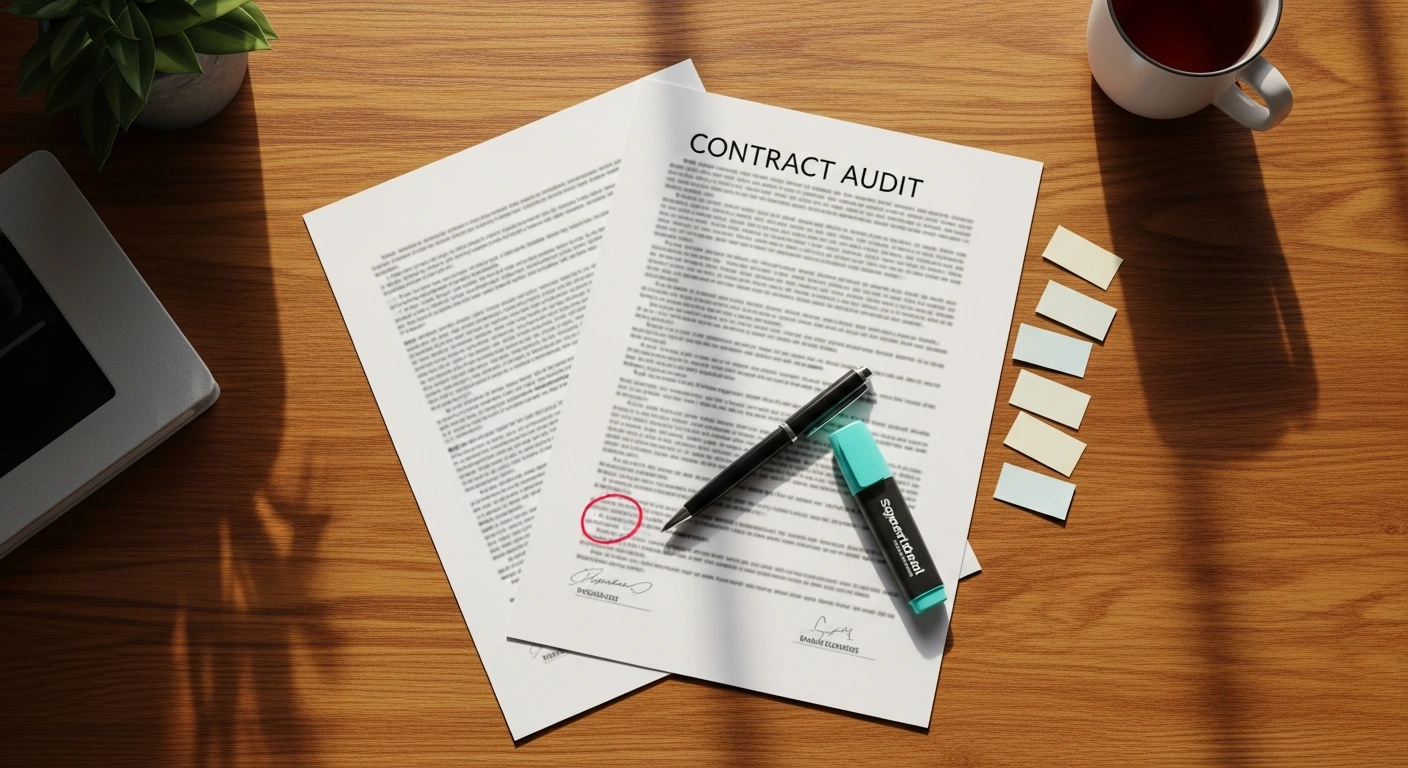
An influencer contract audit checklist is the 15-point review you run before signing an influencer or UGC deal, to catch the clauses brands and creators most often skip. Six clauses are non-negotiable; five are strongly recommended; and four are 2026-only: AI training rights, generative-AI usage windows, deepfake and likeness protection (now codified by Tennessee's ELVIS Act and California AB 2602 / AB 1836), and a platform-policy kill switch. Below: the 5 clauses we see forgotten most often (each with a public-record case), then the required-clauses matrix by deal type. For clause-by-clause explanations and a free downloadable template, see our influencer contract template post.
The 5 Most-Forgotten Clauses (Real Cases, Real Cost)
These are the five clauses we see missing most often when brands send us a contract to audit. Each has a public-record case attached so you can see what the missing language has historically cost.
1. Exclusivity gap (the "competitor posted next week" pattern)
With no exclusivity window, the same creator can ship for a direct competitor a week after your post airs. The audience reads both posts and attributes nothing to either brand.
Public-record case. The 2016 Lord & Taylor FTC settlement: 50 influencers paid $1,000–$4,000 each to post the same paisley dress on the same weekend, reaching 11.4 million users. The dress sold out, and the consent order locked Lord & Taylor into a five-year compliance program. With no exclusivity, the same 50-creator simultaneous-post strategy can be your competitor's a week later.
Audit prompt. Look for "category exclusivity," "named competitors," and a duration. If absent, ask for 30 days post-publication in your product category.
2. Usage windows (the "we can't run their video as a paid ad" pattern)
The brand pays for UGC, sees it perform organically, tries to push it as a paid ad, and discovers the contract granted only "organic social usage." Renegotiation now happens from a position of weakness because the creator knows the video works.
Public-record case. The 2023 Vital Pharmaceuticals / Bang Energy copyright matter detailed by Arnold & Porter: Bang was held potentially liable for copyright infringement on roughly 140 TikTok videos posted by retained influencers, because the contracts gave Bang enough control to be treated as a co-publisher but not enough licensing scope. Usage rights, indemnity scope, and asset ownership all have to line up.
Audit prompt. Look for "paid social usage," "duration in days," "geography," and a per-channel breakout. If absent, default to 30 days paid social, US-only, with option pricing locked in at signing for 90- and 365-day extensions.
3. Kill fees (the "cancelled mid-production" pattern)
The brand pulls the campaign for an unrelated reason (CEO change, quarter miss, strategy pivot) after the creator has shot the content. With no kill-fee schedule, the creator gets full payment for unaired content or nothing for completed work. Both outcomes generate disputes.
Public-record framing. Revision Legal's overview of influencer kill fees summarizes the standard ladder: 25% if cancelled before production, 50% mid-production, 100% after delivery and approval. The number isn't the point; the existence of an agreed schedule is.
Audit prompt. Look for "kill fee," a percentage tied to project stage, and a separate clause for creator-side cancellation. If absent, ask for the 25 / 50 / 100% ladder plus a definition of "production start."
4. AI training rights (silence-is-default-yes)
This clause is absent in roughly 60% of templates brands bring us to audit. Silence on AI training is legally ambiguous and trending against creators: once content is in the wild, downstream platforms may train on it under their own terms of service.
Public-record framing. The Authors Guild model clause prohibiting AI training without express written permission is written for books, but the contractual logic ports directly to influencer content.
Audit prompt. Look for "AI training" or "machine-learning training" with an explicit grant, denial, or carve-out. If absent, default to mutual prohibition unless either side negotiates an exception.
5. Platform-policy kill switch (the "TikTok ban" contingency)
The brand signs a TikTok-heavy creator deal. Mid-campaign, a divestiture deadline, an API change, or an account suspension takes the deliverable offline. Without a platform-policy kill switch, the brand owes full payment for content that can't reach the audience.
Public-record framing. The FTC's 2023 Endorsement Guides update plus the rolling US policy debate around TikTok divestiture have made platform-contingency clauses table-stakes for any deal weighted to a single platform.
Audit prompt. Look for "platform availability," "force majeure," and a named-platform contingency. If absent, ask for pro-rata payment plus delivery on an alternate platform if the primary becomes unavailable for reasons outside either side's control.
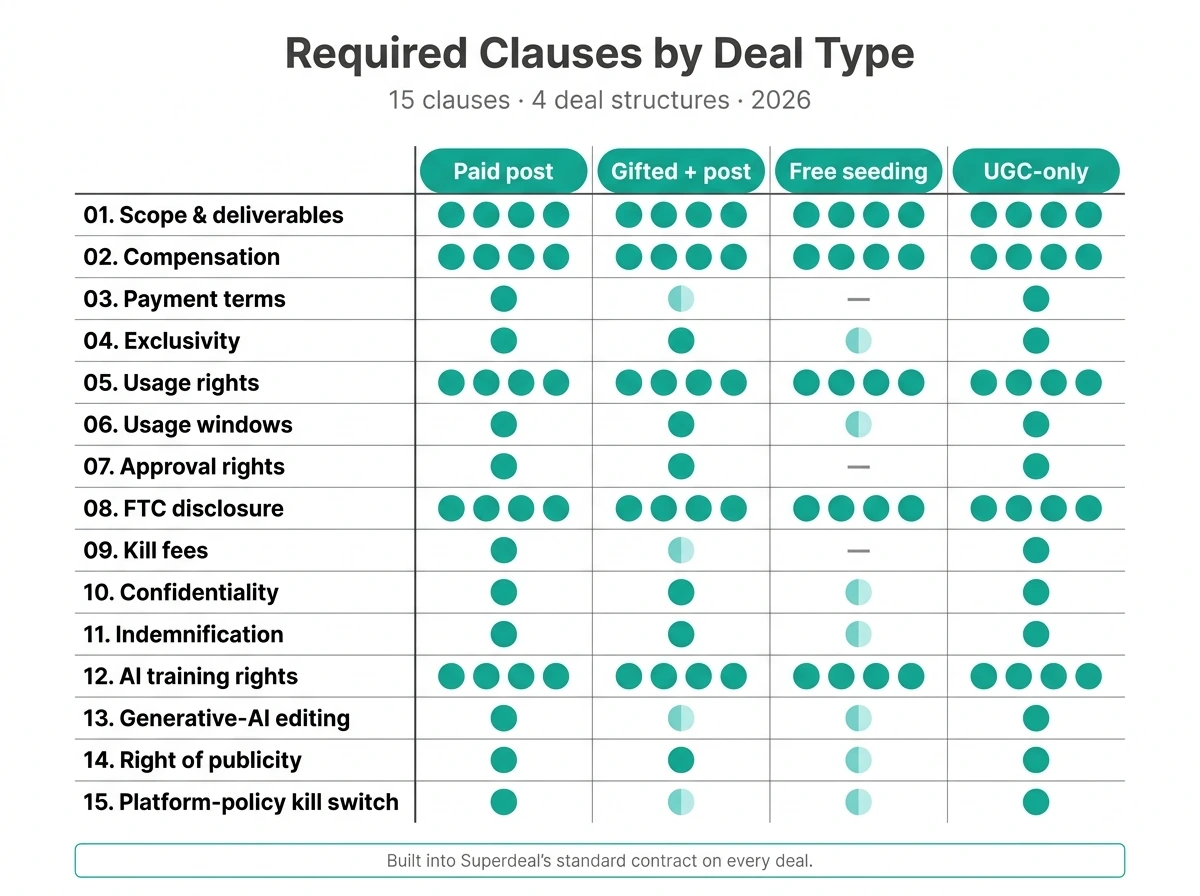
Required Clauses by Deal Type — The Audit Matrix
Different deal types need different clause stacks. Find your deal type below, then walk the list top to bottom.
Paid post. All 15 clauses apply. Highest-stakes column: money, posting, public attribution.
Gifted product + posting. Twelve of fifteen. Payment drops out; FTC disclosure, content rights, and AI training still trigger. Most-skipped on gifted: exclusivity and AI training.
Free seeding. Five clauses minimum: parties, content rights, FTC disclosure, AI training, light-touch indemnity cap.
UGC-only. Thirteen of fifteen. Exclusivity and deepfake protection drop to optional; AI training and gen-AI usage windows become more important because UGC is heavily re-edited. See also What is a UGC creator.
The Full 15-Clause Audit Checklist
For full walkthroughs of clauses 1–11, see our Free Influencer Contract Template post. Below is the one-line audit prompt for each. Tier 3 (clauses 12–15) gets full treatment because it's net-new vs. the template post.
Tier 1 — Non-negotiable
Parties + legal entity. Names and EINs, not Instagram handles.
Scope of work. Counts, formats, durations, platforms.
Payment terms. Amount + schedule + trigger event.
Content rights + usage windows. Owner, license scope, duration, geography.
Deadlines + revisions. Hard dates + revision cap.
FTC disclosure language.
#adplacement + platform-specific rules per the FTC Endorsement Guides.
Tier 2 — Strongly recommended
Exclusivity. Category + duration + named competitors.
Approval rights. Named approver + business-day SLA.
Termination + kill fee. Exit triggers + fee schedule.
Indemnification + liability cap. Cap = deal value, mutual.
Confidentiality / NDA. Scope + carve-outs + term.
Tier 3 — 2026-only (full treatment)
These four are why this checklist exists in 2026 and didn't in 2024. Each is now table-stakes.
12. AI training rights (explicit grant or deny)
Pick one of three positions and write it down: brand-grant-only (brand may train its own internal AI), mutual prohibition (neither side may train), or carve-out (training permitted for specific named purposes, prohibited otherwise). Silence defaults to "yes" in many platform terms of service. Reference: the Authors Guild model AI training clause.
13. Generative-AI usage windows (edit and synthesis rights)
Separate from training rights: can the brand AI-edit, synthesize, or extend the creator's footage during or after the contract window? For a 30-second hero video, the brand may want to spin out 15 paid-ad variants using generative tools. The contract has to say whether that's allowed, for what window, and at what additional fee. The IAB Tech Lab's Generative AI Disclosure Standards are the industry reference for what counts as AI-modified.
14. Deepfake / likeness protection
Three 2024 state laws made synthetic-likeness clauses standard in any deal where the creator's face or voice appears.
Tennessee ELVIS Act (Ensuring Likeness Voice and Image Security Act), signed March 21, 2024, effective July 1, 2024. Extends right-of-publicity protection to a person's voice and visual likeness against unauthorized AI replication. Skadden's analysis covers contractual implications.
California AB 2602 (workplace digital replicas), signed September 17, 2024, effective January 1, 2025. Voids any contract clause permitting creation of an AI digital replica without a reasonably specific description of intended uses and professional representation during negotiation.
California AB 1836 (post-mortem digital replicas), signed the same day. Prohibits commercial use of digital replicas of deceased performers without estate consent; statutory damages the greater of $10,000 or actual damages.
For influencer deals, the practical contract move is a named opt-in for deepfake or AI-likeness uses, with a separate fee. Default to opt-out for everything not explicitly granted.
15. Platform-policy kill switch (TikTok / API / account contingencies)
Name the events that can take a deliverable offline (platform ban, account suspension, API change, force majeure), and define what happens to payment and remaining deliverables when one triggers. Standard 2026 structure: pro-rata payment for completed work plus delivery on an alternate named platform.
What changed in 2026 vs. 2024. AI training default flipped from "we didn't talk about it" to "yes" in many jurisdictions. Three 2024 state laws (Tennessee ELVIS, California AB 2602, California AB 1836) made likeness and deepfake clauses table-stakes. The rolling TikTok divestiture timeline made platform-contingency clauses standard for any deal weighted to a single platform.
How to Use This Audit Checklist
Reviewing a template the brand sent. Find your deal type in the matrix and walk that column against the contract. If you're starting from our free influencer contract template, clauses 1–11 are already in; run this checklist to verify 12–15.
The other side sent you a contract — the redline pass. This is the "influencer contract negotiation" use case. Print the 15-clause table, put it in the margin, check each row. Anything missing becomes a redline request. The Cooley Go guide for influencers is a useful second opinion on which clauses are typically negotiable from the creator side.
Writing one from scratch (how to write an influencer contract). Start from our free template, then run this checklist on the draft. The template covers 1–11; this checklist adds the four 2026-only clauses.
How Superdeal Removes the Audit
If you're running more than five deals a month, the audit becomes the bottleneck. Superdeal's standard contract has all 15 clauses built in and updates quarterly when laws change, so a creator in Tennessee or California isn't a special case.
Audit vs. Superdeal — side by side:
Time per deal. Manual audit: 30–90 min review. Superdeal: 30 seconds (already complete).
Cost. Manual audit: $200–$1,000 lawyer review. Superdeal: $0 (built into platform fee).
Updates when laws change. Manual audit: research per change. Superdeal: auto (platform-managed, quarterly).
Frequently Asked Questions
1. What should be included in an influencer contract?
An influencer contract should include 15 clauses across three tiers: six non-negotiable (parties, scope, payment, content rights, deadlines, FTC disclosure), five strongly recommended (exclusivity, approvals, termination, indemnification, NDA), and four 2026-only (AI training, gen-AI usage, deepfake protection, platform-policy kill switch). The matrix above shows which apply per deal type.
2. What's the difference between a contract template and an audit checklist?
A template is the document you start from when writing a contract — full clause language and sample terms. A checklist is the gap-check you run before signing, whether you wrote the contract or the other side did. Start from the free influencer contract template, then run this checklist on the draft.
3. Can I use this checklist for UGC-only deals?
Yes. See the by-deal-type matrix above. Thirteen of fifteen clauses apply to UGC-only. Exclusivity and deepfake protection drop to optional because the creator's face may not appear in the deliverable, but AI training rights and generative-AI usage windows become more important because UGC is heavily re-edited.
4. What's a platform-policy kill switch clause and why does it matter in 2026?
A platform-policy kill switch is contract language that triggers if a named platform event (TikTok divestiture, API change, account suspension) makes the agreed deliverable impossible to ship. Without it, the brand owes full payment for content that can't reach the audience. The 2026 standard is pro-rata payment plus delivery on a named alternate platform.
5. Do I need a lawyer to use this checklist?
No. The checklist is operator-grade, designed for marketing and legal-ops teams to run without per-deal counsel review. For deals above $25,000, international jurisdictions, perpetual rights structures, or equity components, layer counsel review on top. The checklist closes the 80% gap; a lawyer handles the long tail.
6. What about AI training rights — is "no" the safe default?
Yes. In 2026, silence on AI training in an influencer contract increasingly defaults to "yes" because platform terms of service permit training on uploaded content. Explicitly grant or deny in the contract. The safe default is mutual prohibition with named carve-outs (analytics, A/B testing) for anything either side negotiates. See clause 12 above.
7. How is Superdeal's standard contract different from a free template?
A template is a starting document you customize per deal. Superdeal's standard contract is already complete on every deal — all 15 clauses baked in, updated quarterly when laws change (Tennessee ELVIS, California AB 2602 / 1836, future legislation). Trade-off: less per-deal customization, faster ship time, no per-deal legal review.
8. Can I customize Superdeal's standard contract?
Yes. Clause-level overrides are available for exclusivity, payment schedule (deposit split, milestone structure), content rights (channel mix and license duration), and usage windows (paid social, OOH, perpetual). Default is the 15-clause version; overrides apply per deal without rewriting the contract.
About this checklist (legal disclaimer)
This checklist is provided as-is and does not constitute legal advice. It reflects general US influencer-contract practice as of May 2026, drafted from public legal sources (FTC Endorsement Guides, Tennessee ELVIS Act, California AB 2602 / 1836, IAB Tech Lab Generative AI Disclosure Standards, Authors Guild model AI training clause). For jurisdiction-specific requirements or any contract above $25,000, consult your own counsel before signing. Nothing here creates an attorney-client relationship.
For brands: Send your next deal with all 15 clauses built in →