Influencer Rate Card: 2026 Benchmarks + Free Template
Build your influencer rate card the right way: exact line items, a fill-in template, and 2026 benchmark rates by platform and follower tier (nano to macro).

Founder & CEO, Superdeal

An influencer rate card is a document that lists every content format you offer and the price you charge for each one, so brands can review your rates and send a deal without a back-and-forth negotiation. It should cover your base rates by platform and format, your follower-tier justification, and add-on pricing for usage rights, exclusivity, and whitelisting — at minimum ten line items. Below: the exact line items to include, a fill-in template you can copy today, and 2026 benchmark rate tables for Instagram, TikTok, YouTube, and UGC-only deals by follower tier (nano through macro).
What Is an Influencer Rate Card?
A rate card is your pricing document — one or two pages you share with brands before any negotiation begins. It tells a brand what they'll get, what it costs, and what's included, so the conversation starts from a concrete number rather than a blank negotiation. The FTC also expects creators to understand their commercial relationships clearly before they begin, and a rate card formalizes that structure (FTC Endorsement Guides).
A rate card is not a binding contract. It's a starting document. Once a brand agrees to the rate and deliverable scope, the contract comes in. See our influencer contract template for the full agreement structure.
For the broader picture of what being a creator looks like as a business, see how to become a UGC creator (once live) and how to get brand deals (once live). This post covers the pricing piece specifically.
What to Include in Your Rate Card — the Line Items
Most creators underbuild their rate cards: they list a follower count, one or two prices, and an email address — and that format costs them money on every deal. It skips the add-ons (usage rights, whitelisting, exclusivity) that brands routinely pay when those line items are called out explicitly. According to Backstage's guide to influencer rate cards, the creators who see the highest deal values are those who present a structured, itemized document rather than a ballpark number in a DM.
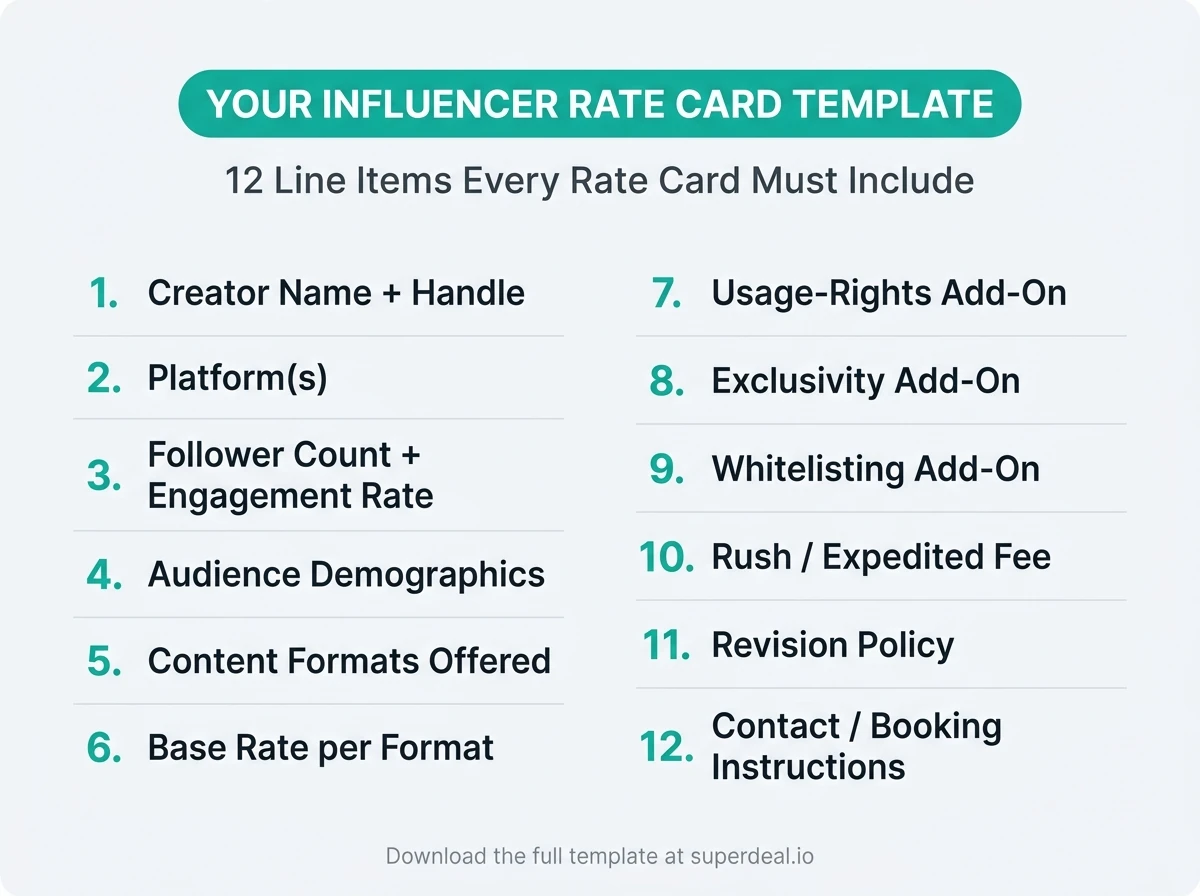
Here are the twelve line items every rate card should include.
The 12 line items:
Creator name + handle. Your legal name and the URL of your primary account (not just the @username — link directly so the brand can verify stats).
Platform(s). Instagram / TikTok / YouTube / Pinterest — list each platform you actively create on.
Follower count + engagement rate. Verified stat from the last 90 days. Include where you pulled it (platform native analytics or a third-party tool) — brands will check. Instagram's native analytics are available via Instagram for Creators.
Audience demographics. Primary age range, gender split, and top two countries. This lets a brand know whether your audience matches their customer profile.
Content formats offered. Post / Reel / Story / TikTok video / YouTube integration / UGC-only. List each separately — they carry different rates. TikTok's Creator Marketplace and YouTube's creator support docs define these format categories officially.
Base rate per format. Your price for a standard deliverable with no add-ons. One line per format per platform.
Usage-rights add-on. The fee for the brand to run your content as a paid ad (boosted posts, whitelisted from your account, or repurposed on the brand's own channels). This is the line item most creators forget.
Exclusivity add-on. The fee to lock out named competitors for a set window after posting.
Whitelisting add-on. The fee to allow the brand to boost content from your handle — a separate permission from usage rights.
Rush / expedited fee. A surcharge for delivery inside 72 hours. Have this written down so it doesn't surface as a surprise mid-deal.
Revision policy. How many rounds are included; what you charge per additional round.
Contact / booking instructions. An email address or a link to your booking form. Without this, a brand that loves your rates has to go find you.
What to leave off your public rate card. Don't include your floor price (the lowest you'd accept) — that anchors a negotiation downward before it starts. Don't include rates for formats you don't actively create in. Testimonials and case studies belong in the media kit, not the rate card itself.
How to Create an Influencer Rate Card — Fill-In Template
Copy the structure below, fill in your numbers, and save it as a PDF or Notion page.
INFLUENCER RATE CARD — [Your Name]
[Your Handle] | [Platform(s)] | [Your Niche]
Updated: [Month Year]

AUDIENCE OVERVIEW
Followers: [#]            Engagement Rate: [%]
Primary audience: [age range], [gender split], [top 2 countries]

CONTENT FORMATS + BASE RATES
[Platform 1]
  [Format 1] (e.g., Reel, 30–60 sec)         $[rate]
  [Format 2] (e.g., Static post)              $[rate]
  [Format 3] (e.g., Story, per slide)         $[rate]

[Platform 2]
  [Format 1] (e.g., TikTok video, 30–60 sec)  $[rate]

[UGC-only (no posting required)]
  30-sec video                                 $[rate]
  60-sec video                                 $[rate]
  Photo pack (3 images)                        $[rate]

ADD-ONS
  Usage rights — paid social (per 30 days)    +$[rate] or +[%]%
  Usage rights — paid social (90-day block)   +$[rate] or +[%]%
  Exclusivity (30 days, named category)       +$[rate] or +[%]%
  Whitelisting (per 30-day boost window)      +$[rate] or +[%]%
  Rush (delivery < 72 hours)                  +$[rate] flat

REVISION POLICY
Includes [#] rounds. Additional rounds: $[rate] each.

BOOKING
[your email] | [link to booking form or calendar]
Format tip. PDF works for one-off sends; a Notion or Google Slides version lets you update rates without redesigning. Either way, always include the "Updated: [Month Year]" line. Brands use rate cards as a reference, and an undated card raises questions about whether the numbers are current.
2026 Influencer Rate Benchmarks by Platform and Tier
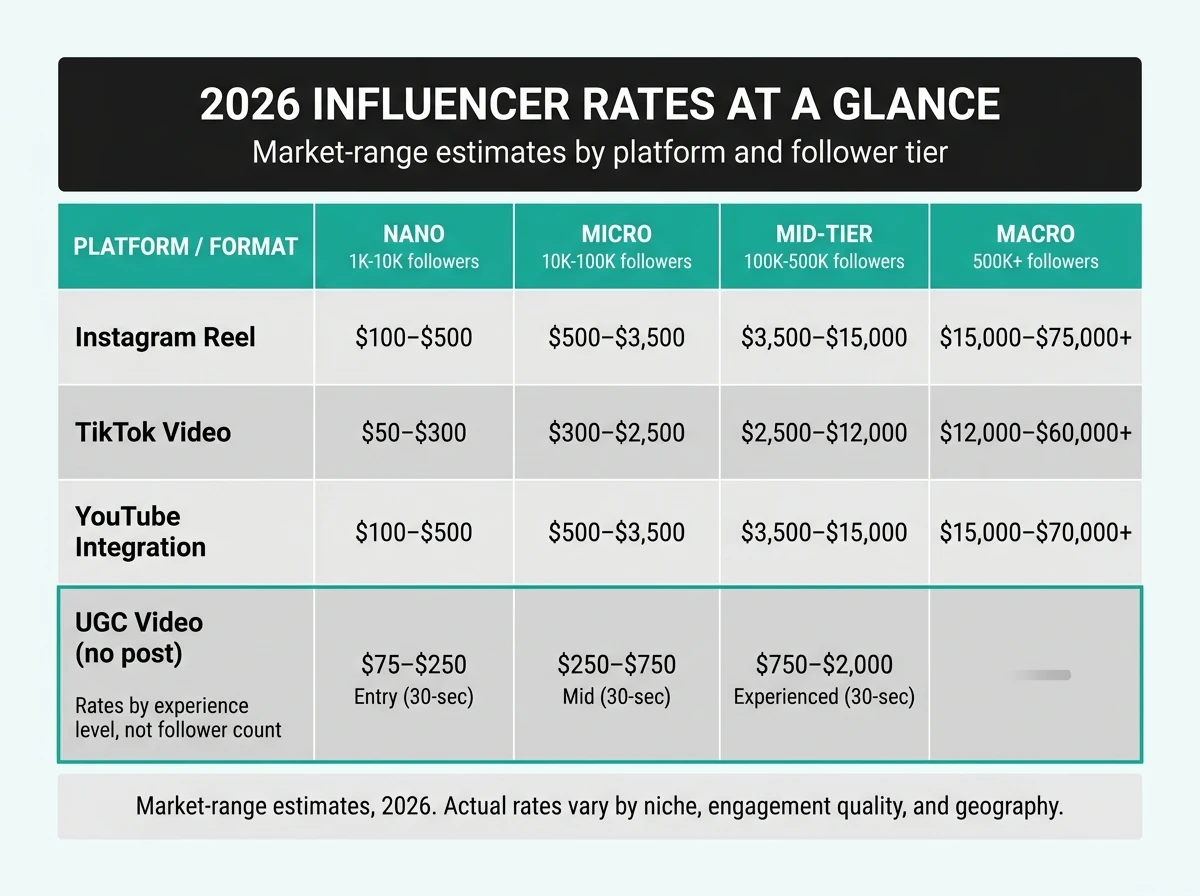
The benchmarks below are market-range estimates based on publicly reported industry data, including the Sprout Social influencer rate analysis and Backstage editorial data. They reflect typical ranges across niches and geographies. Your actual rates will vary based on engagement rate, niche authority, audience quality, and negotiation. Nano creators on Instagram typically start at $50–$300 per post; mid-tier creators on the same platform can command $3,500–$15,000 per Reel. These are NOT a Superdeal price list or a guaranteed rate.
Instagram Rate Benchmarks (market-range estimates)
Static post: Nano $50–$300 / Micro $300–$2,000 / Mid $2,000–$10,000 / Macro $10,000–$50,000+
Story (per slide): Nano $25–$100 / Micro $100–$500 / Mid $500–$2,500 / Macro $2,500–$10,000+
Reel: Nano $100–$500 / Micro $500–$3,500 / Mid $3,500–$15,000 / Macro $15,000–$75,000+
Reels command the highest base rate because of reach. Stories are often bundled into a post deal at a reduced per-slide rate. If a brand asks for a story add-on, price it explicitly rather than folding it into the post rate.
TikTok Rate Benchmarks (market-range estimates)
Standard TikTok video: Nano $50–$300 / Micro $300–$2,500 / Mid $2,500–$12,000 / Macro $12,000–$60,000+
TikTok Live integration: Nano $100–$500 / Micro $500–$3,000 / Mid $3,000–$15,000 / Macro $15,000–$80,000+
TikTok rates have caught up with Instagram Reels in many niches. The Live category commands a premium because of its real-time, higher-conversion context.
YouTube Rate Benchmarks (market-range estimates)
Dedicated video: Nano $200–$1,000 / Micro $1,000–$8,000 / Mid $8,000–$30,000 / Macro $30,000–$150,000+
Integration / mid-roll (30–60 sec): Nano $100–$500 / Micro $500–$3,500 / Mid $3,500–$15,000 / Macro $15,000–$70,000+
YouTube rates are higher per deliverable than Instagram or TikTok because of production effort, evergreen search value, and longer shelf life. A dedicated video has a longer production window — factor that into your revision policy.
UGC Rate Card Benchmarks (Content-Only, No Posting — market-range estimates)
UGC deals pay for the content itself, not a posting obligation. Because follower count is not the value driver, UGC rates anchor to deliverable type and production complexity. See also UGC videos and what is a UGC creator for format context.
30-second UGC video: Entry $75–$250 / Mid $250–$750 / Experienced $750–$2,000
60-second UGC video: Entry $100–$350 / Mid $350–$1,000 / Experienced $1,000–$3,000
Static UGC photo (3-pack): Entry $50–$150 / Mid $150–$400 / Experienced $400–$900
UGC testimonial / review video: Entry $100–$300 / Mid $300–$800 / Experienced $800–$2,500
Pricing Factors That Adjust Your Base Rate
Your base rate covers one standard deliverable posted to your feed with organic reach only — but most brand deals involve at least one add-on that should raise the total. These are the adjustments that are most commonly forgotten or underpriced.
Usage rights — organic social only: Base rate, no add-on. This is the default if nothing is specified in writing.
Usage rights — paid social (brand runs ad, per 30 days): +30–50% of base rate. Lock the window at signing or renegotiation happens from weakness.
Usage rights — paid social extended (90+ days): +75–100% of base rate. Price the extension option at signing, not on renewal.
Usage rights — OOH / broadcast: +50–150%. Requires separate licensing language in the contract.
Exclusivity (category, 30 days): +25–30% of base rate. Name the competitor category exactly — "beauty" is too broad.
Exclusivity (category, 90 days): +50–75% of base rate. Longer exclusivity commands a steeper premium.
Whitelisting (boost from creator handle, per 30-day window): +20–30% of base rate. Different from usage rights — this is boosting from your account.
Rush / expedited (delivery under 72 hours): +25–50% flat surcharge on total deal value.
AI training rights (explicit grant to brand): $250–$500 minimum, negotiable. Silence is not permission — lock it in the contract.
Across thousands of deals reviewed at Superdeal and MightyJoy, the most common underpricing pattern is the usage-rights gap: a creator prices a reel at $800 base, the brand gets 12 months of paid-social usage without paying the add-on, and by the time the creator realizes how much spend went through their content, the deal window has closed. Put usage rights on your rate card. Price them explicitly. Lock them in a contract.
How to Set Your Rates When You're Just Starting Out
If you're a nano or new UGC creator building your first rate card, the tables above may feel out of reach. Most brands won't pay mid-tier rates for an account with 2,000 followers. Here's how to approach pricing in the first six months.
Start with the UGC floor. Even with a small following, you can charge for content itself. A 30-second video with good production value is worth $75–$150 to brands who need creative assets regardless of your follower count. Set a UGC line item on your rate card from day one.
Price platform posts at the nano range, but defend it. The $50–$300 range for a nano Instagram post is a floor, not a target. If your engagement rate is 6%+ (strong for nano), price at the upper end of the range and cite the engagement figure to justify it.
Add usage rights from the start. Even if your base rate is $100, include a usage-rights add-on of $30–$50. It trains brands to expect the conversation and signals that you understand how the industry works.
Build toward proof points. Your rate card in month six should name a brand you've worked with. That one name raises the floor on every future negotiation. See how to get brand deals for the process, and how to become a UGC creator for the credential-building path.
How Superdeal Handles Rate Cards and Negotiation
The standard creator process: build a rate card, cold-pitch brands by DM or email, negotiate over several messages, send an invoice, wait. The biggest friction points — brands ghosting after a rate reveal, payment terms dragging out — happen in the negotiation and invoice stage.
On Superdeal, you list your rates once during profile setup. Brands browse the creator database and send deal offers at or above your stated rate. No cold DM. No back-and-forth over price. Payment is held in escrow when the deal is accepted and released automatically when the deliverable is approved. The contract is built in.
Frequently Asked Questions
1. How much should I charge as an influencer?
It depends on your platform, follower tier, engagement rate, and deal type. Nano creators (1K–10K followers) typically charge $50–$500 per post; micro (10K–100K) charge $300–$3,500; mid-tier (100K–500K) charge $2,000–$15,000; macro (500K+) charge $10,000–$75,000+. Add 30–50% for usage rights and 25–75% for exclusivity. Lock add-ons in a signed contract before the deal begins.
2. What's the difference between a rate card and a media kit?
A media kit is your full brand pitch: audience stats, past collaborations, testimonials, and your rate card. A rate card is just the pricing section. Many creators send both as one PDF; others keep the rate card separate so they can update pricing without redesigning the whole kit. Either approach works.
3. Should I put my rates on my website or only share on request?
Both work. Public rates filter low-budget brands before you spend time on outreach. Private rates let you adjust per brand. A common middle ground: publish your starting base rates and note that custom packages, including add-ons for usage rights and exclusivity, are available on request.
4. What is a UGC rate card and is it different from an influencer rate card?
A UGC rate card covers content-only deals: you create assets, the brand runs them, and you don't post. Because your follower count isn't the value driver, UGC rates anchor to deliverable type and production complexity rather than audience size. See what is a UGC creator for format context.
5. How often should I update my rate card?
Review quarterly. Trigger an update when your follower count grows 25%+, your engagement rate changes, you land a notable brand as a proof point, or the market shifts. The Creator IQ annual benchmark report, published each January, is the most cited market reference. Don't let your card go six months without a check.
6. Can I charge different rates for different brands?
Yes. Your published rate card is a starting point, not a binding price list. Add-ons — usage rights, exclusivity, whitelisting, rush — are negotiated per deal individually. On Superdeal, you set your base rate once and brands send offers at or above it, with payment held in escrow automatically.
7. How does Superdeal handle rate cards and pricing?
You list your rates during profile setup. Brands browse and send offers at or above your rate — no DM negotiation. Payment is held in escrow when the deal is accepted and released when the deliverable is approved. Usage rights and exclusivity terms are built into every deal. See our influencer contract template for details.
About the benchmark rates: all tables are market-range estimates based on publicly reported industry data (Creator IQ 2024 Influencer Marketing Benchmark Report, Backstage.com, Sprout Social industry data). Actual rates vary significantly by niche, engagement quality, geography, and negotiation. These tables are educational context, not a Superdeal price guarantee or a rate recommendation.