Influencer Marketing for Small Business: How to Find Local Influencers
7 ways a small business can find local influencers in any city, how to check their audience is really local, what to pay, and how to track visits.

Founder & CEO, Superdeal
Updated October 10, 2026.
TL;DR. For most small businesses, the best influencers are local creators with 1,000 to 20,000 followers who live near you. They cost less, their followers can actually walk in this week, and many will work for a free meal, service or product.
Find them fastest in Superdeal's free creator database, then through your own tagged posts, your city's location tag, local hashtags and TikTok searches. Seven methods below.
Check the audience is local before you invite anyone: ask for a screenshot of their top cities.
Start small: invite five creators, give each a code, and pay cash only to the ones who bring customers.
👉 Browse Superdeal's free creator database by niche and send offers directly. Free to search.
Influencer marketing for a small business means giving creators money, product or a free experience so they show your business to their followers. For a café, salon, gym, boutique or local service, the right creator is not the biggest one. It's the one whose followers live within driving distance. A food creator with 4,000 followers in your city can fill more tables than a national account with 400,000.
Why Local Influencers Work for Small Businesses
Their followers can come in. A post from someone across the country gets views. A post from someone across town gets visits.
They cost less. Many nano creators (1,000 to 10,000 followers) accept a free experience for an honest post. Paid posts usually start around $50 to $500.
People trust them like a neighbor. Local creators recommend places their followers already walk past.
You get content you can reuse. With permission, a good video can go on your own page, your website or your ads.
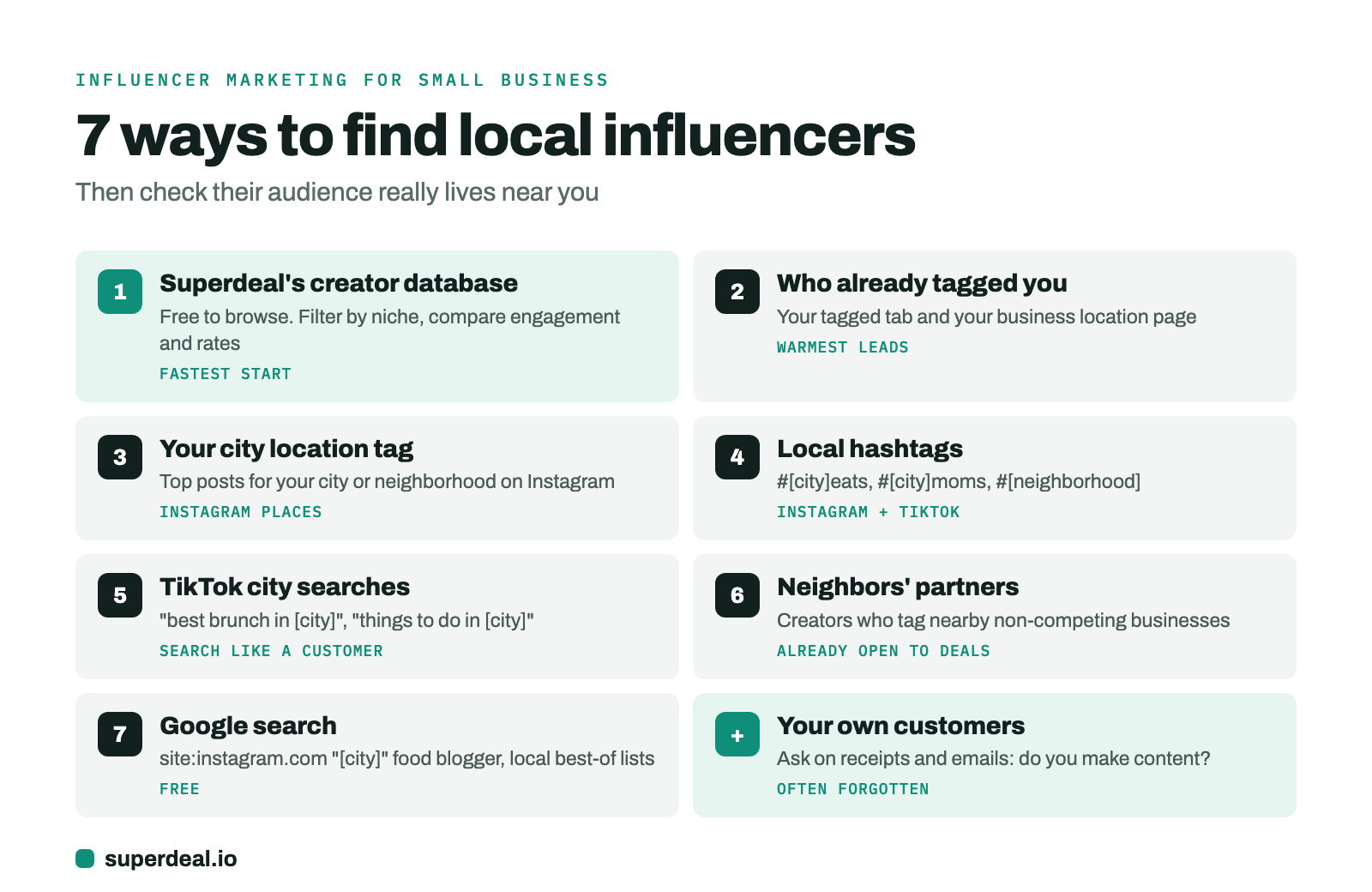
7 Ways to Find Local Influencers
Start at the top. The first three are free and take a few minutes each.
1. Use Superdeal's free creator database
It's the fastest place to start. A creator database lets you filter by niche and see engagement, past brand work and rates in one place. Superdeal's creator database is free to browse. Our guides on finding micro-influencers and finding YouTube influencers cover more search tactics.
2. Check who already tagged you
Start with people who already like you. Open your Instagram profile and look at the tagged tab, then open your business's location page and look at recent posts. On TikTok, search your business name. Anyone with a few thousand engaged followers who posted on their own is your warmest lead.
3. Search your city's location tag
On Instagram, search your city or neighborhood under "Places" and open the top posts. Creators who post there often are the people locals follow for recommendations. Do the same for busy spots near you: the farmers market, the main park, the popular brunch place.
4. Use local hashtags
Most cities have their own hashtags by niche: #austineats, #nycfoodie, #dallasmoms, #chicagofitness, #[yourneighborhood]. Search the ones for your city and your category. Look for accounts that show up again and again, not one-off posts.
5. Search TikTok by city plus niche
Type what a customer would search: "best brunch in [city]," "things to do in [city]," "[city] hair salon," "[city] date night." Filter by videos and note the creators who make local recommendations regularly. TikTok's local food and "hidden gems" creators often have very local audiences.
6. See who neighboring businesses work with
Look at the tagged posts of local businesses that don't compete with you: a nearby gym if you run a juice bar, a florist if you run a bakery, a venue if you plan events. Creators who already work with local businesses know how it works and are open to it.
7. Search Google
Try searches like site:instagram.com "[city]" food blogger, "[city]" mom blogger, or "top influencers in [city]." Local news sites and city magazines often publish "best local accounts" lists. Local Facebook groups are another place where active creators show up.
One more source people forget: your own customers. Ask on your receipts, booking confirmations or email list: "Do you make content? We'd love to work with you."
How to Check a Creator's Audience Is Really Local
A creator who lives in your city doesn't always have followers in your city. Check before you invite.
Ask for an audience screenshot. Instagram and TikTok both show top cities, age and gender. You want a big share in your city and the nearby area.
Read the comments. Locals ask "where is this?" and "going this weekend!" Generic "love this 😍" from accounts across the world is a bad sign.
Look at past posts. Do they post local places often, or was it a one-time trip?
Check engagement. Likes and comments should look normal for the follower count. A big account with almost no comments may have bought followers.
What to Pay Local Influencers
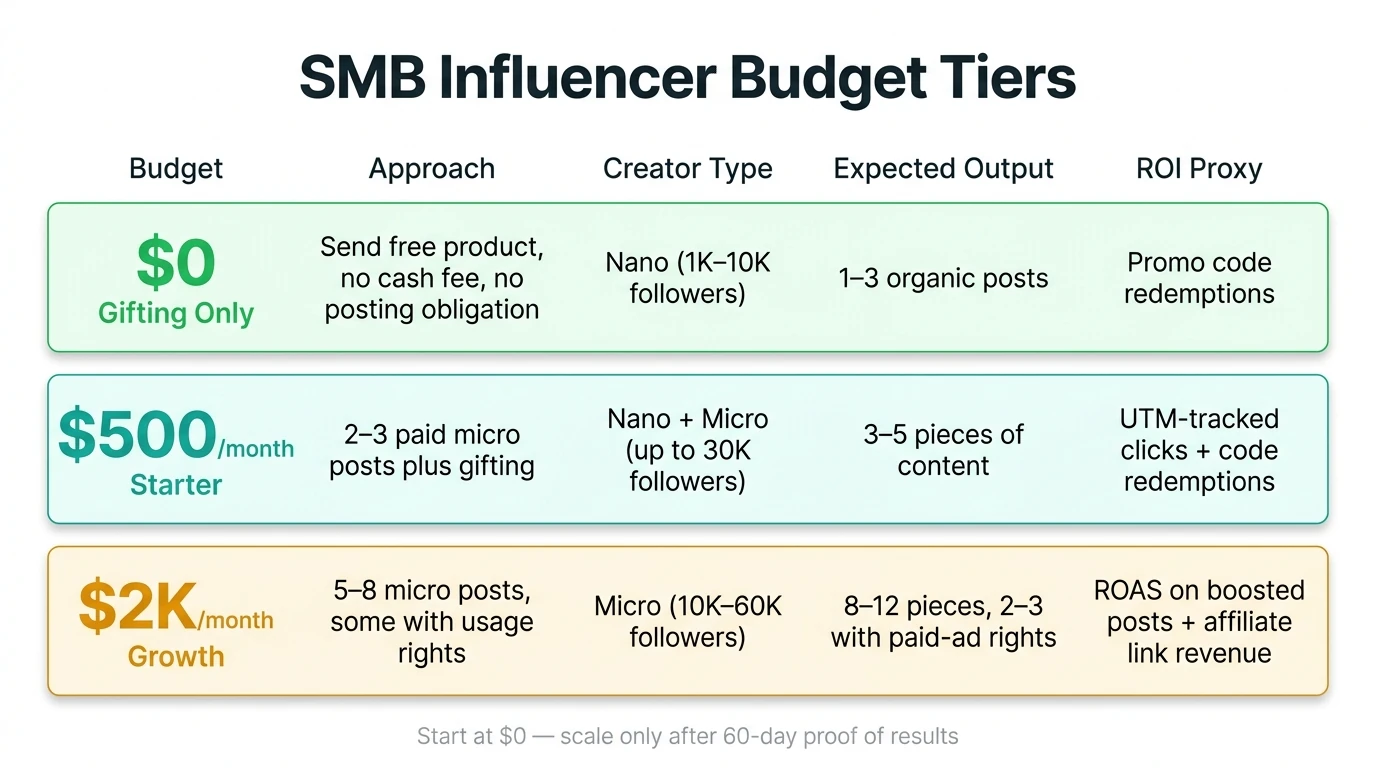
A free experience or product. Many nano creators will try your place for free and post if they like it. Offer something worth a visit: dinner for two, a full treatment, a month of classes.
A paid post. Nano creators usually charge $50 to $500 per Reel or TikTok, micro creators (10,000 to 100,000 followers) $300 to $3,500. See our influencer rate card for details by platform.
Content rights. If you want to run their video as your ad, expect to pay 30% to 50% more.
A simple way to start: invite five creators for free, give each a unique code, and after 30 days pay the one or two who brought customers for a regular monthly post.
How to Invite a Local Influencer (Message Template)
Keep the first message short and personal. Instagram DM or email both work.
Hi [name], I'm [your name], the owner of [business] on [street]. I loved your post about [specific place or topic]. We'd like to invite you for [free experience] on us, any day that works for you. No obligation to post, but if you enjoy it, we'd love an honest Reel or Story. We'd also give your followers [10% off] with your own code. Would [two dates] work?
If they say yes, agree in writing on what they'll post, when, and how they'll disclose it. For paid deals, use an influencer contract. For more message examples and follow-ups, see our influencer outreach guide.
How to Track Results Without Expensive Tools
A unique code per creator. NAME10 at checkout, or "mention Sarah for a free dessert" in store.
A tracked link for online orders and bookings (add UTM tags so it shows up in Google Analytics).
Ask new customers "how did you hear about us?" at checkout or in the booking form.
Story stats. Ask the creator for a screenshot of views and link clicks 48 hours after posting.
After 30 days, compare visits or orders from each creator with what you gave them. That tells you who to work with again.
Local Influencer Ideas by Business Type
Restaurant or café: a tasting night for five local food creators when you launch a new menu.
Salon or spa: a free treatment filmed as a before-and-after.
Gym or studio: a free month and a "trying it for 30 days" series.
Boutique: a try-on video with three outfits from the new collection.
Home services: a before-and-after of a real project at the creator's home.
One rule for all of them: free counts. If a creator gets a free meal or service, the post still needs "#ad" or "#gifted," and the business is responsible too. The FTC explains it in Disclosures 101 for Social Media Influencers.
👉 Find creators on Superdeal and send an offer in minutes. Contracts are generated for both sides, and payment is held until the creator delivers.
Local Influencer Marketing FAQ
How do I find local influencers near me?
Start with a free creator database like Superdeal to compare engagement and rates in one place. Then check who already tagged your business, browse your city's location tag and local hashtags on Instagram, search TikTok for "[your city] + your niche," and look at who works with other local businesses.
How do I find local influencers on Instagram?
Search your city or neighborhood under "Places," open top posts, and check city hashtags like #[city]eats or #[city]moms. Then ask promising creators for a screenshot of their top audience cities.
Is influencer marketing worth it for a small business?
Yes, if you work with small local creators and track results. Start with free experiences and unique codes, and spend cash only on creators who bring real customers.
How much should a small business pay an influencer?
Many nano creators accept a free experience or product. Paid posts usually run $50 to $500 for nano creators and $300 to $3,500 for micro creators. Add 30% to 50% if you want to use the video in your ads.
Does a free meal or service need to be disclosed?
Yes. In the US, any free product or service given for a post is a material connection, so the creator must disclose it with "#ad," "#gifted" or the platform's label.
Do I need an agency for local influencer marketing?
No. For a handful of local creators, you can find, invite and track them yourself with the steps above. A creator platform like Superdeal helps once you work with more than a few creators a month. Our list of the best influencer marketing tools compares the options.