Influencer Outreach: 5-Step Process + Email Templates (2026)
How to do influencer outreach that actually gets replies – a 5-step process, 4 copy-paste email and DM templates, a mistakes-vs-fixes table, and realistic benchmarks brands should expect.

Founder & CEO, Superdeal
Influencer outreach is the process a brand uses to contact creators, propose a collaboration, align on scope and rate, and move to a signed deal — across email, Instagram DM, TikTok message, YouTube Studio, or a purpose-built marketplace. It covers the full arc from first contact through to a confirmed yes: channel selection, message framing, rate discussion, follow-up cadence, and handoff to a contract. Most outreach fails not because the brand chose the wrong creator, but because the message reads like a template, the rate isn't mentioned, and there's no clear next step. The five-step process below fixes all three. Ready-to-copy templates are in the section after the process.
Why Most Influencer Outreach Gets Ignored
Before the process, the diagnosis. Across thousands of deals run through Superdeal, the outreach that goes unanswered shares three patterns.
Creators can spot a template at 10 words
"Hi [Name], I love your content! We're a brand that..." — creators in competitive niches receive dozens of these a week. The tell isn't the grammar; it's the absence of anything specific. When a message could have been sent to 200 people without changing a word, creators treat it like a newsletter and move on.
The fix takes two minutes: name one specific post or video and say exactly why it fits your campaign brief. Not "your aesthetic is great." More like: "your unboxing video from March had the exact low-key review tone we're looking for."
The rate isn't in the first message
One consistent complaint across creator forums and Reddit threads: brands reach out without any budget signal, ask the creator to send rates, and then go quiet when the number comes back too high. The creator completed three rounds of back-and-forth for nothing.
Putting a budget anchor in message 1 ("budget in the $500–$1,500 range for this scope") filters for fit immediately and removes a full round-trip from the thread. If the number doesn't work for the creator, both sides find out in 30 seconds instead of three days.
No deal structure means back-and-forth before a yes
A first message that says "let's collaborate!" without scope, timeline, or deliverables shifts the entire discovery burden onto the creator. They have to ask about platform, post count, timing, usage rights, and exclusivity — each question is another message and another delay.
A good first outreach answers: what the deliverable is, roughly when, and what the budget looks like. That's the minimum. Everything else belongs in the deal, not the DM. For the strategic question of whether influencer marketing makes sense for your business at all, see our guide on influencer marketing for small business.
How to Find Influencers Before You Reach Out
You can't write a good first message without knowing the creator. Before reaching out, spend time identifying the right people for your campaign. If you're building a list by platform, our guides on how to find YouTube influencers and how to find influencers on Amazon cover discovery in detail. To speed this up, compare the best influencer marketing tools. Once you have a shortlist, work through the five steps below.
How to Do Influencer Outreach: A 5-Step Process
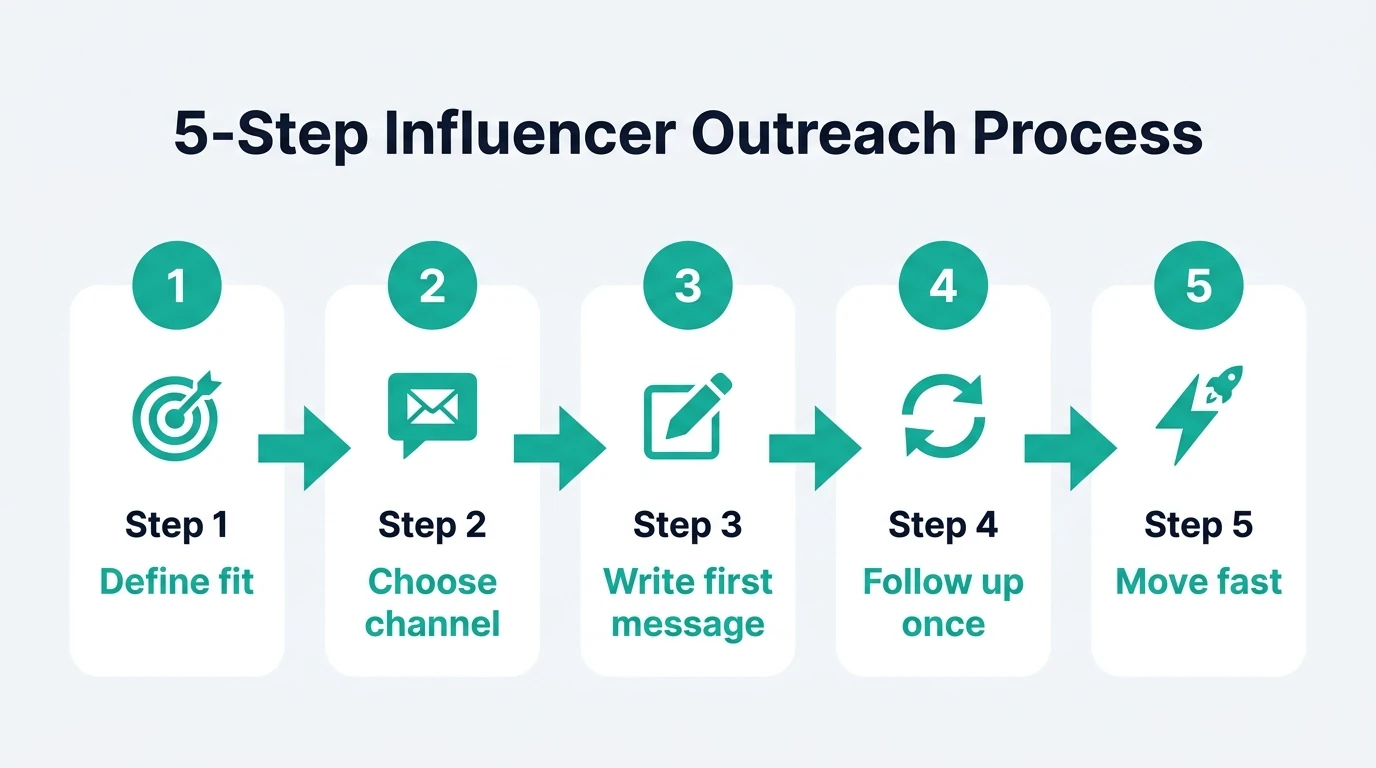
Step 1: Define campaign fit before you contact anyone
Outreach that works starts before any message is sent. Define: which creator profile fits this campaign (size range, niche, platform, tone), what the deliverable is (one Instagram Reel, two TikToks, a YouTube integration), what you're paying, and what usage rights you need (organic only, paid social for 30 days, perpetual). Write these down before you open a DM window.
If you don't know the usage rights you need before reaching out, you'll agree verbally on one thing and write another in the contract — setting up a dispute before the campaign ships. Knowing your terms before contact means the first message can include scope, and the contract can go out the same day they say yes.
Step 2: Choose the right channel
Nano and micro creators (5K–100K followers): Instagram or TikTok DM. Response rates are higher because inbox volume is lower. Check the bio for a preferred contact method — many mid-tier creators list an email address specifically for brand inquiries. Instagram's branded content tools also offer a structured way to tag partners once a deal is in place.
Mid-tier and macro creators (100K–1M+): email to the business inquiry address or manager. DMs at this level often land unseen in the "requests" folder.
YouTube: YouTube Studio message or the linked email in the "About" tab. Studio messages have a dedicated inbox separate from social DMs.
TikTok: for formal campaigns, the TikTok Creator Marketplace provides a direct outreach channel with campaign briefs built in. DMs work for smaller creators. Our guide to TikTok influencer marketing covers the full campaign setup.
LinkedIn: for B2B creators and thought-leaders, a connection request with a brief note or InMail.
When in doubt, check the bio link. Many creators link to a media kit or booking form. Using it signals you actually read the profile, which already puts you ahead of most outreach.
Step 3: Write a first message that earns a read
Your first message has one job: earn a reply, not close the deal. Keep it under 100 words. The structure that works:
A specific reference (name a post/video and say why it fits).
One sentence on what the collaboration is.
A budget anchor or range.
A single clear ask ("Would you be open to a quick call, or want me to send the brief?").
Do not include a full campaign deck, a pitch, or a list of your brand's achievements. Those belong after the yes. See the ready-to-copy templates in the next section.
Step 4: Follow up once
If you get no reply within 5–7 days, send one follow-up. One sentence: "Following up on my note below — happy to share more details if the timing works." That's the whole message.
Do not follow up twice. A second bump within two weeks reads as cold-sales pressure. If there's no reply after two messages, either the creator isn't interested, the DM was buried, or the timing is off. Move on. Creator availability changes — you can try again in 90 days if the campaign is still running.
Step 5: Move fast once they reply
When a creator replies with interest, the window to close is short. Reply within 24 hours with: the full brief, the rate or counter-offer, and the contract. Not "let me send the brief tomorrow." Brief today, rate today, contract the same day they agree verbally.
Deals that stall at the verbal-yes stage go cold. The creator gets a faster offer from another brand. Send the influencer contract template or a standardized deal link the same day. The faster you move from "yes" to signed, the fewer campaigns you lose to nothing.
Influencer Outreach Email Templates (Copy-Paste)
Use these as starting points. Personalize the bracketed fields before sending. Each template includes a disclosure note — keep it in. The FTC requires brands to ensure creators include #ad or #sponsored language, and the outreach message is where that expectation is set. The contract should echo what you committed to here.
Mailchimp's influencer outreach template resource covers the mechanics of outreach sequencing if you want a second perspective — they're not a direct competitor and rank for the template intent at position 10 in this SERP.
Template 1: First-contact email (paid collaboration)
Subject: Collaboration opportunity — [Brand Name] x [Creator Handle]

Hi [Creator Name],

I came across your [specific post/video] last week — the [specific thing you noticed] was exactly the tone we're looking for.

I'm [Your Name] from [Brand Name]. We're running a campaign around [brief one-line description] and think you'd be a great fit.

Quick details:
- Deliverable: [e.g., 1 Instagram Reel, organic post]
- Timeline: [e.g., content live by mid-July]
- Budget: $[X]–$[Y] for this scope
- Usage: organic social only (no paid boost)

All deals include a written agreement — we handle the paperwork.

Would you be open to more details, or want me to send the brief directly?

[Your Name]
[Title], [Brand Name]

Note: this collaboration would be disclosed as #ad/#sponsored per FTC guidelines — we'll confirm the exact wording in the contract.
Template 2: First-contact DM (short form, Instagram/TikTok)
Hey [Creator Name] — saw your [specific post] and loved [specific thing].

Working on a campaign for [Brand Name] that seems like a strong fit. Budget's around $[X]–$[Y] for a [one Reel / TikTok / etc.].

Would you be open to hearing more details? Happy to send a brief.

(All deals come with a written agreement + #ad disclosure — keeping it transparent.)
Template 3: Follow-up (one bump, 5–7 days later)
Subject: Re: Collaboration opportunity — [Brand Name] x [Creator Handle]

Hi [Creator Name],

Following up on my note below — still think you'd be a great fit for this one. Happy to share more details or adjust scope if timing is the issue.

[Your Name]
For DM version: "Hey — just following up on my note from last week. Happy to send more details if the timing works!"
Template 4: Gifting / seeded send (no posting requirement)
Subject: [Brand Name] would love to send you [Product Name]

Hi [Creator Name],

I'm [Your Name] from [Brand Name]. We've been following your content on [platform] — specifically [specific post] stood out to us.

We'd love to send you [Product Name] with no posting requirement. If you try it and want to share your thoughts, that's entirely up to you — and we'd be happy to work together on a paid post down the road.

Shipping address? Happy to send over directly.

[Your Name]

Note: if you do choose to post, please disclose the gifted product per FTC guidelines (#gifted or #ad where applicable).
Influencer Outreach Mistakes vs. Fixes
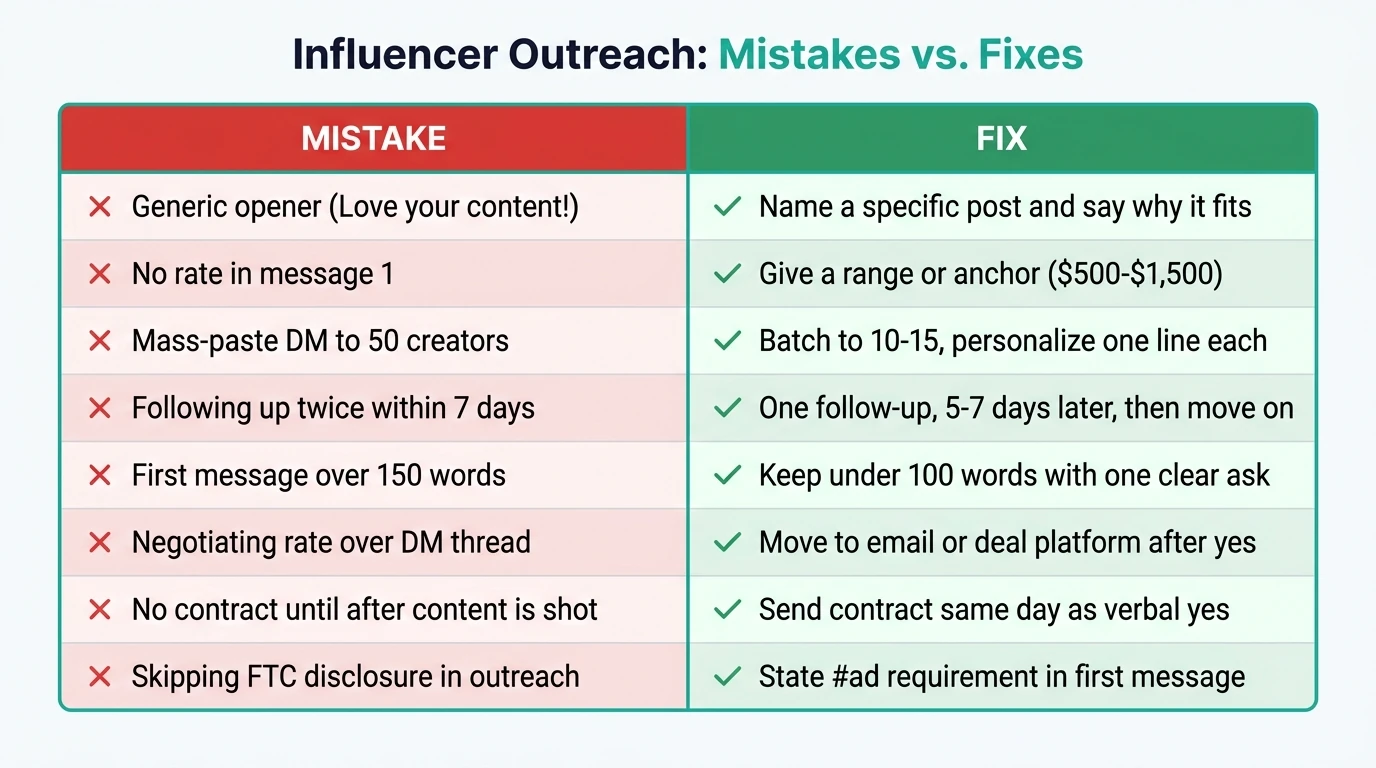
These are the eight patterns that kill reply rates. Each one has a direct fix.
Generic opener ("Love your content!"): creators hear this phrase dozens of times a week. Fix: name a specific post and say why it fits your brand.
No rate in message 1: the creator has to ask, which adds a full round-trip to the thread. Fix: give a range or anchor ("budget in the $500–$1,500 range").
Mass-paste DM to 50 creators at once: creators compare notes and it reads as transactional. Fix: batch to 10–15 at a time; personalize one line per creator.
Following up twice within 7 days: reads as cold-sales pressure. Fix: one follow-up, 5–7 days later. Then move on.
First message over 150 words: creators skim on mobile and you lose them at the scroll. Fix: keep first contact under 100 words with one clear ask.
Negotiating rate over DM thread: slow, informal, and creates scope misunderstandings. Fix: move to email or a deal platform once they say yes.
No contract until after content is shot: scope-creep and payment disputes start here. Fix: send contract the same day as the verbal yes.
Skipping FTC disclosure language in outreach: this is brand liability, not just creator liability. Fix: state the
#ad/#sponsoredrequirement in the first message.
Influencer Outreach Benchmarks: What to Actually Expect
Most brands overestimate how many creators will reply to cold outreach. These are industry-level benchmarks to calibrate against — drawn from Sprout Social's influencer marketing data and Statista's social media engagement research.
Cold email open rate: 25–40% (varies by niche and list quality)
Cold email reply rate: 5–15% (lower in oversaturated niches like beauty and fitness)
DM reply rate for nano/micro creators (under 100K): 10–20% (higher because inbox volume is lower)
Time to first reply (if they reply): 24–72 hours (past 7 days is typically a soft no)
Verbal-yes to signed deal: 30–50% of those who reply (drops sharply if rate wasn't in message 1)
Follow-up bump lift: 20–30% of non-repliers respond to one bump (one bump only; a second rarely adds conversion)
According to HubSpot's marketing benchmarks, cold outreach reply rates across industries rarely exceed 15-20% even with strong personalization — influencer outreach sits within that range when message quality is high. If your reply rate is consistently below 5% on a well-segmented list, the message is the problem, not the creator list.
What moves these numbers most: personalization (highest lever by far), budget transparency in message 1 (second-highest), and message length — shorter messages generate more replies on DM.
The Alternative: Send a Deal, Not a Cold Email
The cold-email model works. But the friction isn't in the first message — it's in everything that follows the yes. Rate negotiation over DM. Contract drafted from scratch. Payment terms left vague. FTC disclosure language forgotten until the content is already live. Each gap adds days, and deals go cold in the gaps.
The structural alternative: find a creator on Superdeal and send a standard deal in minutes. Scope, rate, and contract go out together in one message. Payment is held in escrow until the deliverable is approved. The creator sees the full picture before accepting, which means fewer back-and-forth threads and faster closes.
For brands running more than five deals a month, the outreach loop isn't the bottleneck. The back-end is. Superdeal removes it.
Skip the back-and-forth — find a creator and send a standard deal in minutes →
Frequently Asked Questions
1. What is influencer outreach?
Influencer outreach is the process a brand uses to contact creators, align on collaboration scope and rate, and move to a signed deal. It spans email, DM, YouTube Studio, or a creator marketplace. The arc covers channel selection, first-message framing, budget anchoring, follow-up, and contract handoff.
2. What should I say in a first influencer outreach message?
Include three things: a reference to a specific post (and why it fits your campaign), a one-sentence description of the collaboration, and a budget anchor or range. Close with a single clear ask. Keep it under 100 words. Do not open with "Love your content!" and save the full pitch for after the yes.
3. How many times should I follow up with an influencer?
Once. Send the follow-up 5–7 days after the first message. A second bump rarely adds conversion and reads as cold-sales pressure. If there's no reply after two messages, move on. Creator availability changes — reaching out again in 90 days is reasonable if the campaign is still running.
4. What's a realistic reply rate for cold influencer outreach?
5–15% for cold email; 10–20% for DM to nano and micro creators under 100K followers. Rates drop sharply in oversaturated niches: beauty, fitness, lifestyle. The two biggest levers are including a budget range in message 1 and referencing a specific piece of content. Generic mass-outreach typically lands below 5%.
5. Email or DM — which works better for influencer outreach?
Depends on creator size. Nano and micro (5K–100K): DM gets faster replies because inbox volume is lower. Mid-tier and macro (100K+): email to the business inquiry address converts better — DMs at that scale land in the hidden "requests" folder. For YouTube, use Studio messages or the linked email in the "About" tab.
6. How much does a 100K influencer charge?
A creator with 100K followers typically charges $500–$2,000 per sponsored post on Instagram and $1,000–$4,000 per YouTube integration. The range reflects niche, engagement rate, and usage rights. According to HBR's influencer rate research, beauty and lifestyle command premiums while B2B and niche tech run lower.
7. Is influencer outreach the same as influencer marketing?
No. Influencer marketing is the overall strategy: goals, budget, creator mix, and measurement. Influencer outreach is one step within it — the first-contact-to-contract arc. For the strategic layer, including whether influencer marketing fits your size and budget, see our guide on influencer marketing for small business.
8. What's wrong with cold-emailing influencers in 2026?
Nothing, if the message is personal and includes a budget signal. Cold email breaks when it is mass-templated, rate-free, and asks creators to do discovery work the brand should have done first. The structural alternative is a marketplace deal: the creator sees scope, rate, and contract in one message.