How to Find Influencers on Amazon in 2026 (8 Methods)
The 8 ways to find Amazon influencers for your brand in 2026, starting with Superdeal's free creator database, then Amazon Live, Storefront search, and OneLink. Commission ranges, vetting checklist, and outreach templates.

Founder & CEO, Superdeal
The fastest way to find Amazon influencers is a free creator database like Superdeal: filter by category and prior Amazon work, and you have a shortlist of 10 in about five minutes. After that, seven more methods work in 2026: the Amazon Live "Live Now" page, the Storefronts directory, OneLink + the Brand Referral Bonus, TikTok Shop mining, YouTube review-channel mining, competitor-storefront mining, and Amazon-focused agencies. This guide walks each method, with commission and flat-fee benchmarks pulled from real 2026 deals plus outreach templates that earn reply rates above 25%. Pick the method that fits your budget and timeline below.
Who this guide is for. If you're a shopper trying to find Amazon creators you already follow, see Amazon's Following page on amazon.com/gp/help - that's a different feature and a different intent. If you're a creator trying to find your own Storefront link, log into Associate Central. This guide is for brands hiring Amazon-active creators.
👉 Browse Amazon-active creators on Superdeal — free. Filter by category and prior Amazon work, send a deal in 30 seconds, contract auto-generated.
What Counts as an "Amazon Influencer"?
Amazon recognizes four working definitions, and the difference matters because each type is paid, vetted, and hired in a different way. (Amazon Influencer Program info page)
The four working categories:
Amazon Influencer Program creators (with Storefronts) earn 1–10% commission on sales through their public Storefront URL plus per-product on-page video royalties. Brands hire them with a flat content fee plus optional commission upside. Best for product launches and evergreen reviews.
Amazon Live creators stream product demonstrations on
amazon.com/live. They earn live-stream commission plus flat appearance fees brands pay to book a slot. Best for demo-heavy products and time-bound launches.Amazon Associates affiliates only have a link, not a Storefront, and earn 1–10% category commission alone, per the Associates program docs. Brands hire them to publish off-Amazon content - TikTok, YouTube, blogs - using the tracked link. Best for high-volume publishers.
Off-Amazon creators who drive Amazon traffic are pure influencers on TikTok, YouTube, or Instagram pointing followers at Amazon listings. Brands hire them with a standard influencer deal - flat fee plus sometimes affiliate commission. Best for funnel-top awareness routed to Amazon.
The first two are unique to Amazon's ecosystem; the last two overlap with any other influencer hiring you already do. Most 2026 brand budgets split across all four.
Why People Search "How to Find Influencers on Amazon" (3 Different Reasons)
This search query bundles three different intents, and Google groups them under one parent topic - which is why the SERP feels noisy. Sorting out which one you are saves an hour.
You're a shopper trying to find creators you already follow
If you've been watching a creator on Amazon Live or browsing a Storefront and want to re-find them, that's a shopper-side problem. The official solution is Amazon's Follow feature, documented on amazon.com/gp/help. This guide does not cover that - close this tab, use the link, you'll be done in a minute.
You're a creator trying to find your own Storefront link
If you're enrolled in the Amazon Influencer Program and you need the public URL for your own Storefront so you can share it, that lives inside Associate Central. Log in, go to the Storefront tab, copy the amazon.com/shop/<your-handle> URL. Again, not what this guide covers.
You're a brand trying to hire Amazon-active creators
Everything from here down is for you - brand-side teams looking to discover, vet, and pay Amazon influencers. Eight methods, real rates, outreach templates. Keep reading.
Amazon Influencer Program 101 (What Brands Need to Know)
Most brands hire Amazon influencers without understanding how the program actually works on the creator side - which leads to bad first messages. The program is creator-enrolled and brand-invisible by default; there is no brand-facing search built into Amazon itself. (Amazon Influencer Program info page)
What the program actually is
The Amazon Influencer Program is a creator-side enrollment that gives qualifying creators (a) a public Amazon Storefront at amazon.com/shop/<handle>, (b) the ability to upload review videos that appear on Amazon product detail pages, and (c) commission tracking on every sale routed through their Storefront or videos. There is no brand-side discovery layer - that gap is why creator marketplaces exist.
How creators qualify
Amazon does not publish a hard follower number, but in practice the floor is roughly 1,000 followers on at least one qualifying platform (Instagram, TikTok, YouTube, Facebook), gated on engagement and content quality. Many 5,000-follower applicants are rejected if engagement is weak; many 1,500-follower applicants are approved if content is clearly product-focused.
What a Storefront is and how it earns
A Storefront is a public, indexable page on amazon.com/shop/<handle> showing curated products plus the creator's photo, bio, and idea lists. Creators earn 1–10% commission on every product sold through the Storefront or linked videos. The Storefront URL is also the creator's public portfolio - what a brand evaluates before pitching.
Brand Referral Bonus + OneLink - the only native attribution path
If you sell on Amazon and route external traffic through an influencer's OneLink, Amazon refunds 10% of the sale as a Brand Referral Bonus. That is the single native attribution path for brands working with off-Amazon influencers. Build OneLink into every Amazon influencer contract you sign in 2026 - it adds nothing to the creator's workload and meaningfully changes the unit economics.
Why brand relevance matters more than follower count
Amazon's algorithm rewards creators whose existing content matches the products they Storefront. A 12,000-follower fitness creator with a Storefront full of supplements converts at multiples of a 500,000-follower lifestyle creator with random kitchen tools. Hire on Storefront fit, not follower count. (See also the influencer rate calculator for ballpark pricing once you have a fit-checked shortlist.)
8 Ways to Find Amazon Influencers
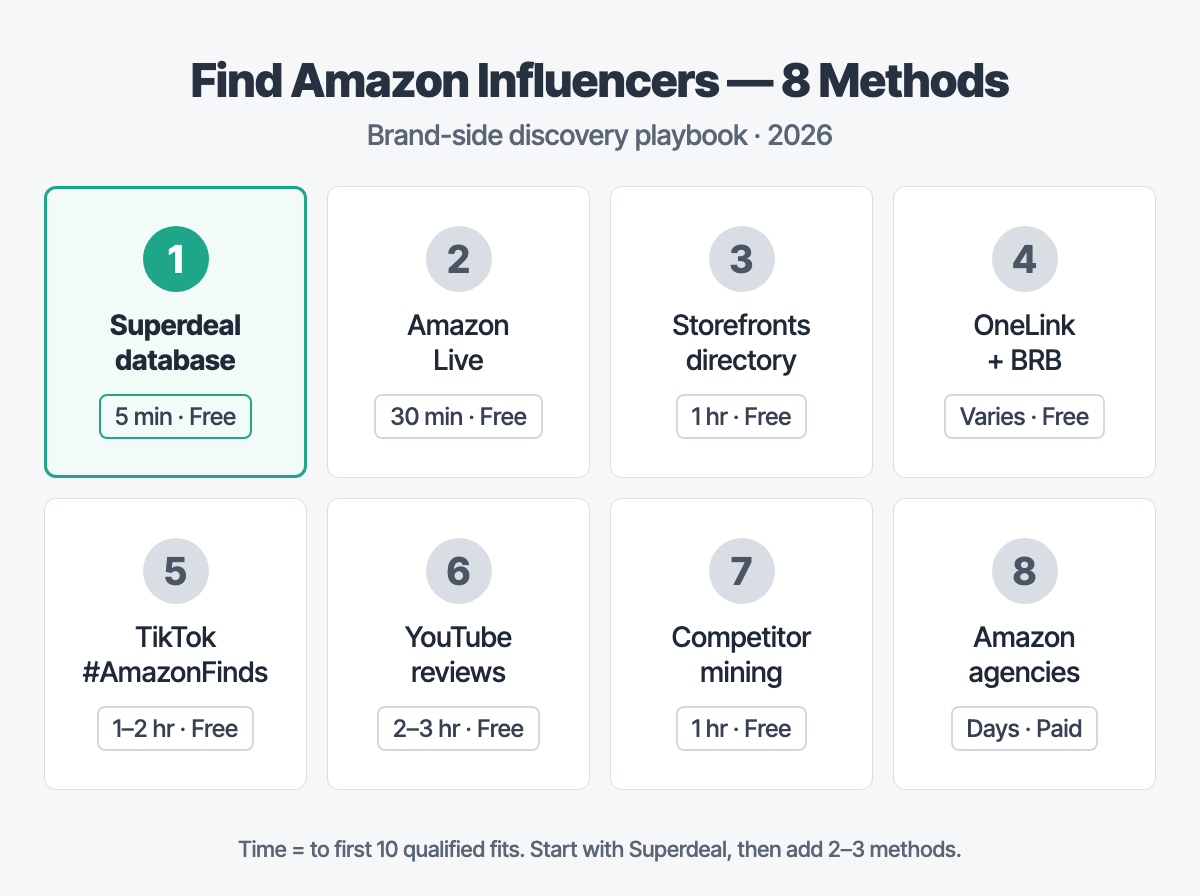
These are the methods that actually work in 2026, ordered roughly fastest-to-slowest for time-to-first-fit. Start with Superdeal for a first shortlist in minutes, then add two or three of the others for category-specific names.
1. Superdeal's free creator database
Free indexable creator databases are the fastest way to build a vetted shortlist of Amazon-active creators across categories. On Superdeal, you can filter by category, follower band, prior Amazon work, and Storefront URL in five minutes - every profile shows the creator's Storefront link directly, so vetting starts pre-loaded. Free to browse; flat fee per deal sent, contract included.
👉 Filter Amazon-active creators on Superdeal → - 5 minutes to a shortlist of 10.
2. Amazon Live "Live Now" page - find Amazon Live influencers in real time
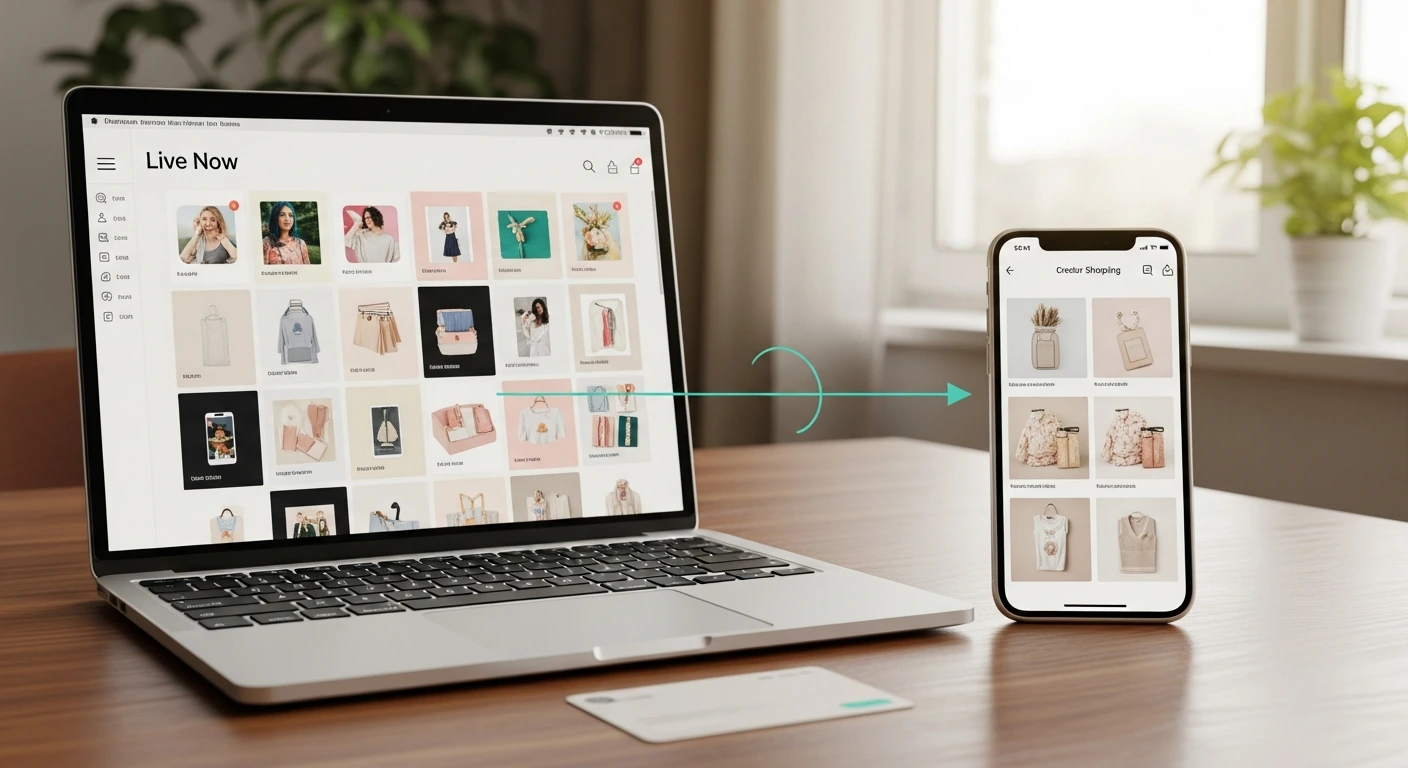
The Amazon Live "Live Now" page at amazon.com/live shows every Amazon Live stream currently airing, organized by category, and almost no brand uses it for discovery. Filter by your category (beauty, fitness, kitchen, tech), watch 30 seconds of a stream, click through to the creator's profile, save the Storefront URL. In 30 minutes you can build a list of 10–15 active live-stream creators in any major category.
What to look for in 30 seconds: real-time chat engagement (50+ concurrent viewers with conversational chat is healthy), product-handling confidence, and a clear sponsor disclosure per the FTC Endorsement Guides. Streams that look like infomercials read off cards convert badly; conversational streams convert well.
3. Amazon Influencer Storefronts (and how to find them by category)
There is no official directory of Amazon Storefronts, but Amazon's Shop By Interest pages and category Storefront pages surface curated Storefronts by vertical. Try a Google search of site:amazon.com/shopplus your category keyword (for example, site:amazon.com/shop "skincare" returns ranked Storefronts in that vertical). One hour of focused searching yields 20–40 category-relevant Storefronts.
For each Storefront, check the update timestamp (anything older than 60 days is dormant), the on-page video count (more than 10 videos signals serious commitment), and niche coherence (one or two related categories is healthy; an "everything store" is not).
4. Amazon OneLink + Brand Referral Bonus (the only native attribution path)
If you're an Amazon seller, the OneLink + Brand Referral Bonus combo is how you attribute and reward off-Amazon influencer traffic with zero technical overhead beyond Seller Central. Generate a OneLink for each influencer, ask them to use it in their off-Amazon content, and Amazon credits you 10% of the resulting sale via the Brand Referral Bonus program. That bonus typically covers half the flat content fee, depending on conversion.
5. TikTok Shop + #AmazonFinds hashtag mining
The #AmazonFinds hashtag on TikTok routes hundreds of millions of monthly impressions to Amazon listings, and the creators tagging it usually have Amazon Storefronts. Open TikTok, search #AmazonFinds plus your category (#AmazonFinds skincare), sort by recent, and scrape the top 50 creators of the past 7 days. Roughly 60–70% will have an Amazon Storefront in their bio; the rest are Associates-only and still worth pitching for off-Amazon promotion.
Many of these creators will let you run Spark Ads or Partnership Ads through their handle for a 20–40% premium on top of the base content fee, inheriting their account credibility and consistently outperforming standard ads.
6. YouTube product-review channel mining
Long-form YouTube reviews drive high-consideration Amazon purchases at multiples of TikTok virality. Search YouTube for "<your category>" review "Amazon", sort by recent, and shortlist channels with 10K–500K subscribers and an Amazon link in the description. These creators typically charge $500–$3,000 per integration plus affiliate commission, and the content stays evergreen for years (versus TikTok's 72-hour lifespan). For a fuller play-by-play, see our guide on how to find YouTube influencers.
7. Competitor-storefront mining (find who's promoting competitor ASINs)
If you sell in a competitive category, the fastest way to find proven Amazon influencers is to find every creator promoting your competitors. Pull your top three competitor ASINs, search them in Amazon's review section (filtered to "videos only"), and note every creator whose review video appears. Cross-reference the same ASINs against TikTok and YouTube. Within an hour you'll have a list of 15–30 creators with proven on-Amazon performance in your exact category.
Cold-pitching a creator already shipping for your competitor works because they have the niche-relevant audience and product-handling skill; you're swapping which brand pays them.
8. Amazon influencer marketing agency + management firms
If you have a five-figure budget per campaign and no internal creative-ops headcount, an Amazon-focused agency runs sourcing, contracting, and reporting for you for a managed fee (typically 15–25% of media spend or a flat $5K–$25K/month retainer). Worth it for hands-off launches; over-priced for small brands who can run a Superdeal-plus-direct-outreach stack instead. Vet agencies by asking for case studies with named brands, three creator Storefront URLs they've sourced, and Brand Referral Bonus attribution numbers from a past campaign.
The 8 methods at a glance:
Method 1 — Superdeal's free creator database. Free. Time to first 10 fits: 5 minutes. Best for all categories, fastest setup.
Method 2 — Amazon Live "Live Now" page. Free. Time to first 10 fits: 30 minutes. Best for live-stream-friendly products.
Method 3 — Amazon Storefronts directory (via Google
site:search). Free. Time to first 10 fits: 1 hour. Best for evergreen reviews and niche specialists.Method 4 — Amazon OneLink + Brand Referral Bonus. Free with a seller account. Time-to-first-fits varies. Best for performance-tracked deals.
Method 5 — TikTok Shop + #AmazonFinds. Free. Time to first 10 fits: 1–2 hours. Best for trend-driven product categories.
Method 6 — YouTube review-channel mining. Free. Time to first 10 fits: 2–3 hours. Best for high-consideration purchases.
Method 7 — Competitor-storefront mining. Free. Time to first 10 fits: 1 hour. Best for direct-competition product launches.
Method 8 — Amazon influencer marketing agencies. Paid (managed fee). Time to first 10 fits: days. Best for hands-off, larger budgets.
Does Amazon Allow Brands to Pay Influencers Directly?
Yes - Amazon does not prohibit brands from paying creators directly for content. The Amazon Operating Agreement governs how creators participate in the Associates and Influencer programs (commission rules, link-cloaking restrictions, prohibited categories), but it does not restrict brands from negotiating private content-and-rights deals on top. Most 2026 Amazon influencer deals work exactly this way: brand pays a flat content fee, creator earns commission on resulting sales, brand attributes performance through OneLink + Brand Referral Bonus.
Two rules to follow:
FTC disclosure is non-negotiable. Every paid endorsement requires a clear and conspicuous disclosure -
#ad, a Paid Partnership label, or a stated on-screen sponsor mention. The FTC's Endorsement Guides cover the exact rules. Hashtag-only disclosure is not enough; it must be unmissable.Don't ask Associates to do things their agreement forbids. Associates cannot link-cloak, cannot post links in email or offline media without permission, and cannot make false product claims. If your brief asks for any of those, the creator can refuse and you create program-compliance risk for them.
Build the deal so the creator stays inside Amazon's rules, you stay inside FTC rules, and both sides have written scope. That's the entire compliance footprint.
How to Vet an Amazon Influencer Before You Pitch
The Storefront is the portfolio. Spend 90 seconds on it before sending a message.
Storefront-level checks
Look at four things on the Storefront itself:
Update cadence. Weekly updates = active; monthly = alive; untouched in 60 days = dormant. Dormant Storefronts get pitched too often and respond poorly.
Niche coherence. One or two related categories signals a real audience. An "everything store" with random products signals a creator monetizing through volume - fine for affiliate, weak for paid content.
Video count and quality. More than 10 on-page videos signals serious commitment. Watch one full video at 1× speed - if it makes you forget you're watching a review, the creator is strong.
Recent product mix. If the most recent picks include three direct competitors of yours, decide whether you're comfortable with that crossover before pitching.
Off-platform reach checks
The Storefront only tells half the story. Visit the creator's TikTok, Instagram, and YouTube. You're checking that audience size matches the deal you're considering (an 800-follower account cannot drive meaningful TikTok-to-Amazon traffic, no matter how good the Storefront looks) and that the off-platform aesthetic matches the Storefront's promised niche.
Conversion-relevance signals
A great fit signal: their last three sponsored posts are in your category for other brands you respect. A bad signal: their last three sponsored posts are crypto, drop-shipped supplements, or other audience-trust-eroding categories. Prior brand mix is a faster trust signal than any vanity metric.
Red flags
Three patterns to walk away from:
Engagement laundering. A 50,000-follower creator with under 50 comments per post is buying followers. The Storefront might still convert (commission tracks real sales), but you cannot trust the audience numbers.
Bot-style live chat. On Amazon Live streams, watch the chat for 30 seconds - real chat is conversational and product-specific; bot chat is generic greetings and emoji.
Paid-to-promote-anything portfolios. If a creator's last 10 posts are for 10 unrelated categories, they will sponsor anything. Brand alignment is performative, not real.
Healthy ranges vs. red flags on key vetting metrics:
Storefront update cadence. Healthy: 1–4 new picks/week. Red flag: last update > 60 days ago.
Storefront niche coherence. Healthy: 1–3 related categories. Red flag: "everything store" with random products.
Avg comments / video. Healthy: 0.5%–2% of followers. Red flag: < 0.1% (engagement laundering).
Off-Amazon following. Healthy: 5K+ on at least one platform. Red flag: no external presence at all.
Past brand mix. Healthy: varied legitimate brands. Red flag: all crypto or drop-shipping.
Live engagement (if Live creator). Healthy: 50+ concurrent viewers and real chat. Red flag: bot-style chat with < 10 viewers.
For the contract clauses that protect both sides on payment, rights, and exclusivity, see our influencer contract template guide.
How Much Do Amazon Influencers Charge in 2026?
Amazon influencer rates have stabilized in 2026 around three pricing structures: commission-only, flat fee plus commission, and Amazon Live appearance fees. Most deals stack at least two. Across 80+ Amazon-active creator deals on Superdeal in Q1 2026, micro-tier flat fees clustered in the $200–$800 range with commissions of 3–7%.
Commission-only deals
For an established creator with a category-relevant Storefront, you can sometimes sign a commission-only deal at 5–15% of resulting Amazon sales. Works best for products with strong organic appeal and a creator who genuinely wants the product. Doesn't work for launches where you need a guaranteed post.
Flat fee + commission (the most common 2026 structure)
The dominant 2026 structure: a flat content fee per video or Storefront post, plus a commission percentage on resulting Amazon sales (tracked through OneLink). The flat fee removes execution risk for the creator; the commission caps your downside and shares the upside. Industry benchmark commentary from Influencer Marketing Hub supports the same flat-fee bands brand-side teams quote on Superdeal.
Amazon Live appearance fees
Booking an Amazon Live slot - one-time stream or recurring monthly slot - typically commands a flat appearance fee on top of standard commission. The fee scales with follower count and stream history.
Bundled deals
For higher-budget launches, bundle: one Storefront review video + one Amazon Live appearance + one off-Amazon TikTok or Reels post + 30 days paid usage rights. Bundles run roughly 80% of the sum of the parts and typically convert better than any single deliverable.
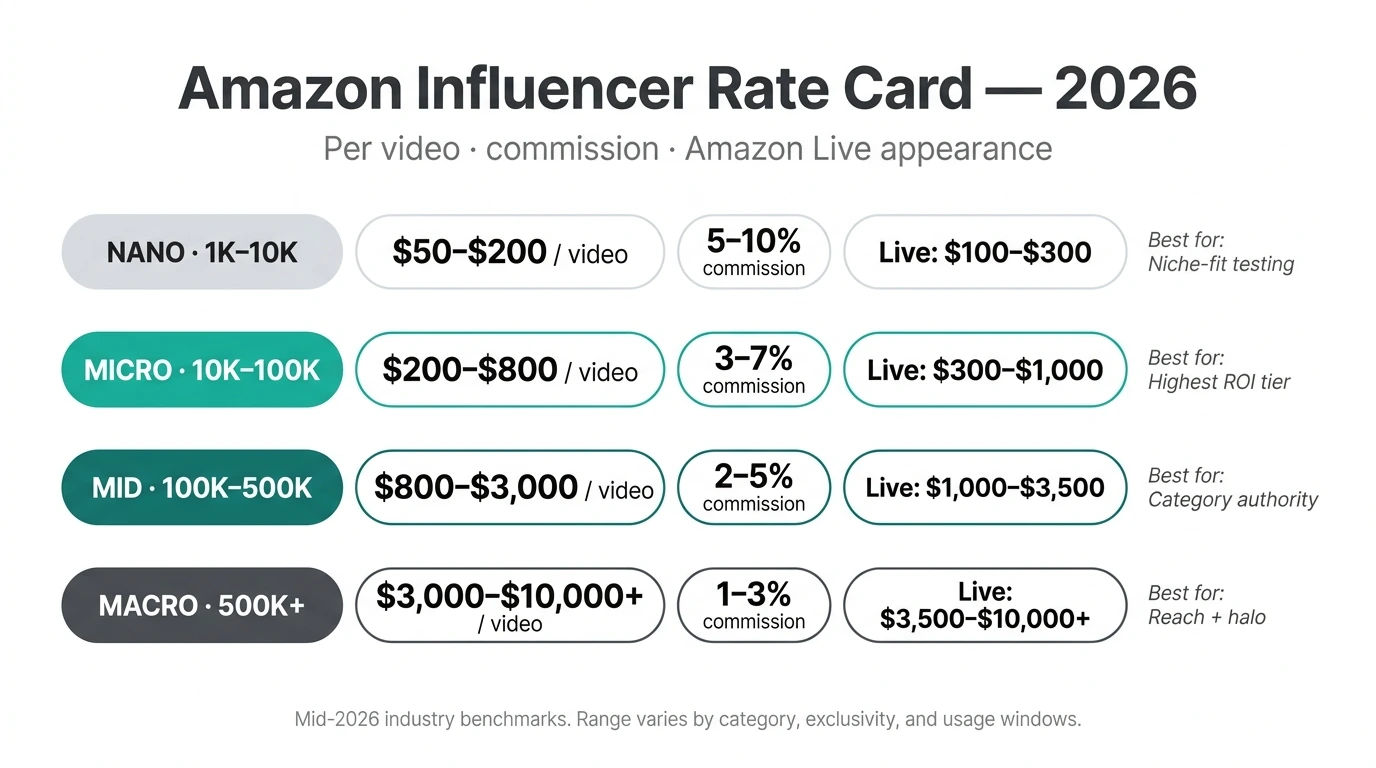
Typical Amazon influencer rates by tier (US, 2026):
Nano (1K–10K followers). Commission: 5–10%. Flat fee per video: $50–$200. Amazon Live appearance fee: $50–$150. Best for hyper-niche products.
Micro (10K–100K). Commission: 3–7%. Flat fee per video: $200–$800. Amazon Live appearance fee: $150–$500. Best for performance-driven launches.
Mid (100K–500K). Commission: 2–5%. Flat fee per video: $800–$3,000. Amazon Live appearance fee: $500–$2,000. Best for brand awareness + conversion.
Macro (500K+). Commission: 1–3%. Flat fee per video: $3,000–$10,000+. Amazon Live appearance fee: $2,000–$8,000. Best for major launches.
(Source: Superdeal deal data Q1 2026, cross-referenced against Influencer Marketing Hub benchmark commentary.)
Outreach Templates That Get Replies (Amazon-Specific)
Three templates that work in 2026 - short, Storefront-referenced, locked terms. Drop in the creator's Storefront URL by name in every first message.
Cold-pitch template (referencing their Storefront)
Subject: 30-second pitch for amazon.com/shop/<their-handle> — <BRAND>

Hi <first name>,

I'm <your name> at <BRAND>. We make <one-sentence product description>.
I've been on your Storefront and the way you handled <specific recent
product they featured> is exactly the energy we want for <our product>.

Concept: a 30–60 second talking-head + product-demo video for your
Storefront, plus an Amazon Live mention if it fits your schedule.

Terms:
- Flat fee: $<X> per video, paid on delivery
- Usage: 30-day paid social, plus Storefront placement (your decision)
- Commission: <Y>% via OneLink (Brand Referral Bonus tracked)
- Turnaround: <N> days from receipt of product

Worth a quick reply if you're open?

<your name + handle + Superdeal profile link if applicable>
Amazon Live booking template
Subject: Sponsor slot for your <category> Amazon Live — <BRAND>

Hi <first name>,

I caught your <date> stream on <product or category>. We're <BRAND>
and we'd like to sponsor a 5-minute featured-product segment in your
next stream.

Terms:
- Appearance fee: $<X>, paid before air
- Commission: <Y>% on resulting sales (OneLink + Brand Referral Bonus)
- Deliverable: a featured-product segment with on-air demo, plus a
  pinned link to our ASIN in the chat
- Date: your next available stream, your choice

Reply with your fee and an open date and I'll send the contract.

<your name + handle>
What NOT to say
Four patterns that hurt reply rates:
"Free product in exchange for a review" unless the retail value is significant and the creator is genuinely starting out. Asking for free work signals a brand that won't pay for the deliverable.
"We need this in 48 hours." Amazon creators batch shoots; 48-hour turnarounds get declined or rushed. Five business days is the floor.
Generic "we love your content!" with no Storefront reference. Treated as bulk pitch, deleted in 5 seconds. Always name a specific Storefront pick.
"Send us the Storefront analytics." Amazon doesn't share detailed Storefront analytics with creators - you're asking for something they cannot provide. Focus on prior brand work and audience screenshots instead.
Manual Search vs. a Creator Marketplace - When Each Wins
Manual Amazon search (Methods 2–7) takes 3–5 hours to assemble a vetted shortlist of 10 Amazon-active creators. Superdeal does the same in 5 minutes because the database is pre-filtered for Amazon experience, with profiles that surface off-Amazon reach data, listed rates, and prior brand mix in one place. The right play in 2026 is to use both - Superdeal for the first 10 fits in 5 minutes, then 1–2 hours of manual mining on Methods 2, 3, 5, and 7 to surface category-specific creators not yet on any database.
Manual Amazon search vs. Superdeal - side by side:
Time to find 10 Amazon-active fits. Manual: 3–5 hours. Superdeal: 5 minutes.
Off-Amazon reach data. Manual: cross-check per creator. Superdeal: surfaced in profile.
Rate transparency. Manual: email back-and-forth. Superdeal: listed up-front.
Sending a deal. Manual: email + custom contract. Superdeal: 30-second flow + built-in contract.
Cost. Manual: your time. Superdeal: free to browse; flat fee per deal.
👉 Send your first Amazon-creator deal in 30 seconds → - contract auto-generated, payment held in escrow until delivery.
Frequently Asked Questions
1. What is the Amazon Influencer Program?
The Amazon Influencer Program is a creator-side enrollment that gives qualifying creators a public Storefront at amazon.com/shop/<handle>, the ability to publish review videos on Amazon product detail pages, and commission of 1–10% on resulting sales. It is the single largest UGC pipeline in the US.
2. How do you find Amazon influencers for free?
The fastest free path is a creator database like Superdeal: a shortlist of 10 Amazon-active creators in about 5 minutes. After that, try the Amazon Live "Live Now" page at amazon.com/live, the Storefronts directory via site:amazon.com/shop Google searches, the TikTok #AmazonFinds hashtag, and YouTube review-channel mining, at 30 minutes to 3 hours each.
3. How much do Amazon influencers cost?
Rates split by tier in 2026. Nano creators (1K–10K followers) charge $50–$200 per video at 5–10% commission. Micro (10K–100K) charge $200–$800 at 3–7%. Mid (100K–500K) charge $800–$3,000 at 2–5%. Macro (500K+) command $3,000–$10,000+ at 1–3%. Amazon Live fees stack on top.
4. Amazon influencer vs Amazon associate - what's the difference?
Amazon Influencers have a Storefront and qualified through a social-audience gate; Associates only have a tracked link with no Storefront. Influencers earn higher commissions on Storefront sales, can host Amazon Live, and are easier for brands to vet because the Storefront is a public portfolio. Associates work better for high-volume off-Amazon publishers.
5. How many followers do you need to be an Amazon influencer?
Amazon does not publish a hard number, but roughly 1,000 followers on at least one qualifying platform (Instagram, TikTok, YouTube, or Facebook) is the floor, gated by engagement and content quality. Many 5,000-follower applicants are rejected when engagement is weak; many 1,500-follower applicants are approved when content is product-focused.
6. Can I sponsor an Amazon Live stream?
Yes. Book directly with the creator using a flat appearance fee for a featured-product segment plus a commission percentage on resulting sales through OneLink. Larger sponsorships can also run through Seller Central's Amazon Live for Brands program if you need scheduled recurring slots across a calendar quarter.
7. How do I track ROI from Amazon influencer deals?
Use OneLink plus the Brand Referral Bonus as the native attribution path - Amazon credits you 10% of any sale routed through a OneLink, which tags creator-driven traffic. For off-Amazon content (TikTok, YouTube, Instagram), layer UTM-tagged links so your analytics platform sees the click-through separately from the on-Amazon conversion.
8. Do I need a contract for an Amazon influencer deal?
Yes - every Amazon influencer deal needs a written contract covering scope (deliverables, format, deadline), rights (where and for how long the brand can use the content), payment terms (flat fee, commission, milestones), and FTC disclosure language. For the full clause-by-clause template, see our influencer contract template.
9. How much do Amazon influencers make?
Range is wide. Nano-tier creators earning only Storefront commission typically clear $50–$500 per month; mid-tier creators stacking brand deals plus Amazon Live appearances plus Storefront commission can clear $5,000–$15,000 per month. The top end is paid mostly through brand flat fees and whitelisting deals, not commission alone.
10. What is an Amazon influencer?
An Amazon influencer is a creator enrolled in the Amazon Influencer Program - the creator-side program that gives them a public Storefront at amazon.com/shop/<handle> and commission on sales driven from their off-Amazon content. Distinct from generic Amazon Associates (link only) and from off-platform influencers who happen to promote Amazon products.
Sources and further reading
Amazon - Amazon Influencer Program info page
Amazon - Amazon Live
Amazon - Amazon Associates program
Amazon - Brand Referral Bonus
eMarketer - Influencer Marketing Set to Surpass $13 Billion by 2027
Influencer Marketing Hub - Influencer Rates: How Much Do Influencers Really Cost in 2026?
TikTok for Business - Spark Ads 101: Turn TikToks into Ads
Statista - Influencer marketing spending worldwide
For brands: Browse Amazon-active creators on Superdeal - free →. Filter by category and prior Amazon work.