How to Become an Amazon Influencer in 2026
Learn how to become an amazon influencer in 2026, including follower requirements, approval, storefronts, commissions, and payouts.

Founder & CEO, Superdeal
Do you have a solid audience on TikTok, Instagram, YouTube, or Facebook? You can turn all those product recommendations you make into actual income. The Amazon Influencer Program is one option, but getting started is not quite as simple as creating an account and adding Amazon links to your bio.
When researching how to become an amazon influencer, the first thing to know is that Amazon does not publish a fixed follower requirement or a guaranteed approval formula. Your audience matters, yes, but Amazon also considers the quality and activity of your social presence.
The good news? You do not need to be a celebrity or have hundreds of thousands of followers to apply. What you do need an eligible social account, an established presence, and content that gives Amazon a reason to believe you can influence customer purchases.
Here is what you need to know for how to become an Amazon influencer in 2026.
What Is the Amazon Influencer Program?
So, what is the amazon influencer program exactly?
The Amazon Influencer Program is an extension of Amazon's Associates program built for social media creators. Instead of just sending followers to individual Amazon product pages, approved influencers can create a public page, referred to as an Amazon influencer storefront, where they can organize and recommend products.
You get to share your storefront with your audience, create product lists, and publish eligible content such as photos and videos. Amazon can also choose eligible influencer content to display to shoppers on Amazon. When customers make qualifying purchases through your traffic or through eligible onsite content, you earn commissions.
Amazon Influencer Program vs. Amazon Associates
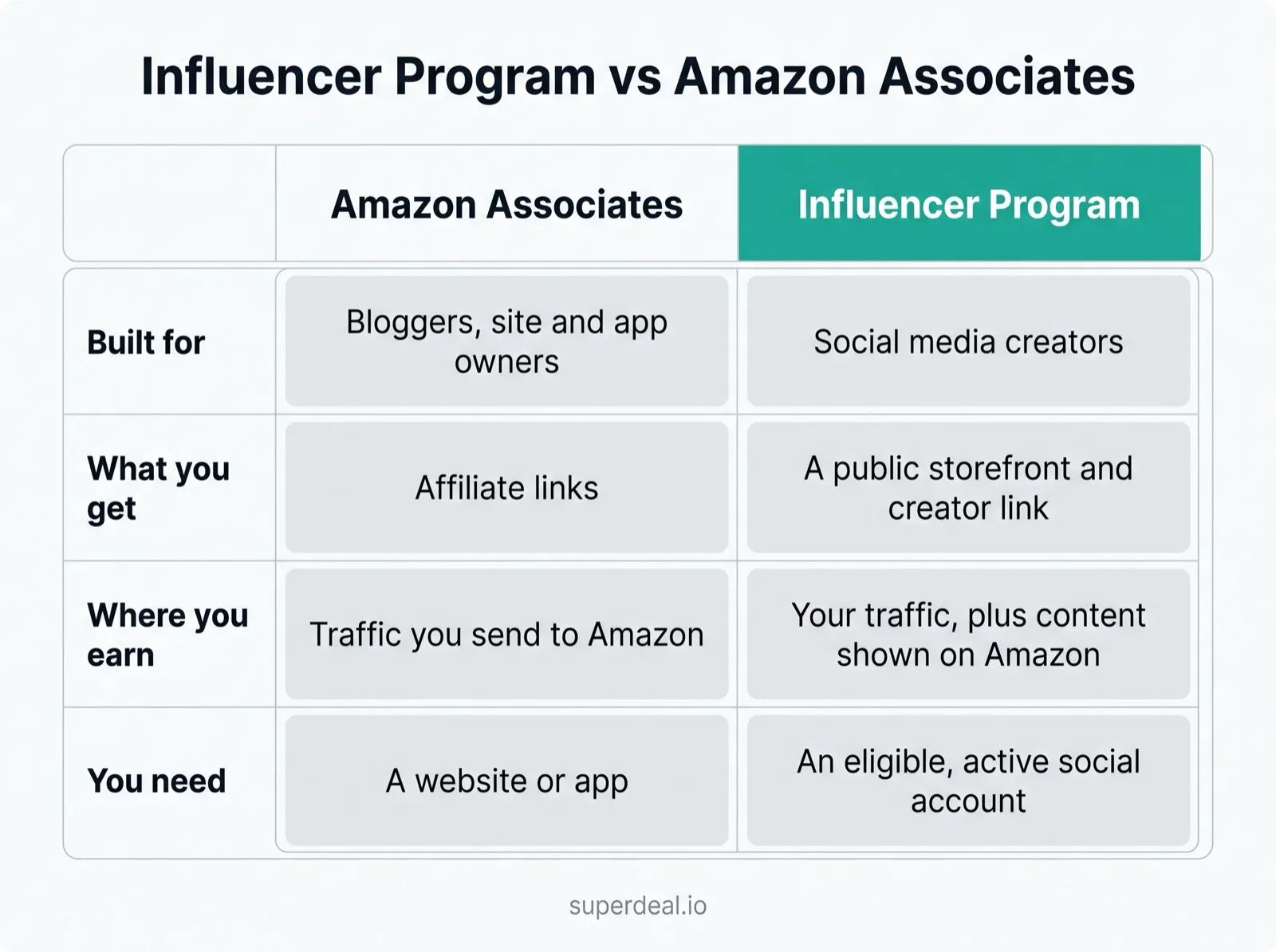
Amazon Associates is the broader affiliate program. Publishers, bloggers, website owners, app developers, and other eligible participants can use special affiliate links to send shoppers to Amazon.
On the other hand, the Influencer Program is specifically built around a social media presence. It gives you an influencer page or storefront, a unique creator link, and opportunities to earn from content displayed on Amazon itself.
The key difference is that Amazon influencers usually earn from qualifying purchases or commissions, not just for posting about products.
How Many Followers Do You Need for the Amazon Influencer Program?
This is probably the question you were hoping had a simple answer. Sorry, but it doesn't.
There is no publicly stated follower minimum that Amazon guarantees will qualify you for the program. Amazon's current policy says influencers must meet qualitative and quantitative thresholds, but it does not publish a specific number of followers that every applicant must have.
That means searches for how many followers for amazon influencer program often produce conflicting answers. You may see people claiming that you need a particular number, but you should not treat those numbers as official Amazon requirements.
So, how many followers do you need for amazon influencer? There is no fixed public threshold. Amazon has indicated that it considers follower count along with other engagement metrics. Its seller-facing guidance has also identified YouTube, Instagram, Facebook, and TikTok as eligible social platforms, with additional requirements for some account types.
In practical terms, your chances may be stronger if your account:
Is public and active
Has genuine followers
Shows consistent posting
Has meaningful engagement
Has content that demonstrates influence in a specific niche
Looks like a real creator account rather than a recently created promo page
Follower count is useful, but it is only one signal. If you are asking how many followers do you need for amazon influencer, don't wait until you hit some mythical follower number. If you have an established audience and regularly create content, you may already be worth applying.
What Amazon Looks at Besides Followers
Amazon doesn’t disclose its full approval scoring methodology. This is an important aspect to consider since any claims regarding specific follower counts, posting frequencies, or engagement rates warrants approval better than Amazon itself.
Your social account should make it easy for Amazon to understand who you are and what kind of content you create.
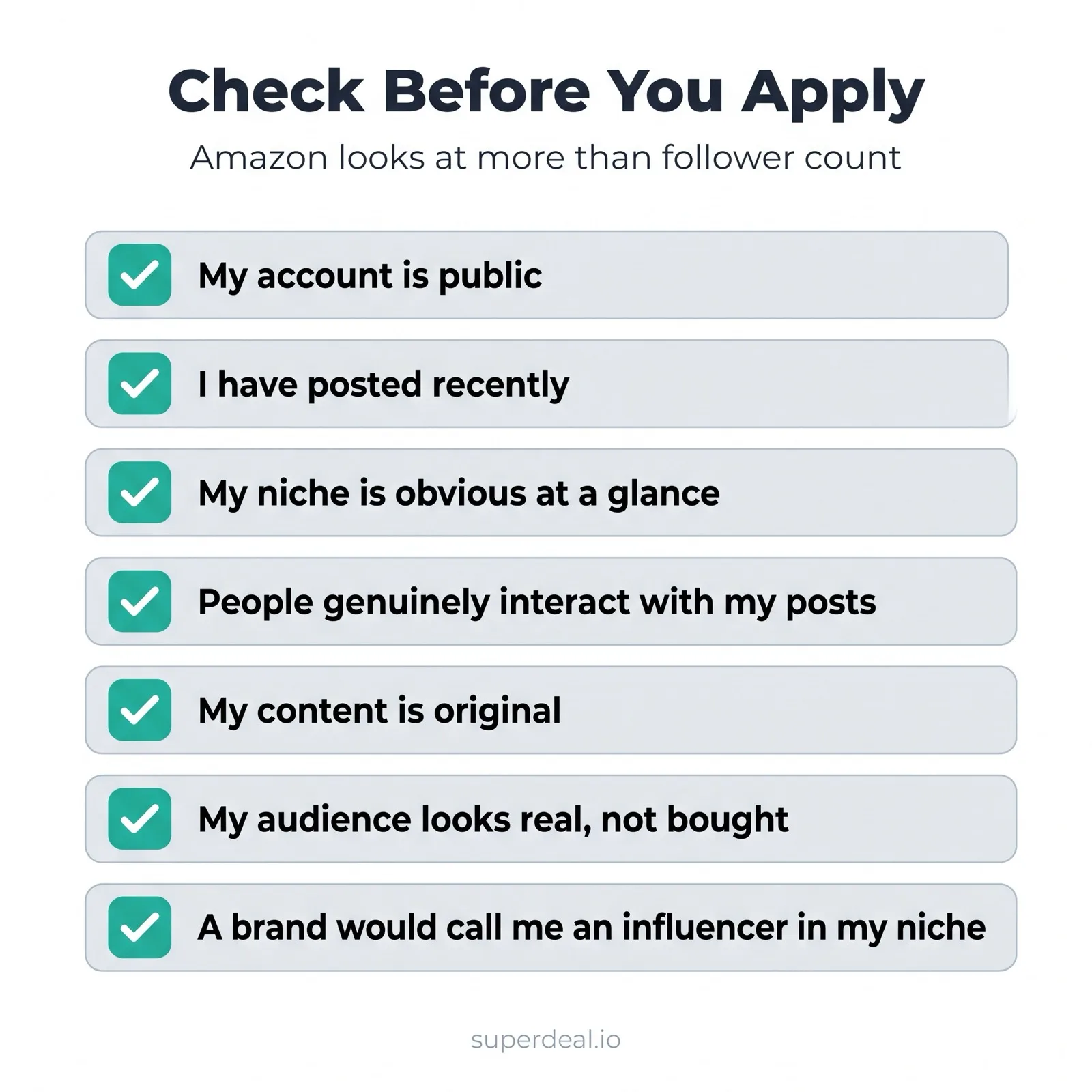
Look at your profile before applying and ask:
Is my account public?
Does it have recent content?
Is my niche obvious?
Do people really interact with my posts?
Does my content include original material?
Does my audience appear genuine?
Would a brand or retailer reasonably consider me an influencer in my niche?
Your social profile should look polished and complete. A profile photo, clear bio, consistent content, and recent posts can make your account easier to evaluate. An account with thousands of followers but almost no recent activity isn’t necessarily a stronger application than a smaller, more active account.
How to Get Approved for the Amazon Influencer Program
If you're wondering how to get approved for amazon influencer program, focus less on trying to game the application and more on presenting an established creator account.
Before applying, clean up your profile. Remove obvious spam, update your bio, make sure your account is public, and publish recent content that reflects the niche you want associated with your creator brand.
It can also help to apply using the social platform where you have the strongest combination of audience, engagement, and consistent content. You don’t need to apply using your largest account if another platform better represents your actual influence.
Take note that Amazon's current policy requires applicants to provide registration information and grant Amazon access to information about their social media presence as part of registration.
Amazon Influencer Program: How to Join
When you begin searching for ‘Amazon influencer program how to join’, the process is straightforward. But let’s break it down:
1. Choose Your Strongest Social Account
Start with the platform that best demonstrates your influence. Depending on Amazon's current eligibility rules, qualifying social platforms can include YouTube, Instagram, Facebook, and TikTok.
Make sure the account is public and active before you submit it.
2. Go to Amazon's Influencer Program Registration Page
Sign in using your Amazon account and begin the Influencer Program application.
Amazon may ask for permission to access information from your social media account. Review the information requested and make sure you are submitting the account you want Amazon to evaluate.
3. Complete Your Registration Information
Provide the requested account and payment information accurately.
Don't rush through this section. If your legal, payment, tax, or social account information is inconsistent, fixing account issues later can be more annoying than taking a few extra minutes during registration.
4. Submit Your Social Profile for Review
Amazon evaluates the social presence you provide against its eligibility thresholds. There is no public formula that tells you exactly how many followers, likes, or comments will result in approval.
5. Wait for the Decision
Amazon doesn’t give a universal approval timeline, so don't assume that every application will receive a decision within a particular number of hours or days. You may receive a decision quickly, while another application may take longer. If you are not approved, that does not necessarily mean you can never qualify. Amazon's criteria can change, and your social presence can change too.
What Happens After You Are Approved?
Once you're accepted, you can begin building your Amazon presence. One of the biggest benefits is your storefront. Think of it as a carefully crafted shopping page where your audience gets to browse products you recommend.
Instead of repeatedly telling followers, "Here's the Amazon link," you can organize recommendations around topics that make sense for your audience.
For instance, a beauty creator might have lists for:
Everyday makeup favorites
Skincare products
Hair tools
Travel essentials
Products under a set price point
A home creator could organize recommendations around kitchen gadgets, organization products, cleaning supplies, home office items, or seasonal finds.
The key? Curation. Your storefront should help people make decisions rather than merely dumping hundreds of products onto one page.
How to Build an Amazon Influencer Storefront People Actually Use
Getting approved is only the first step. Your storefront will not automatically generate meaningful income just because it exists. You still need to give people a reason to visit it.
Start with products you genuinely use or understand. Your recommendations should match the content your audience already follows you for. Then create useful categories. Instead of a list called "My Amazon Stuff," try something specific such as "My Work-From-Home Setup" or "My Favorite Travel Products."
You can also create videos demonstrating products instead of relying entirely on static recommendations. Demonstrations, comparisons, tutorials, and honest product explanations can be more useful than simply holding an item up to the camera.
Amazon may select eligible storefront content to appear to customers while they search and browse the Amazon site. If Amazon uses your content onsite and results in a qualifying purchase, you earn an onsite commission.
What Does the Amazon Influencer Program Pay?
This is where expectations need to stay realistic. There is no universal "Amazon influencer salary." Your income depends on what you promote, the applicable commission rate, how much traffic or onsite exposure your content receives, and how many qualifying purchases result.
Amazon's published onsite commission rates vary substantially by category. For example, the current onsite rate table lists rates of 4% for Luxury Beauty, 3% for Furniture and Home categories, 2% for Beauty and Musical Instruments, 1.25% for several categories including Kitchen and Automotive, and 0.50% for categories such as physical books, toys, and some electronics. Some categories have a 0% onsite rate. Check out Amazon's current onsite commission rates for up-to-date info.
These are onsite rates, so don't assume they represent every type of Amazon commission you can earn. Standard commissions for traffic you directly send to Amazon are governed by a separate rate structure. The important takeaway is simple: a sale doesn’t automatically mean a large commission. Category matters.
What About the Shoppable Video Bonus?
You might come across creators talking about Amazon's shoppable video bonuses or other ways to earn extra money. While Amazon does have special commissions and promotions on occasion, these programs can change at any time. The latest Associates policies make it clear that these bonus opportunities may be adjusted or canceled.
Because of this, you should be cautious when looking at old screenshots or creator videos that promise a particular shoppable video bonus.
The best way to stay informed is to consult the current terms and check your own Amazon dashboard for any bonuses for which you genuinely qualify. Avoid relying on a bonus as part of your income plan, since Amazon may change it or you may not be eligible for it.
When Do Amazon Influencers Get Paid?
Amazon doesn’t generally pay you immediately after someone makes a purchase. Under Amazon's current Associates payment terms, standard and special commission income is paid approximately 60 days after the end of the calendar month in which the commissions were earned, using the payment method you selected.
You also need to provide the required tax and payment information. Amazon says influencers have a separate Onsite Store ID used to track onsite earnings, and payment and tax information must be added for that account.
Why Amazon Influencer Applications Get Rejected
Since Amazon doesn’t publish its full approval formula, you cannot always know exactly why an application was unsuccessful. Still, there are some obvious problems worth checking before you apply again.
Your Account Is Too Inactive
If you haven't posted in months, your profile may not show an active creator presence.
Your Profile Is Difficult to Evaluate
A private account, incomplete profile, unclear niche, or very little original content gives Amazon less information to work with.
Your Audience Does Not Appear Genuine
Buying followers or engagement is a bad idea in general, and it does not create the type of audience you need to monetize through recommendations.
Your Content Does Not Demonstrate Influence
Having followers is not the same as influencing buying decisions. Your posts should show that people really care about what you recommend.
You Are Relying on Outdated Requirements
This is a particularly common problem. Advice about Amazon's program can become outdated as the company changes its policies and eligibility criteria.
If you are rejected, don't immediately assume you need thousands more followers. Review your social presence, improve your content, build more consistent engagement, and check Amazon's current requirements before trying again.
Is Becoming an Amazon Influencer Worth It?
It can be, but it isn't effortless money. The biggest advantage is that you can monetize product recommendations that you might already be making. If your audience regularly asks where you bought something, what camera you use, which skincare product you recommend, or what you packed for a trip, an Amazon storefront can give those recommendations a more organized home.
The downside is that commissions can be modest, and you are dependent on people buying. You also must keep creating content, such as:
Testing products
Filming short-form videos
Taking product photos
Updating storefront lists
Reviewing analytics
Recommending products consistently
Driving traffic from your existing social channels
If you want to build a broader creator business, don't make Amazon your only plan.
While your Amazon application is pending, you can also make yourself easier for brands to find directly. You can learn how to become a UGC creator and build a portfolio that shows brands what you can create. You can also put together a strong influencer media kit so your audience size, engagement, niche, and past work are easy for potential clients to understand.
Superdeal offers another option for creators who want to create a free public profile that brands can use to discover them. This doesn’t replace Amazon or affect your Amazon application. It just gives you another place to be visible while you build your creator business.
Don't Forget FTC Disclosures
Affiliate marketing comes with disclosure responsibilities. If you have a financial relationship with a brand or retailer, the Federal Trade Commission (FTC) says that connection should be clearly and conspicuously disclosed. That includes affiliate relationships. The disclosure should be easy to notice and understand, rather than hidden in a long list of hashtags or placed somewhere followers are unlikely to see. Be sure to read the FTC's guidance for social media influencers.
Amazon also requires influencers to comply with applicable laws, including FTC guidance on endorsements and testimonials. Keep your disclosures straightforward. If you earn commissions from purchases, make that relationship clear to your audience.
FAQ: Becoming an Amazon Influencer
How do I become an Amazon influencer?
Create an eligible, active social media presence, apply through Amazon's Influencer Program registration process, provide the requested information, then wait for Amazon to review your account. There is no public follower number that guarantees approval.
How many followers for Amazon Influencer Program approval?
There isn’t a set follower minimum. Amazon evaluates qualitative and quantitative thresholds, which can include your social presence and engagement.
How many followers do you need for Amazon influencer approval?
There is no official universal number. An active, engaged audience can be more valuable than a large but inactive one. Amazon does not disclose a minimum follower requirement for acceptance.
Can you make money without sending people directly to your storefront?
Yes. Amazon says eligible influencer content may be selected for display on Amazon itself. If customers interact with that content and make qualifying purchases, you can earn onsite commissions.
How long does Amazon Influencer approval take?
Amazon doesn’t have a guaranteed approval timeline. Processing time can vary, so don't plan your creator income around receiving approval by a particular date.
Is the Amazon Influencer Program free?
The program is part of Amazon's Associates ecosystem, and you don’t need to pay an application fee to apply. Your potential earnings come from qualifying purchases and eligible commission opportunities, not from simply having a storefront.
The Bottom Line
If you have an established audience and regularly offer product recommendations, it may be worthwhile to apply. There is no need to focus on achieving a specific follower count, as Amazon doesn’t disclose such requirements.
Instead, prioritize developing an authentic creator presence, maintaining consistent and relevant content, selecting products that come from your niche, and understanding the mechanisms of affiliate commissions.
Once approved by Amazon, approach the storefront as an integral component of your content strategy rather than simply a passive income source. Creators who derive the most benefit are those with expertise in producing valuable product content and building audience trust in their recommendations.
While you wait for an Amazon decision, don't put your entire monetization strategy on hold. Create a free creator profile on Superdeal so brands can discover your work and potential collaboration opportunities can come from more than one direction.