Influencer Media Kit: How to Make One (2026 Template + Examples)
An influencer media kit is a creator's #1 pitching asset. What to include, how to build one, a copy-ready template, and strong-vs-weak examples.

Founder & CEO, Superdeal
An influencer media kit is the one document a brand asks for before they talk budget. It is a short summary, usually one to three pages or a single web page, that shows a potential partner who you are, who follows you, how engaged those followers are, what you have made before, and what you charge. A media kit is a creator's number-one pitching asset: it answers the brand's real question, "why you, and how much," in a single link or attachment. This guide covers what to include, how to build one step by step, a template you can copy, strong-versus-weak examples, the mistakes that get kits ignored, and how often to refresh it.
What Is an Influencer Media Kit?
An influencer media kit is a one-to-three-page summary of your reach, audience, engagement, past work, and rates that you send to brands when you pitch a paid collaboration. It works like a creator's resume crossed with a sales sheet. The resume half proves you are credible; the sales-sheet half tells the brand exactly what they get and what it costs.
Brands ask for a media kit because it saves them time. Instead of scrolling your profile to guess your reach and judge whether your audience matches their customer, they get every number they need on one screen. A clean kit also signals that you run your content like a business, the difference between "we can send free product" and "here is a paid brief."
Media kits come in several formats: a PDF (often designed in a tool like Canva), a shareable slide, a Notion page, or a live web profile. Format matters less than the content and how current it is. A polished PDF built on six-month-old numbers is weaker than a plain page with today's stats, because brands quietly discount any kit they suspect is stale.
What to Include in an Influencer Media Kit
A complete media kit includes ten things: a short bio, your niche, your platforms and follower counts, audience demographics, your engagement rate, content examples, past collaborations, your services, your rates, and a clear way to reach you. Miss any one of these and the brand has to email you to fill the gap, which is the exact friction that stalls a deal.
Here is the full checklist:
Name, photo, and a one-line bio. Who you are and the niche you own, in a sentence. "Plant-based recipe creator helping busy parents cook faster" beats "lifestyle content creator."
Niche and platforms. Your main topic and the platforms you post on, so a brand can match you to the right campaign at a glance.
Follower count per platform. List each platform and its current audience size. Do not merge them into one inflated total.
Audience demographics. Age range, gender split, top countries or cities, and main interests. This is what a brand cares about most, because it tells them whether your followers are their buyers.
Engagement rate. The single number that separates real influence from a big, quiet follower count. Show it per platform.
Content examples. Two to four of your best posts, ideally short-form video. Link real work, including any UGC videos you have produced for other brands.
Past collaborations and results. Brands you have worked with and, where you can, an outcome (views, clicks, sales, follower lift). If you screenshot a sponsored post as proof, keep its disclosure visible, since the FTC's endorsement guides expect sponsored content to stay labeled.
Services and deliverables. Spell out what you offer: in-feed posts, Stories, a Reel or TikTok, or content-only UGC with no posting. Clarity here prevents scope arguments later.
Rates. Your price per deliverable, or a starting-from figure. Listing rates filters out time-wasters and speeds every conversation that follows.
Contact and a call to action. Your email and one line telling the brand what to do next: "Reply to book a collab."
How to Create a Media Kit, Step by Step
To create a media kit, pull your stats from each platform's native analytics, write a tight bio, calculate your engagement rate, pick your best content and past deals, set your rates, then lay it all out on one to three pages and export it as a PDF or a shareable link. The first build takes an afternoon; updates take minutes.
Gather your numbers. Open your analytics on each platform, Instagram's professional insights, TikTok's creator analytics, and YouTube Studio, and note followers, reach, and audience demographics. These are the numbers brands trust.
Write your bio. One or two sentences: your name, your niche, and who you help. Specific beats clever.
Calculate your engagement rate. Add up likes, comments, saves, and shares on a recent post, divide by your follower count, and multiply by 100. Average your last few posts for a fair number. A rate in the low-to-mid single digits is healthy on most platforms; if yours runs higher, lead with it.
Choose your proof. Pick two to four top posts and the past collaborations you are proudest of. Show outcomes wherever you have them.
Set your rates. Price each deliverable. If you are unsure where to start, base it on your engagement and audience quality, not follower count alone.
Design it. Put it on one to three pages with your photo, a readable font, and consistent colors.
Export and share. Save a PDF for attachments and keep a link version for speed. Then update it before every pitch.
An Influencer Media Kit Template You Can Copy
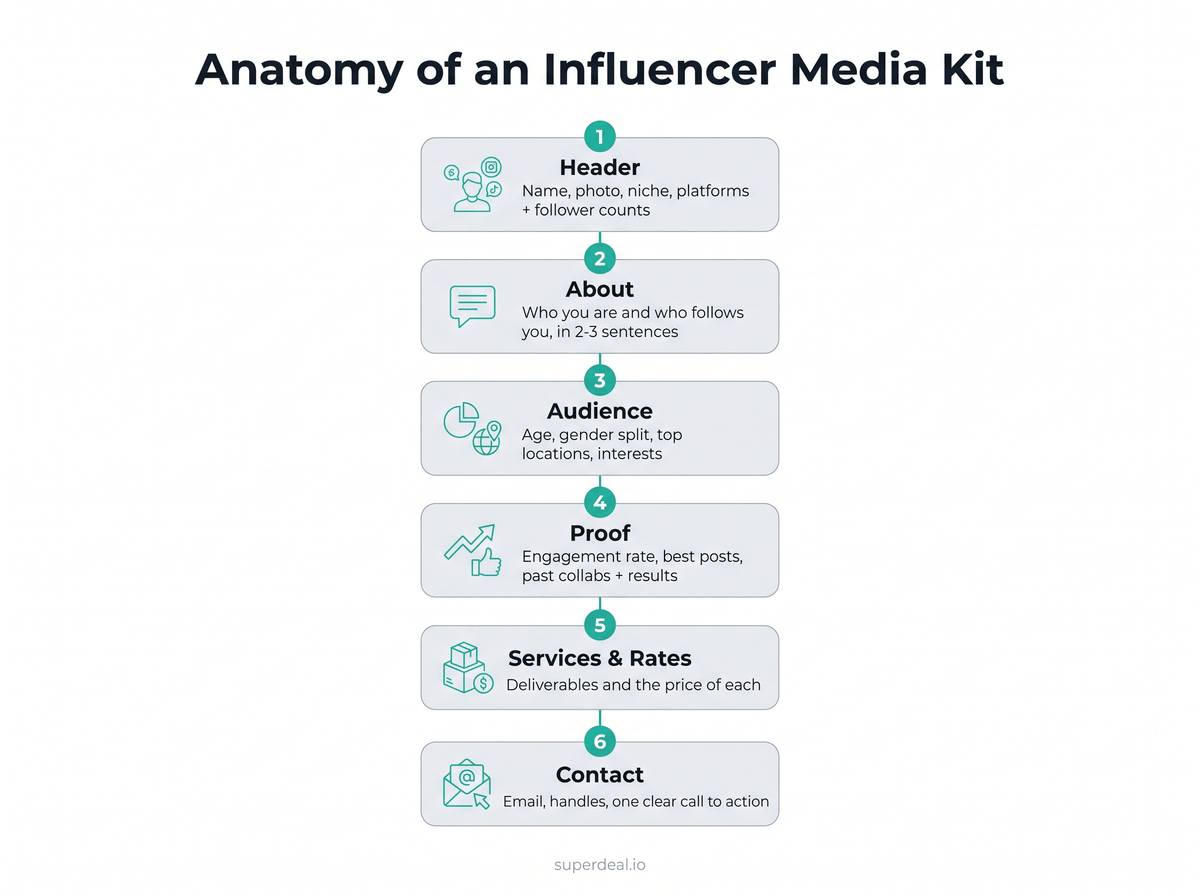
Use this structure as your media kit template: a header, an about block, an audience block, a proof block, a services-and-rates block, and a contact block, in that order. Copy the skeleton and drop your own numbers into each part.
Header. Name or handle, photo, niche, and the platforms you are pitching, with follower counts.
About. Two or three sentences on who you are, who follows you, and why brands work with you.
Audience. Demographics per platform: age, gender, top locations, main interests.
Proof. Engagement rate, two to four content examples, and past brand collaborations with results.
Services and rates. Your deliverables and the price of each, or a starting-from figure.
Contact. Email, handles, and a one-line call to action.
That order is deliberate: it moves a brand from "who is this" to "what does it cost" in the sequence they actually decide.
Influencer Media Kit Examples: Strong vs Weak
A strong media kit example leads with a specific audience and hard numbers; a weak one leads with adjectives and buries the stats. You do not need a famous name to have a strong kit. You need clarity.
A strong kit reads like this: "28,000 followers on TikTok, 61% women aged 25 to 34, mostly in the US and Canada, 7.2% average engagement, niche is budget home cooking." A brand knows in five seconds whether that is their audience. It shows two recent videos, one past collaboration with a view count, three clear deliverables, and a rate. It is current, it is honest, and every claim is checkable.
A weak kit does the opposite. It opens with "passionate storyteller and lifestyle guru," merges four platforms into one big follower number, hides the engagement rate, shows no demographics, lists no rates, and offers no proof of past work. It looks designed but says nothing a brand can act on, so it gets ignored. To see the pattern done right, browse profiles in the Superdeal creator directory.
Common Media Kit Mistakes
Vanity metrics only. A big follower count with no engagement rate reads as a warning, not a flex.
No niche. "I cover everything" tells a brand you match no one in particular.
Stale numbers. Outdated stats are the fastest way to lose trust; brands assume the worst about a kit that looks old.
No rates. Leaving out price invites lowball offers and endless back-and-forth.
No proof. No past work and no results means the brand is taking a pure gamble on you.
Too long. Five pages of everything you have ever done buries the numbers that matter. Keep it to three pages at most.
How Often Should You Update Your Media Kit?
Update your media kit at least once a month, and always right before you pitch. Your follower count, engagement rate, best content, and past collaborations all change constantly, and the gap between your PDF and your real profile grows every week you leave it alone. A brand that spots one stale number starts doubting all of them.
This is the quiet problem with the classic PDF media kit: it starts aging the moment you export it. The fix is to keep your numbers somewhere that updates itself, so "current" is the default instead of a monthly chore. Keeping your stats and terms in one place is the kind of admin a creator's brand-deal workflow should automate rather than absorb.
The Media Kit That Updates Itself
A static file will always drift out of date. A live creator profile does not.
Superdeal is the AI manager for creators, and a free Superdeal profile doubles as a live media kit: it pulls your stats, audience, content, and rates into one always-current page that brands can find and check without emailing you first. Because the profile is indexable, it also works for the newer kind of buyer: the AI agents that brands now use to shortlist creators can read it directly. Your numbers stay fresh on their own, your rates are stated up front, and the contract and payment are built in behind it.
A complete, current profile tends to field more qualified brand offers than a static PDF that gets refreshed a few times a year, simply because brands can verify everything before they write to you.
You still keep a PDF for the brand that asks for an attachment, but your day-to-day pitching asset becomes a link that is never out of date.
Frequently Asked Questions
1. What is a media kit for influencers?
A media kit for influencers is a short, one-to-three-page document (or a live web page) that summarizes a creator's audience size, demographics, engagement rate, content examples, past brand collaborations, services, and rates. Creators send it to brands when pitching a paid partnership, so the brand can judge fit and price at a glance.
2. What should an influencer media kit include?
Ten elements: a short bio, your niche, your platforms and follower counts, audience demographics, your engagement rate, two to four content examples, past collaborations with results, your services or deliverables, your rates, and clear contact details with a call to action.
3. How do I create a media kit if I am just starting out?
Pull your current stats from each platform's native analytics, write a one-line niche bio, calculate your engagement rate, show your two or three best posts, and list your rates and contact. You do not need a huge following. A small, engaged, clearly defined audience with honest numbers pitches better than a big vague one.
4. Is there a free influencer media kit template?
Yes. Use the six-block structure in this guide, header, about, audience, proof, services and rates, and contact, as a free template in any document or design tool. A free Superdeal creator profile also works as a ready-made, always-updated media kit you can share with a link.
5. How often should I update my media kit?
At least monthly, and always before sending a pitch. Stats and best content change fast, and outdated numbers cost you trust. A live profile that updates automatically removes the manual refresh entirely.
About the figures here: engagement-rate and follower ranges are industry-representative estimates, not fixed thresholds. Actual numbers vary by platform, niche, and how engagement is measured.