How Do Influencers Manage Collaborations? The Creator System
The end-to-end system creators use to manage brand deals - triage offers, vet brands, negotiate rates, sign contracts, and get paid safely.

Founder & CEO, Superdeal
Landing brand deals is one skill. Managing them is a different one, and it kicks in the moment your inbox starts filling with offers. Influencers manage collaborations by running the same repeatable process on every offer: triage the inbound, vet the brand, agree a rate for the full scope, put the deliverables and deadlines in a signed contract, secure the payment before posting, and keep every open deal in one tracker. The creators who stay calm through a busy month just refuse to treat each deal as a one-off. This guide is that process, step by step, with a checklist you can copy and a way to automate the whole thing. If you are still landing your first partnerships, start with how to get brand deals first, then come back here for what happens after the "yes."
The Seven-Step System, at a Glance
Every well-run collaboration moves through seven stages, and the creators who scale run all seven the same way every time. Skip one and it comes back as an unpaid invoice or a scope you cannot deliver. The seven stages: triage the offers, vet the brand, set and negotiate the rate, scope the deliverables and deadlines, sign a contract, invoice and get paid safely, and track every deal in one place.
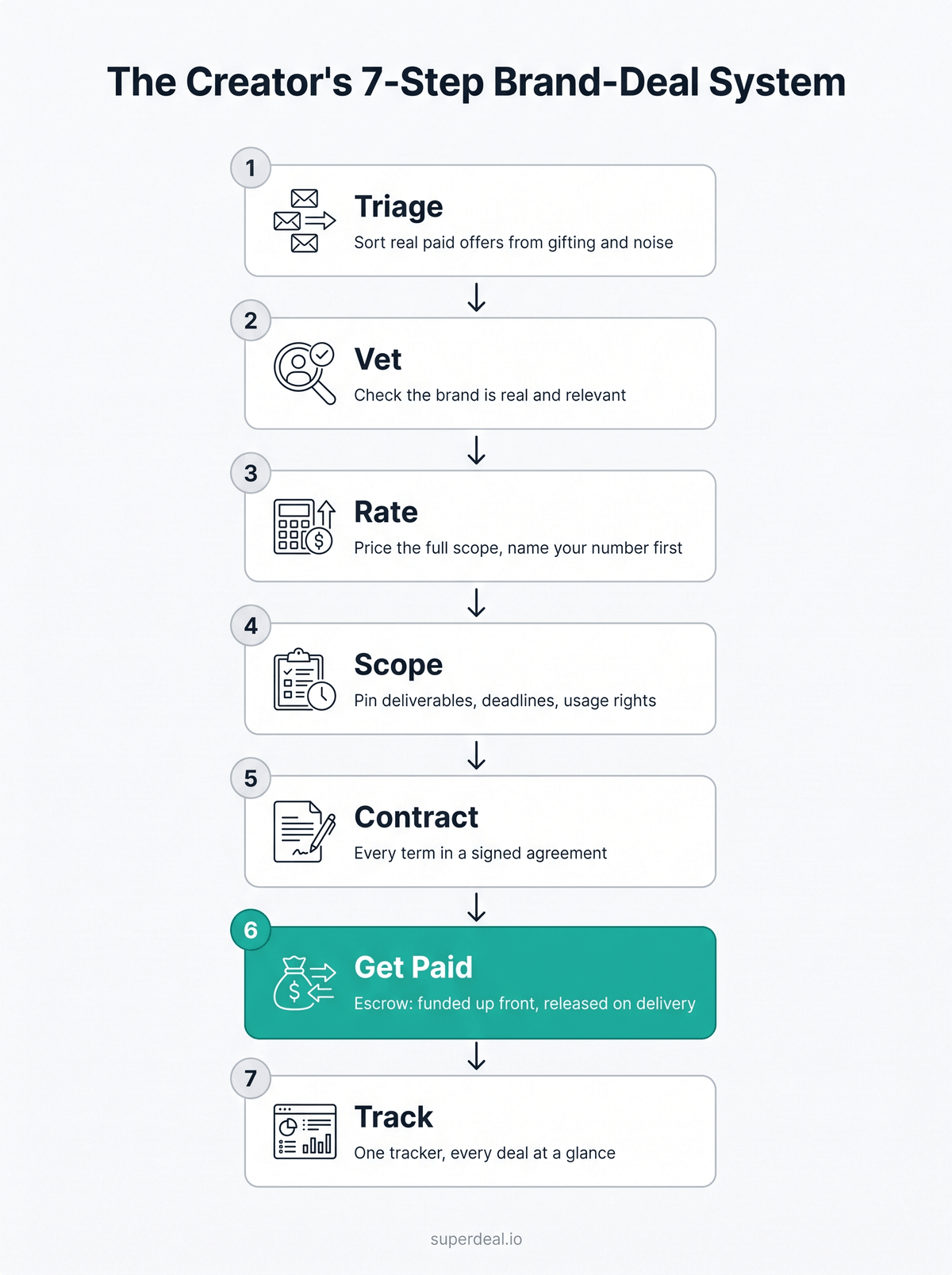
Step 1 - Triage the Inbound Offers
Triage means sorting a full inbox into three piles - real paid offers, gifting-only pitches, and noise - before you reply to anything. A message that says "we love your content, let's collaborate" with no budget and no ask is a lead, not a deal. Sort each one fast: is there money on the table or only free product; is the brand relevant to your niche; is this a personal note or a mass blast. Reply quickly to real paid offers while interest is warm, batch the gifting ones for a weekly pass, and let the "great exposure" pitches go. For most creators, the bulk of inbound is gifting-only or off-brand pitches rather than paid offers ready to negotiate.
Step 2 - Vet the Brand Before You Reply
Vetting is a five-minute background check with two questions: is this brand a fit for my audience, and can it actually pay on time? Fit comes first: would you use the product, and does it clash with an existing partner or an exclusivity you already signed. Then confirm the brand is real: a working website, active socials, and a named human on a company email, not an anonymous free account. Watch the early red flags, because they predict how payment will go: pressure to skip a contract, "we will pay after the post performs," or any request for your banking logins. A brand that resists a simple contract or a deposit is telling you something.
Step 3 - Set Your Rate and Negotiate
Name a specific number first, price the entire scope rather than the follower count, and treat the brand's opening offer as a starting point. Know your base rate per deliverable before anyone asks. A Reel a brand can run as a paid ad is worth far more than a single organic story, so price by deliverable and rights, not audience size alone. The usual add-ons that raise the fee: usage or whitelisting rights, exclusivity, extra platforms, and rush timelines. When a brand leads low, counter with your rate and a reason - audience fit, past performance, the number of deliverables - and bundle instead of discounting, adding a deliverable rather than dropping the price. A current media kit and a set rate card do the pitching for you.
Step 4 - Scope the Deliverables and Deadlines
A deliverable is only clear when it names the format, the platform, the count, the dates, the revision limit, and who owns the content afterward. "One Instagram post" is not a scope; it is an argument waiting to happen. Write it as something a stranger could execute: one in-feed Reel plus a three-frame story set, draft due on a set date, live on another, one round of revisions, and the brand may reuse the content for thirty days of paid ads. Pin down the exclusivity window if there is one - thirty to ninety days is common - and whether you are posting to your own channel or delivering content only. A content-only arrangement is a UGC creator deal, where you hand over the footage and the rights differ from posting on your own feed.
Step 5 - Get It in a Contract
No signed agreement, no content. A one-page contract locks the rate, the scope, the payment terms, and the disclosure both sides are legally on the hook for. Every paid collaboration needs it in writing, even a short version. Cover the parties, the deliverables and dates, the fee and payment terms (deposit, net-30, a late fee), usage rights and exclusivity, a revision cap, and a kill fee if the brand cancels. Disclosure is not optional: the FTC's Endorsement Guides require you to clearly label any paid or gifted partnership, and the FTC holds the creator responsible regardless. Start from a proven influencer contract template and run every deal past an influencer contract checklist so nothing important slips through.
Step 6 - Invoice and Get Paid Safely
The safest structure secures the money before you post: a deposit up front, or the full fee held in escrow and released when the deliverable is approved. The biggest risk in a brand deal is not a low rate, it is doing the work and never getting paid. Protect yourself with a deposit before production (fifty percent is common) or a hold-and-release setup: the brand funds the deal up front and you are paid on approval, so the money cannot simply vanish. Send a clean invoice with your business name, the deliverables, the agreed fee, the terms (net-30 is standard), and a due date, and enforce the late fee you wrote into the contract. Set money aside for taxes too: brand-deal income is self-employment income, which in the US usually means a 1099-NEC and quarterly estimated payments, covered in the IRS self-employed tax center.
Step 7 - Track Every Deal in One Place
Managing several collaborations is a pipeline problem: each open deal needs a status, a rate, a due date, and a paid-or-unpaid flag you can see at a glance. Once you are running more than two or three at a time, memory and a cluttered inbox stop working. Build one simple tracker - a spreadsheet or a board - with a row per deal and columns for the brand, the contact, the status (pitched, negotiating, signed, in production, delivered, invoiced, paid), the rate, the deliverables, the key dates, and the payment status. Update it whenever anything moves. That habit is the difference between catching a late invoice on time and finding it a month late. Superdeal platform can supply the tracker, the invoice, and the media kit if you would rather not build each one yourself.
The Creator's Deal-Management Checklist (Copy This)
Run every collaboration through the same short checklist and you will never wing a deal again. Pin it in your notes app or paste it at the top of your tracker:
Is this a real paid offer, or only gifting or exposure?
Does the brand fit my audience, and can it pay on time?
Have I quoted a specific rate for the full scope, not just the post?
Are the deliverables, dates, revisions, and usage rights written down?
Is there a signed contract with FTC disclosure in it?
Is a deposit or escrow in place before I publish anything?
Is the deal logged in my tracker with a clear paid-or-unpaid status?
Answer yes to all seven and the collaboration is under control. Any "no" is where it is most likely to go wrong.
Or Let an AI Manager Run the System for You
Everything above is what a talent manager does for a ten to twenty percent cut. An AI manager does it for free. The seven-step system works, but running it well is a second job on top of making content. That is the gap Superdeal closes. Its AI manager watches your inbox and flags the real brand offers while filtering the noise (Step 1), drafts replies that quote your rate (Steps 2 and 3), turns the agreement into a contract with disclosure built in (Steps 4 and 5), and holds the brand's payment in escrow until you deliver, so you keep one hundred percent with no manager commission (Step 6). Every deal stays visible in one view (Step 7). Brands also find you through Superdeal's free, indexable creator database, so new offers arrive in the same place that manages them.
Frequently Asked Questions
1. How do influencers manage collaborations?
Influencers manage collaborations by running every brand offer through the same system: triage the inbound to find the real paid offers, vet the brand for fit and ability to pay, agree a rate for the full scope, put the deliverables and deadlines in a signed contract, secure payment with a deposit or escrow, and track every open deal in one place.
2. How do creators keep track of multiple brand deals at once?
With a simple pipeline. Creators use a spreadsheet or a board with one row per deal and columns for the brand, the contact, the status (pitched, signed, in production, delivered, invoiced, paid), the rate, the deliverables, the key dates, and the payment status. Updating it whenever a deal moves prevents missed deadlines and unpaid invoices once you juggle more than two or three at once.
3. How do you negotiate a brand deal as a creator?
Quote a specific rate first, price the full scope rather than the follower count, and treat the brand's opening number as a starting point. Charge extra for usage rights, exclusivity, added platforms, and rush timelines. When a brand pushes back on price, bundle in an extra deliverable instead of discounting, and anchor your rate to audience fit and past performance.
4. What should be in a brand deal contract?
A collaboration contract should name both parties, the exact deliverables and dates, the fee and payment terms (deposit, net-30, late fee), usage rights and any exclusivity window, a revision cap, a kill fee if the brand cancels, and FTC disclosure language. A proven template plus a contract checklist keeps anything important from slipping.
5. How do influencers get paid safely?
The safest setup secures the money before the content goes live: a deposit up front, commonly fifty percent, or the full fee held in escrow and released when the deliverable is approved. Send a clean invoice with net-30 terms and a due date, and set a late fee. Brand-deal income is self-employment income, so set aside a portion for taxes.
6. Do you need a manager to handle brand deals?
No. A traditional talent manager handles offers, negotiation, contracts, and payment for a ten to twenty percent cut, but a creator can run the same system solo, and AI tools now automate most of the work. Superdeal's AI manager filters your inbox, drafts replies with your rates, builds the contract, and holds payment in escrow, so you keep one hundred percent with no commission.
Figures in this guide - deposit percentages, exclusivity windows, payment terms - are industry-representative conventions, not fixed rules or a Superdeal price list, and vary by niche, platform, and geography. Tax treatment is general information, not tax advice.