How to Build a UGC Portfolio With No Clients
Brands want samples before they hire you, but you cannot get samples without clients. You can - using products you already own. Here is how to build a UGC portfolio from scratch, what to put in it, and where to host it.

Founder & CEO, Superdeal
If you're aiming to become a UGC creator, you've probably faced the same challenge many newcomers encounter: brands ask to see examples of your work, but you don't have any paid projects yet.
This catch-22 can make launching your career seem daunting. Without clients, it's hard to assemble a portfolio, and without a portfolio, it's tough to land clients.
Fortunately, your initial UGC portfolio doesn't need to feature paid collaborations. You can produce compelling sample content on your own, using items you already have at home. This approach is actually one of the best ways to demonstrate your skills to brands before you've built a client roster.
In this guide, you'll learn how to start building a UGC portfolio from the ground up, what elements to include, where to showcase it, and strategies to make sure it appeals to brands rather than just being visually attractive.
What Is a UGC Portfolio?
A portfolio is a selection of your top user-generated content samples designed to show brands what you can produce. Unlike an influencer's social media page, it focuses less on follower count and more on your skill in making authentic, valuable content that brands can use for their marketing needs.
When a brand opens your portfolio, it wants to quickly answer questions like:
Can this creator make videos that feel natural?
Does this person understand how to demonstrate a product?
Can they speak comfortably on camera?
Can they follow a concept or brief?
Does their filming and editing look clean?
Can they create different types of content?
Would their style make sense for our product?
Your portfolio should make those answers easy to find. That means you do not need dozens of samples. You need a handful of good ones that demonstrate your skills.
If you are still learning the basics of the profession, start with this guide to and how the work differs from influencing. You can also read more about if you are starting from square one.
UGC Portfolio vs. Media Kit: They Are Not the Same Thing
It is easy to see the two terms used together and assume they mean the same thing. They do not.
Your portfolio shows your work. It contains actual videos or photos you have created and gives brands an idea of what you could make for them.
A media kit shows information about you as a creator. It may include your audience demographics, follower counts, engagement information, previous partnerships, services, and rates. For UGC, your portfolio is especially important because brands are hiring you to create content. They need to see the content first.
If you eventually need a media kit, you can learn more in this guide to . For now, keep your focus on building actual samples.
How to Create UGC Samples Without Clients
You don't need to wait for a brand to hire you before you start making UGC.
Start by creating spec work, which is sample content that demonstrates what you could create for a brand. You're not claiming the brand hired you; you are simply using a real product as the subject of your sample.
Your kitchen, bathroom, closet, or makeup bag probably contains several potential portfolio pieces already.
Start with Products You Already Own
Look around your home and choose products that give you something to demonstrate.
Good options include:
Skincare and beauty products
Haircare products
Clothing and accessories
Kitchen gadgets
Food and beverages
Home organization products
Cleaning products
Fitness accessories
Pet products
Apps or digital products you already use
Books and stationery
Everyday household items
Think about the type of content you could make for each product.
A moisturizer can be featured in various formats, including testimonial-style videos, unboxings, routine demonstrations, or problem-and-solution presentations. Likewise, a kitchen gadget may be suited for demonstrations or voiceover tutorials.
Selecting an expensive product is not necessary. Rather, it is important to choose an item that allows you to effectively showcase your content creation abilities.
Choose a Few Niches Instead of Everything
You don't need to settle on a single niche before assembling your first portfolio. However, presenting content that lacks a clear connection can leave your portfolio feeling unfocused.
Select two or three categories you truly know well or enjoy creating. You might, for example, concentrate on beauty, wellness, and lifestyle.
Your objective isn't to persuade brands that you can promote every product imaginable. Instead, you want to help the right brands easily envision you producing content for them.
How to Build a Portfolio From Scratch
Here is a simple process you can follow without spending much money.
1. Choose three to five products
Start with products you already own. Pick products that have enough features, benefits, or uses to give you something interesting to demonstrate.
Don't worry about whether the companies are well-known. Your first samples are about showing your skills above all else.
2. Plan different video concepts
Do not film five nearly identical product videos. You need to give each sample a different purpose.
You could create:
A problem-and-solution video
A product demonstration
A testimonial-style video
An unboxing
A voiceover video
A "three things I like about this" video
A tutorial
This gives your portfolio more variety without requiring a huge amount of content.
Need more ideas? This guide to can help you plan your samples.
3. Write a simple hook
The first few seconds of a UGC video matter. Your opening should give the viewer a reason to keep watching. That might mean identifying a problem, asking a question, showing the product in use, or immediately demonstrating the result.
For example:
"If your bathroom counter is always a mess, this little organizer might fix it."
That is more useful than beginning with a long introduction about who you are.
4. Film vertically
For most short-form UGC video, vertical 9:16 footage is the safest format to demonstrate.
Film with your phone and pay attention to lighting, framing, background noise, and what is visible behind you. Natural window light can work extremely well, so you won't need to buy professional lighting equipment just yet.
Your footage doesn't need to look like a TV commercial. It should look polished enough to be useful while still feeling like something a real person would watch.
5. Edit the video
Trim unnecessary pauses and keep the pacing moving. Add captions if they make the video easier to follow. You can edit on your phone using tools you already have access to or use a free design and editing platform such as .
Just make sure to keep your editing clean. Your first portfolio does not need elaborate transitions or special effects.
6. Create a simple portfolio page
Put your strongest samples somewhere a brand can access them without having to download a file or dig through your social media profiles.
A simple portfolio can be a webpage, a public document, or a free creator profile. The important thing is that the link works on a phone and takes the brand directly to your work.
7. Start with six to eight strong pieces
You don't need 30 videos before you start pitching. Focus more on quality and less on quantity.
Six to eight solid samples can give you enough room to demonstrate different formats, products, and skills. If you only have three genuinely good pieces right now, start with three and continue building.
Quality matters more than padding the portfolio with work you would not want a brand to see.
What Should a Single UGC Portfolio Piece Include?
Each sample should make it obvious what the brand is looking at.
A useful portfolio entry might include:
The video: Your actual finished sample
Content type: For example, testimonial, product demo, voiceover, or unboxing
Hook: A short description of the opening concept
Product: What you are demonstrating
Delivery format: For example, talking-head video, voiceover, or lifestyle footage
Format: Usually vertical 9:16 for short-form video
Optional context: A sentence explaining the creative idea
There is no need for a long explanation underneath every video. The work should speak for itself.
If you create photo UGC, include the finished photos in a clean gallery. If you create multiple variations of the same concept, choose the strongest version.
How Many UGC Samples Should You Have?
Starting out with six to eight high-quality pieces is reasonable. As you gain more experience, you can broaden your portfolio and eventually showcase 10 to 15 top-notch samples that span different formats and topics.
Resist the urge to add pieces just to make your portfolio appear more complete. If you include 15 examples but five are noticeably weaker, those less impressive samples may diminish your overall reputation. A concise portfolio filled with strong work is more convenient for brands pressed for time to evaluate.
Should You Show Multiple Niches?
Yes, but with some restraint. If you want to work with beauty brands, showing several strong beauty examples makes sense. You can also include adjacent lifestyle content that demonstrates skills those brands might use.
What you should avoid is a portfolio that jumps from makeup tutorials to car repair, pet food, finance apps, camping equipment, and children's toys without any clear reason.
You want variety in your content skills, not confusion about what kind of creator you are.
Where Should You Host Your Portfolio?
There is no single correct answer. Choose the option that is easy for you to maintain and easy for a brand to open.
A Simple Website
A UGC portfolio website can give you a professional-looking home for your samples. You can create a simple page with your introduction, selected work, and basic information about the types of content you create.
The downside is that a website can take more time to build and maintain than you actually need at the beginning.
A Public Document or Design Page
A simple public page can work perfectly well if it loads quickly and puts your videos near the top. This is a good option if you want to start immediately rather than spend days designing a website.
A Public Creator Profile
A free public creator profile can serve a similar purpose while also making your work discoverable.
Superdeal, for example, allows creators to build a that brands can find. That means your portfolio does not have to exist only as a link you send in a pitch. Your profile can also give brands a way to discover your work on their own.
Whatever you choose, test the link from your phone before sending it to anyone. A portfolio that looks great on a laptop but is difficult to navigate on a phone creates unnecessary friction.
How to Present Your Portfolio in a Pitch
Do not make the brand hunt for your work.
A simple pitch might say:
Hi [Brand Name], I create short-form UGC focused on beauty and lifestyle products. I loved the way you showcase [specific product], and I created content in a similar style. You can view a few examples of my work here: [portfolio link].
That is enough. You do not need to explain that you have never had a paid client. Your samples already demonstrate what you can do.
You can also link directly to a relevant portfolio sample when possible. If you are pitching a skincare company, send them to your strongest skincare example rather than making them scroll through every piece you have created.
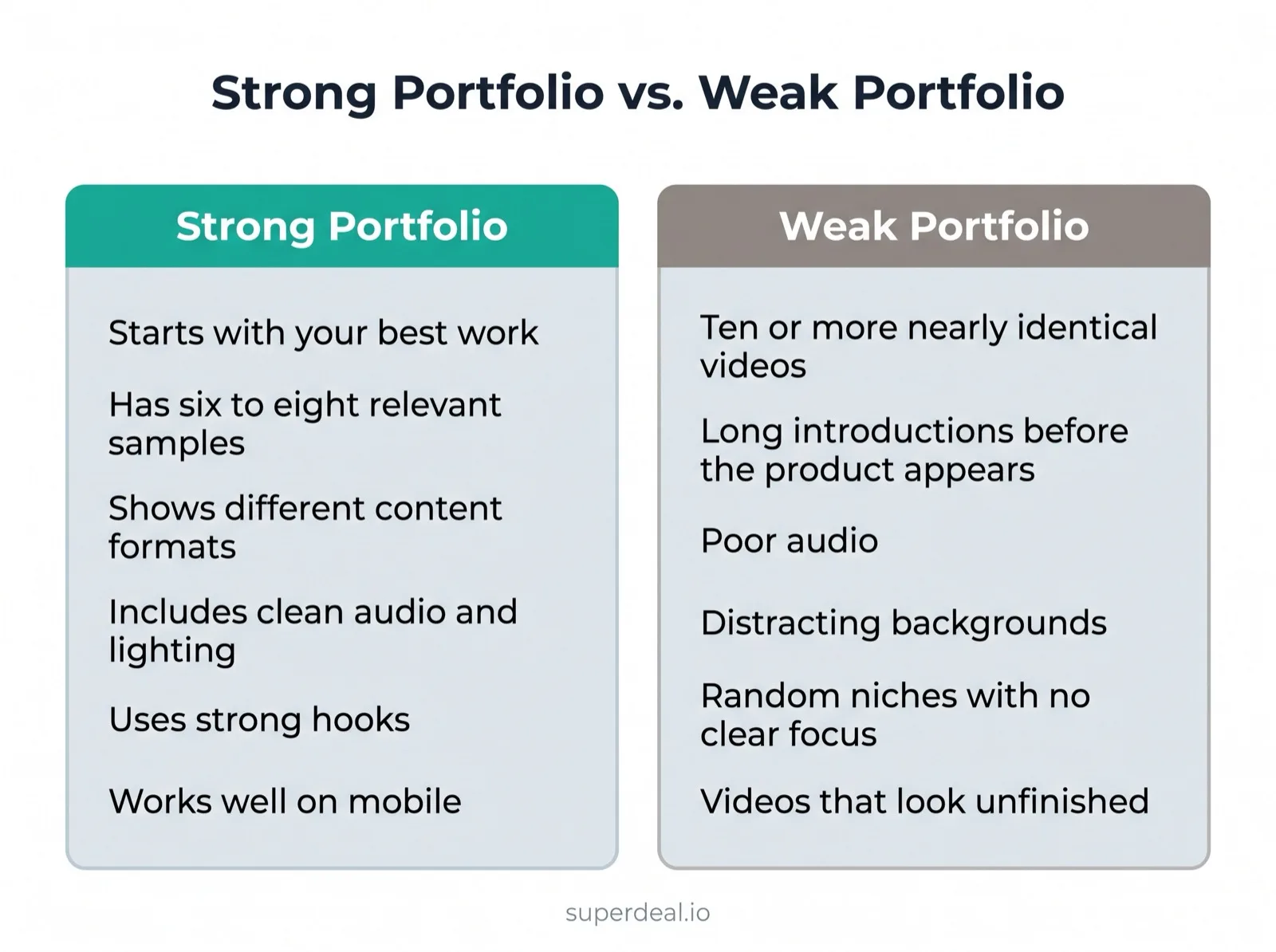
Strong Portfolio vs. Weak Portfolio
The difference is usually not how expensive the portfolio looks. It is how quickly a brand can understand the creator's ability.
A Strong Portfolio
A strong portfolio:
Starts with your best work
Has six to eight relevant samples
Uses clear, readable organization
Shows different content formats
Includes clean audio and lighting
Demonstrates products naturally
Uses strong hooks
Works well on mobile
Makes the creator's strengths obvious
Keeps weaker work out
Imagine a brand manager opens your portfolio on their phone. Within a few seconds, they can play a video, understand what type of content it is, and decide that your style could work for their product.
That's the goal.
A Weak Portfolio
A weak portfolio often has:
Ten or more nearly identical videos
Long introductions before the product appears
Poor audio
Distracting backgrounds
Broken or difficult-to-open links
Samples buried beneath a long biography
Random niches with no clear focus
Videos that look unfinished
Generic descriptions instead of actual examples
One of the biggest mistakes is treating the portfolio like a personal scrapbook. Brands are not opening it to learn everything about your life. They are opening it to see what you can make.
Common Portfolio Mistakes to Avoid
Making the portfolio all about you
A short introduction is useful, but your work should take up most of the space.
Using only one content style
If every sample is a talking-head testimonial, a brand cannot tell whether you can create voiceovers, demonstrations, or lifestyle footage.
Waiting for perfect equipment
Your phone, decent lighting, and a quiet place to record are enough to begin.
Copying trends without showing a skill
A trending format can be useful, but make sure the sample still demonstrates something a brand could hire you to do.
Including every sample you have ever made
Your portfolio is a highlight reel, not an archive.
Making false client claims
If you created a sample using a product you bought yourself, label it as sample or spec content if needed. Never imply that a company hired or sponsored you when it did not.
When Should You Update Your Portfolio?
Update your portfolio whenever you create a noticeably stronger sample. You should also remove older work when it no longer represents the quality you can produce.
Once you start getting paid projects, your portfolio can gradually shift toward your strongest client work. You do not need to keep every early sample forever.
A good habit is to review your portfolio every month or two. Ask yourself:
Is my best work at the top?
Do my samples still reflect the niches I want?
Am I showing enough variety?
Is anything noticeably weaker than the rest?
Does the link still work properly on mobile?
Would a brand understand my strengths within a minute?
If the answer to any of those questions is no, make the change.
Portfolio Checklist
Before you start sending your portfolio to brands, make sure it includes:
Six to eight strong starting samples, or fewer if you are still building
Different UGC formats
Clear hooks
Product demonstrations or other useful product-focused content
Vertical 9:16 video samples where appropriate
Clean audio
Good lighting
Simple, uncluttered presentation
Two or three related niches rather than an unfocused collection
Your strongest sample near the top
A portfolio link that works on mobile
Clear labeling of sample or spec work when appropriate
No exaggerated or invented client experience
A short introduction that does not overshadow the work
FAQ
Can I make a UGC portfolio with no experience?
Absolutely. A portfolio with no experience can be built using spec work. Choose products you already own and create samples that demonstrate different content styles. You do not need paid campaigns before you can show brands what you can make.
How many videos should I put in my UGC portfolio?
Start with around six to eight strong pieces. You can add more as your skills and experience grow, but there is no benefit to filling your portfolio with repetitive or weak samples.
What should I use as a UGC portfolio template?
A simple UGC portfolio template can be as straightforward as an introduction, followed by your best samples, the content type for each sample, and a way for brands to view your work. There is no need for an elaborate design. The portfolio should make your content easy to watch.
Do I need a UGC portfolio website?
No. A portfolio website can be useful, but it is not required. A simple public page or creator profile can work just as well if it is easy to open, easy to navigate, and puts your work front and center.
Where can I find UGC portfolio examples?
Exploring examples of portfolios can give you insight into how creators showcase their work. Just remember, you don't need to copy anyone's design. Focus instead on how well the samples highlight the various skills involved. Look specifically for UGC creator portfolio examples that feature real video samples, rather than those that mostly display follower counts or audience statistics.
Start Building Your Portfolio This Week
You don't need a client to start building your UGC portfolio. Choose three products from your home, create several different concepts, film them vertically, edit your strongest takes, and put the finished pieces somewhere a brand can easily view them. That gives you something much more useful than waiting for an opportunity to appear. You have actual work to show.
And once your samples are ready, you can create a and give brands another way to discover you. Instead of treating your portfolio as something you only send when pitching, your public profile can put your work in front of brands that are already looking for creators.
Start with what you have, make a few genuinely good samples, and improve the portfolio as you go.