Affiliate Agreement Template for Brands and Creators (Free)
A free affiliate agreement template for brands and creators: commission, tracking, cookie window, payouts, promotion rules and FTC disclosure, plus what to check before you sign.

Founder & CEO, Superdeal

Updated October 10, 2026.
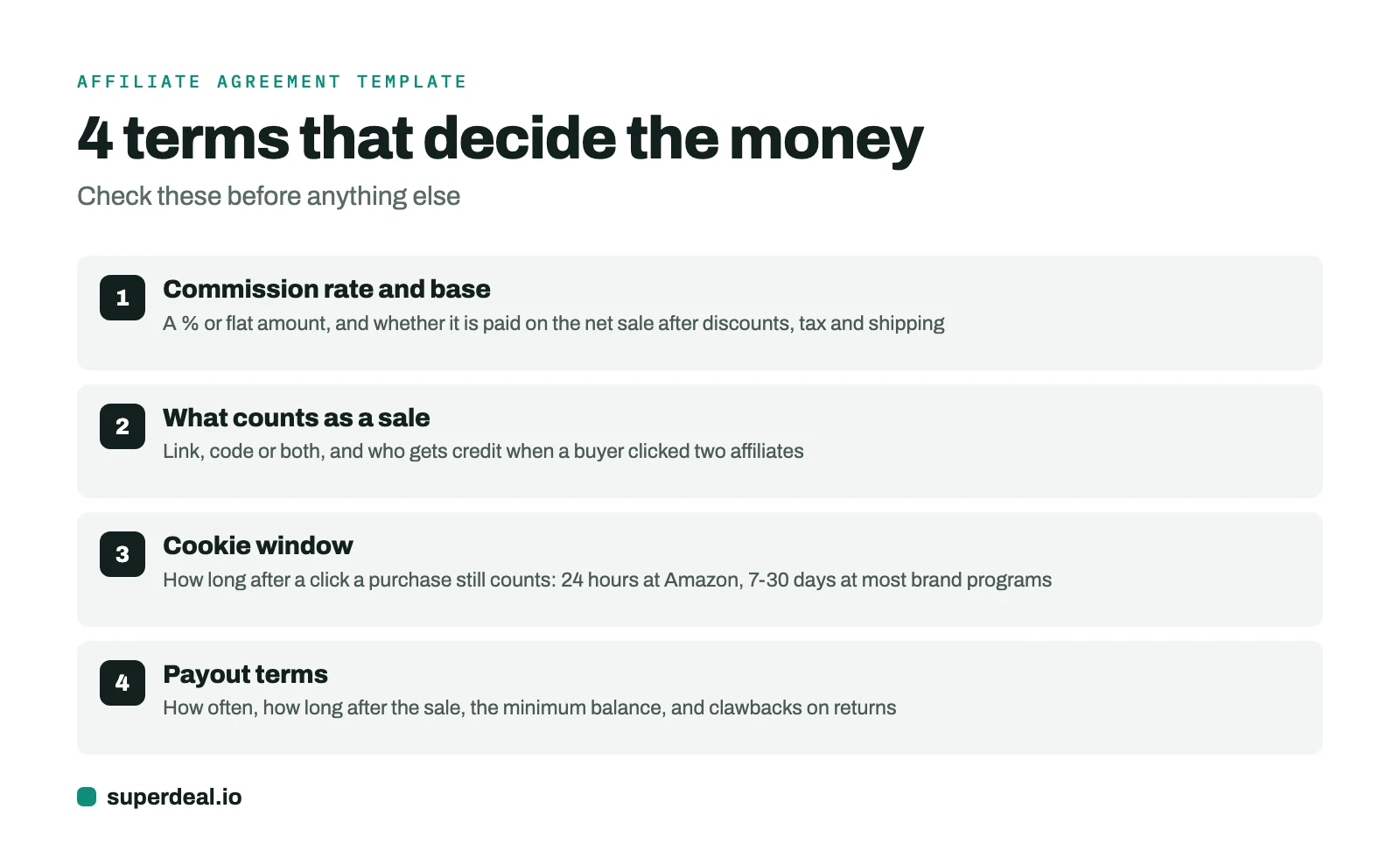
TL;DR. An affiliate agreement is the contract that sets how a creator or partner earns commission on sales they send to a brand. The money is decided by four terms: the commission rate, what counts as a sale, the cookie window, and when payouts happen.
Get the free template as a Google Doc, or copy it from below. Written for brands working with creators and influencers.
Creators: check the six terms in the "before you sign" list. Returns and payout thresholds are where commission quietly disappears.
Brands: a clear agreement keeps affiliates from bidding on your brand name or posting your code on coupon sites.
👉 Find creators for your affiliate program on Superdeal. Free creator database, search by niche.
An affiliate agreement (also called an affiliate marketing agreement or affiliate contract) is a written deal between a brand and a partner who promotes its products for a commission. The partner gets a tracking link or discount code, and earns a percentage or a flat amount on each sale it brings in. If a creator is earning commission from your brand, you need one, even if there is no flat fee involved.
What Is an Affiliate Agreement?
It is the rulebook for a pay-per-sale partnership. It covers:
How sales are tracked (link, code or both)
How much the affiliate earns, and on what amount
When and how they get paid
What they can and cannot do when promoting the brand
How either side can end the partnership
Big retailers publish one standard agreement that every affiliate accepts online. Smaller brands working with a handful of creators usually send their own, and that is where the template below comes in.
Affiliate Agreement vs. Influencer Contract
They solve different problems:
Influencer contract: the brand pays a flat fee for specific content (two Reels by June 10). See our influencer contract template.
Affiliate agreement: the creator earns only when people buy. No content is required, though most brands set rules for it.
Hybrid deal: a flat fee for the content plus commission on sales. More and more creator deals look like this. Use both documents, or one contract with an affiliate section added.
What to Include in an Affiliate Agreement (10 Clauses)
1. Parties and program
The brand's legal company name, the affiliate's name (or their LLC), and the name of the program. Add the start date.
2. Commission rate and base
The percentage or flat amount per sale, and what it is calculated on. Most agreements pay on the net sale: after discounts, taxes, shipping and returns. Spell it out, because "10% of sales" means very different money depending on the base.
3. Tracking and attribution
How a sale gets credited: unique link, unique discount code, or either. Then the cookie window, the number of days after a click in which a purchase still counts. Windows vary a lot: Amazon's associate program counts most purchases only within 24 hours, while many direct brand programs use 7 to 30 days. Also state what happens if a buyer clicked two affiliates' links. Most programs credit the last click.
4. Payment terms
When commission is paid (monthly is common), how long after the sale (often 30 days or more, so returns can clear), the minimum balance before a payout, and the payment method. Include what happens to commission on orders that are returned or charged back.
5. Promotion rules
What the affiliate may do and may not do. Common rules: no bidding on the brand's name in search ads, no posting codes on coupon sites, no claims the brand cannot back up, no spam.
6. FTC disclosure
US law requires affiliates to clearly disclose that they earn from their links. Put it in the agreement so both sides are covered. The FTC explains what counts as clear in Disclosures 101 for Social Media Influencers.
7. Use of brand name and logo
A limited permission for the affiliate to use the brand's name, logo and product images while promoting it, and to stop when the agreement ends.
8. Exclusivity
Most affiliate deals are not exclusive: the creator can promote competitors too. If the brand wants exclusivity, it should pay for it, usually with a higher rate or a flat fee.
9. Term and termination
How long the agreement runs and how either side ends it, usually with written notice (7 to 30 days is common). State that commission earned before the end date still gets paid.
10. Independent contractor and liability
The affiliate is not an employee, handles their own taxes, and each side is responsible for its own actions.
Affiliate Agreement Template (Copy and Paste)
This is a starting point, not legal advice. Have a lawyer review it before you use it for a large program.
📄 Get this template as a Google Doc. Open it, then File > Make a copy (or download it as Word) to edit.
AFFILIATE AGREEMENT
This Affiliate Agreement ("Agreement") is made on [date] between [Brand legal name], [address] ("Brand"), and [Affiliate name or company], [address] ("Affiliate").
1. Program. Brand invites Affiliate to promote [products or "all products"] sold at [website] through the [program name] affiliate program.
2. Tracking. Brand will give Affiliate a unique link and/or discount code [code]. A sale is credited to Affiliate when a customer buys within [number] days of clicking Affiliate's link, or uses Affiliate's code at checkout. If more than one affiliate is involved, [the last click / the code used] decides.
3. Commission. Brand will pay Affiliate [percentage]% of the net sale amount, meaning the price paid after discounts and excluding taxes, shipping and gift card purchases. [Optional: a flat bonus of $[amount] after [number] sales in a calendar month.]
4. Returns. No commission is due on orders that are canceled, returned or charged back. If commission was already paid on such an order, Brand may deduct it from the next payout.
5. Payment. Brand will pay commission monthly, [number] days after the end of the month in which the sale was made, by [PayPal / bank transfer / other], once the balance reaches $[amount]. Brand will provide a report of credited sales with each payment [or: Affiliate can see sales in real time at (dashboard)].
6. Promotion rules. Affiliate will not: (a) bid on Brand's name or trademarks in paid search ads; (b) post Affiliate's code on coupon or deal sites; (c) make claims about the products that Brand has not approved; (d) send unsolicited messages or spam; (e) use paid traffic sources without Brand's written OK.
7. Disclosure. Affiliate will clearly disclose the paid relationship in every post, video or page that promotes Brand, as required by the FTC Endorsement Guides and the rules of each platform.
8. Brand assets. Brand gives Affiliate a limited, non-exclusive right to use Brand's name, logo and product images only to promote Brand under this Agreement. This right ends when the Agreement ends.
9. Exclusivity. This Agreement is non-exclusive. [Optional: During the term, Affiliate will not promote competing products in (category), in exchange for (higher rate / flat fee).]
10. Term and termination. This Agreement starts on the date above and continues until either party ends it with [number] days' written notice. Brand may end it immediately if Affiliate breaks section 6 or 7. Commission on valid sales made before the end date will be paid on the normal schedule.
11. Independent contractor. Affiliate is an independent contractor, not an employee or agent of Brand, and is responsible for Affiliate's own taxes.
12. Limitation of liability. Neither party is liable for indirect or lost-profit damages. Brand's total liability under this Agreement is limited to commission owed.
13. Changes. Brand may change commission rates with [number] days' written notice. Changes do not affect sales made before the change.
14. Governing law. This Agreement is governed by the laws of [state].
Signed:
Brand: ______________________ Name, title, date
Affiliate: ______________________ Name, date
What Are Normal Affiliate Terms in 2026?
There is no single standard, but most creator affiliate deals fall in these ranges:
Commission: low single digits at big retailers, where margins are thin. Around 10% to 30% at direct-to-consumer brands. Higher for digital products and subscriptions.
Cookie window: 24 hours at Amazon, 7 to 30 days at most brand-run programs.
Payout: monthly, 30 to 60 days after the sale, often with a minimum balance before payout.
Exclusivity: usually none.
If a brand offers a rate well below these ranges and wants exclusivity too, that is worth pushing back on. Our guide on how to make money as a content creator shows how affiliate income fits with brand deals and other streams.
For Creators: 6 Things to Check Before You Sign
What the percentage is calculated on. Net after discounts, or the full price? Your own discount code may lower your commission.
The cookie window. A 24-hour window means only same-day buyers count.
Returns. How long the brand can claw back commission. 30 to 60 days is normal; six months is not.
The payout minimum. A $100 minimum at a low rate can mean waiting months for your first payment.
Who sees the numbers. You want a dashboard or a monthly report, not "trust us."
Rate changes. The brand should give notice before lowering your rate, and the change should not apply to sales already made.
Also check the influencer contract checklist if the deal includes required posts.
For Brands: How to Run an Affiliate Program With Creators
Pick the creators first. A small group with the right audience beats hundreds of random sign-ups. Look at niche fit and real engagement, not follower count.
Give each creator a code and a link. Codes catch buyers who watched a video and typed your URL later.
Set a fair window and pay on time. Late or unclear payouts are the fastest way to lose your best affiliates.
Mix in flat fees for content you need. Commission alone rarely gets a creator to make new videos for you.
Many creators already run storefronts through programs like the Amazon Influencer Program, so they know how commission works and will read your terms closely.
👉 Search Superdeal's free creator database by niche and send offers directly. Contracts are generated for both sides, and payment is held until delivery.
Affiliate Agreement Template FAQ
What is an affiliate agreement?
A contract between a brand and a partner, such as a creator or publisher, that sets how the partner earns commission on sales they refer, how sales are tracked, when payouts happen, and the rules for promoting the brand.
What should an affiliate agreement include?
At minimum: the commission rate and what it is calculated on, how sales are tracked (link, code, cookie window), payment timing and minimums, what happens with returns, promotion rules, FTC disclosure, and how either side can end it.
What is a normal affiliate commission rate?
It depends on the product. Large retailers usually pay low single digits. Direct-to-consumer brands often pay around 10% to 30%. Digital products and subscriptions can pay more.
Is an affiliate agreement the same as an influencer contract?
No. An influencer contract pays a flat fee for specific content. An affiliate agreement pays commission on sales. Many creator deals combine both.
Do affiliates have to disclose their links?
Yes. In the US, the FTC requires a clear disclosure whenever someone earns from a link or code they share, on every post, video or page.
This template is a starting point and not legal advice. Laws differ by state and country, so have a lawyer review any agreement before you sign or send it.