Instagram Influencer Marketing: Strategy Guide (2026)
A 2026 Instagram influencer marketing strategy: Reels, Stories, and collab posts, the paid-partnership tools, creator vetting, and how to measure ROI.

Founder & CEO, Superdeal
Instagram influencer marketing is partnering with creators to promote your brand through Reels, Stories, feed posts, and collab posts — usually with a paid-partnership label. Instagram remains the highest-intent platform for brand deals because its formats span discovery (Reels) and conversion (Stories and link-in-bio) in one place. This 2026 guide walks through each format and when to use it, Instagram's native branded-content tools, how to find and vet creators, how to brief and contract them compliantly, and how to measure ROI beyond likes — a strategy that drives sales, not just reach.
What Is Instagram Influencer Marketing?
Instagram influencer marketing is paying or partnering with creators to make branded content on Instagram — content that reaches their audience with the trust a brand account cannot buy directly. The creator produces a Reel, Story, feed post, or collab post; the brand gets exposure, engagement, and, done well, sales. That trust is the whole point: people consistently place more weight on recommendations from individuals they follow than on brand advertising, a pattern Nielsen has tracked for years. The exchange can be paid, gifted, affiliate, or a mix.
Instagram still leads for brand deals for a structural reason: it is the one platform where a single creator can move a follower from never having heard of you to tapping a link in one session. A Reel introduces the product; a Story sends warm viewers to a link; a feed post stays searchable for months. Most platforms do one of those jobs. Instagram does all three, which is why brand budgets keep concentrating there — U.S. influencer marketing spend passed the $7 billion mark in 2024 and continues to grow, according to eMarketer.
The mechanics are simple; the strategy is where brands win or waste money, and the rest of this guide is the strategy. If you are still deciding which creators to work with, the biggest lever is tier: smaller accounts with tighter communities often outperform celebrity accounts per dollar. See our micro-influencer guide for why.
Instagram Content Formats and When to Use Each
Choosing the wrong format is the most common way brands waste an influencer budget — a discovery goal needs a Reel, a conversion goal needs a Story, and paying Reel money for a Story deliverable burns reach you never get back. Each format does a specific job in the funnel. Match the format to the goal before you brief a single creator.
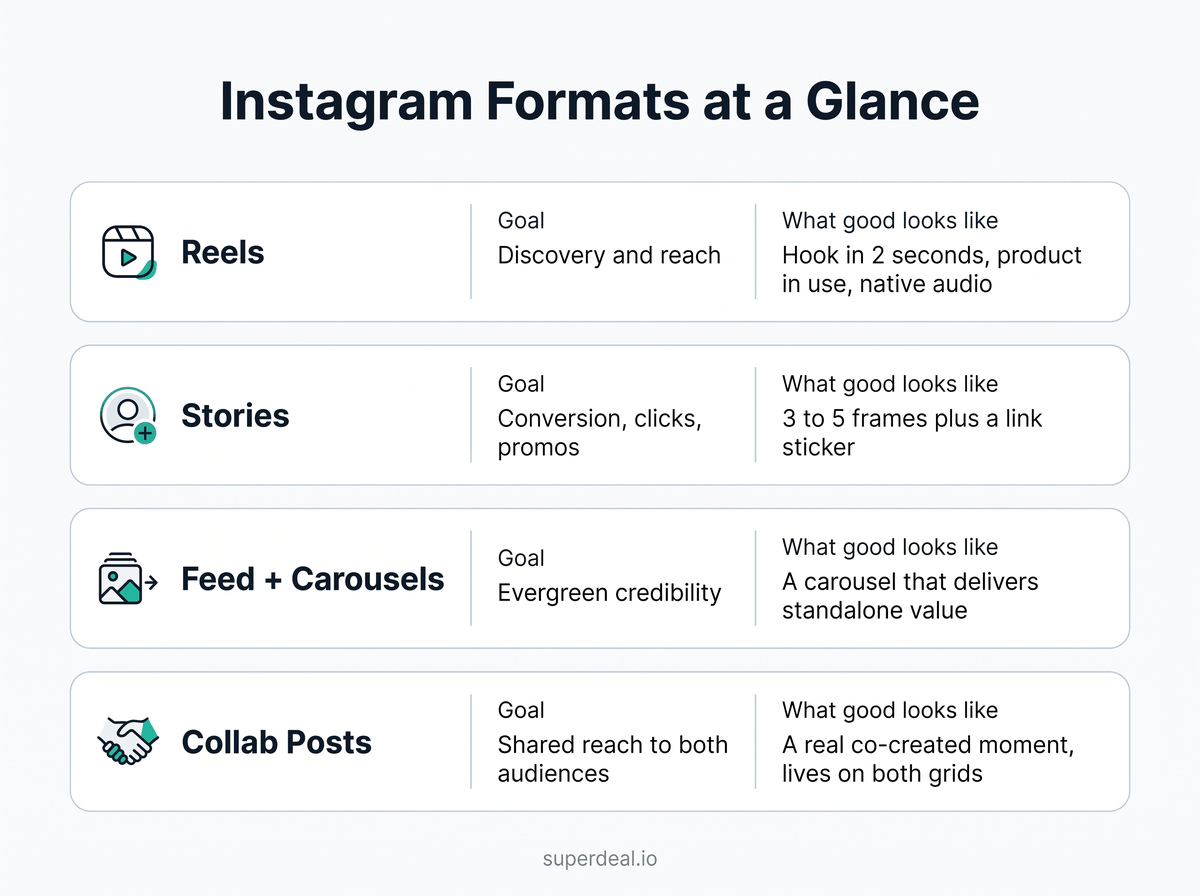
Reels — Discovery and Reach
Reels are Instagram's discovery engine — served to people who do not follow the creator, which makes them the top-of-funnel format. Instagram remains one of the most widely used platforms among U.S. adults, per Pew Research Center, which is why discovery there scales. If your goal is new-audience reach (a launch, a new market, brand awareness), Reels are the default. Instagram itself states that Reels get distributed beyond a creator's existing followers, unlike most feed content (Instagram Creators).
What "good" looks like: a hook in the first two seconds, the product shown in use, native trends or audio, and a clear call to action. Over-produced spots that look like TV ads underperform; Reels reward content that matches the creator's normal feed.
Stories — Urgency, Links, and Social Proof
Stories are the conversion format. They vanish in 24 hours, which creates urgency, and they carry a link sticker that sends viewers straight to your product page. If your goal is clicks, sign-ups, or a time-boxed promo, Stories carry it.
What "good" looks like: three to five frames, not one — a hook, a product demo, a personal endorsement, and a link-sticker frame with an explicit "tap here." A single frame with a bare link converts poorly. Stories are also the natural home for social proof.
Feed Posts and Carousels — Evergreen Credibility
Feed posts and carousels are the credibility layer. They stay on the creator's grid, they are saveable, and carousels drive high saves and shares because they teach or list something. If your goal is durable proof or an educational angle, feed content carries it.
What "good" looks like: a carousel that delivers standalone value (a how-to, a before/after, a comparison) with the product woven in, not bolted on. The caption matters more here than in any other format — it is where the creator's genuine take lives and where the disclosure sits.
Collab Posts — Shared Reach to Both Audiences
Collab posts are the highest-return format most brands underuse. Instagram's Collab feature lets a creator and your brand account co-author one post or Reel — it appears on both grids, shows both handles, and pools engagement from both audiences into a single piece of content, so reach compounds rather than splits.
What "good" looks like: use Collab when you have a real co-created moment (a joint product, an event, a launch) and when growing your own brand account is part of the goal. It is the closest Instagram gets to borrowing the creator's audience directly, because the content lives permanently on your account too.
Instagram's Native Branded-Content Tools
Most Instagram influencer guides skip the part that keeps campaigns compliant and scalable: the platform's own branded-content tools — the paid-partnership label, Partnership Ads, and creator tagging. Learn these and you disclose correctly, amplify the best posts as ads, and never rebuild a creator's content from scratch.
The paid partnership label. When a creator posts branded content, Instagram lets them add a "Paid partnership with [brand]" label above the post. It does two jobs. It satisfies the disclosure regulators expect — the U.S. FTC requires that a material connection between a brand and an endorser be disclosed clearly and conspicuously. And it gives the brand access to performance data and the ability to run the post as an ad. The creator sets the label in their post options; the brand approves the tag once (Meta Business Help).
Partnership Ads (branded-content ads). Once a creator uses the label and grants permission, you can promote their post as an ad from your own ad account — running it to audiences far beyond the creator's followers, with their handle and credibility intact. This is the single biggest multiplier in Instagram influencer marketing: a Reel that earned strong organic engagement becomes ad creative with social proof already baked in.
Creator tagging and product tags. Creators can tag your brand account and, if you sell through Instagram Shopping, tag specific products so viewers tap straight to a product page. Tagging also pulls the content into your brand's tagged feed — a durable archive without asking creators to send files.
Set all three up at the start of a campaign. The paid-partnership label has to be applied by the creator at post time; retrofitting it later is far messier.
How to Build an Instagram Influencer Marketing Strategy, Step by Step
A working Instagram influencer strategy is a sequence, not a shopping list: goal first, creators second, everything else follows. Run these seven steps in order. Skipping the goal step is why so many campaigns end with a folder of pretty content and no way to say whether it worked.
Step 1 — Set one goal and one primary metric. Pick a single objective: awareness (reach and new followers), consideration (saves, shares, profile visits), or conversion (clicks, promo-code redemptions, sales). One primary metric per campaign decides everything downstream: format, creator tier, and brief.
Step 2 — Choose the creator tier and check fit. Nano and micro creators (1K–100K followers) typically deliver higher engagement and lower cost per result; mid and macro creators buy reach and prestige. Match the tier to the goal from Step 1. Fit matters more than size: a creator whose audience matches your customer profile beats a bigger creator whose audience does not. See the micro-influencer guide for tier trade-offs.
Step 3 — Vet each creator. Before you reach out, verify engagement rate, audience authenticity, and brand safety. This is where campaigns are saved or sunk; the next section covers the exact checks. Build a shortlist of vetted creators, not a wishlist of famous ones. Our guide on how to find micro-influencers covers sourcing.
Step 4 — Write the brief and pick the format. Tell the creator the goal, the one thing the audience should do, the required talking points, and what to avoid — then hand format choice largely to them. Match format to goal: Reel for reach, Story for clicks, feed/carousel for evergreen credibility, Collab for shared audience. Keep creative direction light; creators know what their audience responds to. See influencer outreach for briefing and first-contact templates.
Step 5 — Contract the deal. Put deliverables, timing, the paid-partnership label requirement, usage rights, exclusivity, and FTC-compliant disclosure in writing before any content is made. Use our influencer contract template as the starting agreement.
Step 6 — Amplify the winners with Partnership Ads. Once posts are live, take the one or two with the strongest organic engagement and run them as Partnership Ads. Budget efficiency comes from scaling content that already proved it works, not guessing at cold creative.
Step 7 — Measure against the Step 1 metric. Track link-in-bio clicks, per-creator promo codes, saves and shares, DMs, and — for Partnership Ads — cost per result. Attribute results to creators with unique codes or tracked links so you know which partnerships to renew. Reach and likes are inputs; the Step 1 metric is the answer.
How to Vet an Instagram Creator
The single most expensive mistake in Instagram influencer marketing is paying for followers that are not real — and it is avoidable with a fifteen-minute vetting pass. Inflated audiences are common enough that vetting is the difference between a campaign and a donation.
Check engagement rate first. As a representative benchmark, healthy Instagram engagement runs roughly 1–3% for larger accounts and often 3–8% or higher for nano and micro creators — smaller communities engage harder. Treat these as ranges, not rules; a large account posting to near-silence is a red flag regardless of follower count. Then look for these signals of an inflated or mismatched audience:
Comment quality. Real audiences leave specific comments; walls of emojis and "nice post" across every post suggest bought engagement.
Follower-to-engagement mismatch. 500K followers and 800 likes per post is a warning sign — the ratio should be plausible for the tier, and follower counts that jump in vertical steps rather than a steady curve suggest purchased followers.
Audience geography and age. A U.S. brand does not benefit from an audience 70% outside its market. Ask for an insights screenshot of top locations and age range.
Brand-safety scan. Scroll a few months back — content that conflicts with your values is cheaper to catch now than to explain later.
Past partnerships. A creator who has run clean, disclosed brand deals is lower-risk than one who has never done a paid post.
Ask for a media kit and native-insights screenshots rather than trusting third-party estimates. The creator's own analytics are the source of truth, and one who hesitates to share them is telling you something. For a repeatable sourcing-and-vetting workflow, see how to find micro-influencers.
How Much Does Instagram Influencer Marketing Cost?
Instagram influencer pricing runs from about $50 for a nano-creator post to five and six figures for macro creators, and the biggest cost driver most brands miss is usage rights, not the base post rate. As a representative range, nano creators (1K–10K) often start around $50–$300 per post, micro creators (10K–100K) around $300–$2,000, and Reels command a premium over static posts. These are market ranges, not fixed prices; engagement quality, niche, and exclusivity move them substantially.
Budget for the add-ons, not just the post. Running a creator's content as a Partnership Ad, boosting from their handle (whitelisting), or locking out competitors (exclusivity) each carry a fee on top of the base rate — and each is where under-scoped deals cause disputes later. For a full breakdown by platform, format, and tier, plus a fill-in template, see our influencer rate card.
How Superdeal Makes Instagram Deals Easier
Superdeal turns the slow part of Instagram influencer marketing — find, negotiate, contract, pay — into a few clicks, with payment held in escrow until the work is approved. The usual path (cold DM, rate reveal, back-and-forth, manual contract, invoice chase) is a chain of places the deal stalls or a creator ghosts.
On Superdeal, brands browse a free, indexable creator database, filter for the tier and audience they need, and send a deal offer directly. The contract is built into the offer, paid-partnership and usage terms are set up front, and payment is held in escrow the moment the deal is accepted, released automatically when the deliverable is approved. No cold outreach, no negotiation loop, no invoice chase.
Frequently Asked Questions
1. What is Instagram influencer marketing?
Instagram influencer marketing is partnering with creators to promote your brand through Reels, Stories, feed posts, and collab posts, usually with a paid-partnership label. The creator makes the content and shares it with their audience, giving the brand reach and trust its own account cannot generate. Deals can be paid, gifted, affiliate, or a mix.
2. How much does Instagram influencer marketing cost?
It varies by follower tier, format, and add-ons. As a representative range, nano-creator posts start around $50–$300, micro creators run $300–$2,000, and Reels cost more than static posts. Usage rights, whitelisting, and exclusivity add fees on top. See our influencer rate card for a full breakdown by platform and tier.
3. Reels vs. Stories — which is better for influencer campaigns?
It depends on the goal. Reels are the discovery format: they reach people who do not follow the creator, so they win for awareness and reach. Stories are the conversion format: they carry link stickers and urgency, so they win for clicks and time-boxed promos. Most strong campaigns use both.
4. What is a paid partnership label on Instagram?
The paid-partnership label is Instagram's native disclosure tool. A creator adds "Paid partnership with [brand]" above a post to disclose the commercial relationship. It satisfies FTC disclosure expectations and turns on Partnership Ads, letting the brand promote the creator's post as an ad. The brand approves the tag once for it to appear.
5. How do I find Instagram influencers?
Start from your goal and audience, then source creators by hashtag, location, and lookalike audiences, or browse a creator database. Vet each one for real engagement and audience fit before reaching out. Our guide on how to find micro-influencers covers the workflow.
6. How do I measure Instagram influencer ROI?
Set one primary metric per campaign, then track it directly: link-in-bio clicks, a unique promo code per creator, saves and shares, DMs, and cost per result for any Partnership Ads. Per-creator codes and tracked links let you attribute sales to specific partnerships. Likes and reach are inputs, not the answer.
7. Do Instagram influencers have to disclose paid posts?
Yes. The U.S. FTC requires that any material connection between a brand and a creator be disclosed clearly and conspicuously, and Instagram's paid-partnership label is the platform's built-in way to do it. Disclosure protects both the creator and the brand, and it is a required term in a well-written deal — not an optional courtesy.