What Is a Micro-Influencer? Complete 2026 Guide
A micro-influencer has 10K–100K followers and often out-converts celebrities. The full definition, follower tiers, engagement data, and use cases.

Founder & CEO, Superdeal

A micro-influencer is a creator with roughly 10,000 to 100,000 followers — big enough to have real reach, small enough to keep an engaged, trusting audience. Micro-influencers typically post higher engagement rates than celebrity accounts, which is why brands increasingly spend on many small creators instead of one famous one. This guide covers the exact follower tiers (nano to mega), the engagement data behind the shift, when micro beats macro, and how brands actually work with them — find, vet, contract, and pay. If you're deciding whether micro-influencers fit your next campaign, start here.
What Is a Micro-Influencer?
A micro-influencer is a content creator with about 10,000 to 100,000 followers who has built a focused, engaged audience around a specific niche or topic. They sit between nano-influencers (everyday people with small but loyal followings) and mid-tier creators who are approaching full-time professional scale. The label describes audience size, but the reason brands care is what comes with that size: high engagement, topical credibility, and an audience that treats the creator like a knowledgeable peer rather than a distant celebrity.
The exact boundary is fuzzy, and that's worth saying plainly. Different sources draw the micro line at slightly different points — some start it at 10,000 followers, others at 5,000; some cap it at 100,000, others at 50,000. The U.S. Chamber of Commerce describes micro-influencers as creators with roughly 10,000 to 100,000 followers, and that range is the most widely used working definition. The point of the label isn't a precise headcount. It's a shorthand for a kind of creator: niche-focused, highly engaged, and affordable enough that a brand can work with several at once.
A micro-influencer is defined less by a follower number than by a relationship. Their audience follows them for a reason — fitness, skincare, home cooking, personal finance, a specific game — and that shared interest is exactly what makes a recommendation from them land.
Influencer Tiers Explained: Nano, Micro, Mid, Macro, Mega
Influencer tiers sort creators by follower count into five bands — nano, micro, mid-tier, macro, and mega — and each band trades reach for engagement in a predictable way. As audience size climbs, average engagement rate falls. That inverse relationship is the single most important thing to understand about the tiers, because it's why a brand might deliberately choose a smaller creator over a bigger one. It also tracks how audiences behave online generally — Pew Research documents how large a role social platforms play in how Americans get recommendations and information, which is the behavior micro creators convert.
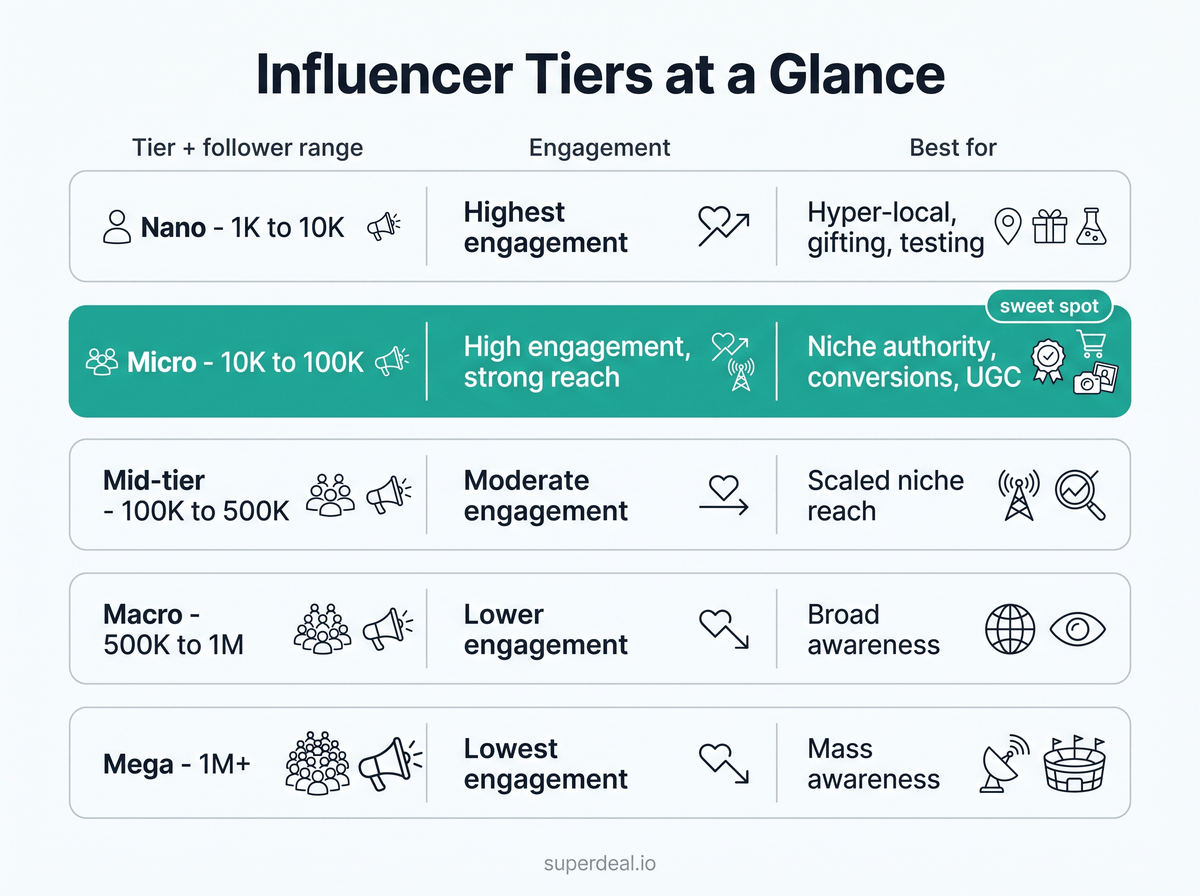
Here's how the five tiers break down. Follower ranges are the widely used industry convention; engagement is expressed as a relative direction rather than a hard percentage, because real rates vary by platform, niche, and how engagement is measured.
Nano (1K–10K followers). Highest engagement of any tier. Best for hyper-local campaigns, gifting, and test-and-learn programs where a brand wants authentic, low-cost coverage from many small voices.
Micro (10K–100K followers). High engagement with meaningfully larger reach. Best for niche authority, conversion-focused campaigns, and user-generated content. This is the sweet spot for most performance-minded brands.
Mid-tier (100K–500K followers). Moderate engagement, scaled niche reach. Best when a brand wants a semi-professional creator who can still speak credibly to a defined community but at a larger scale.
Macro (500K–1M followers). Lower engagement, broad reach. Best for awareness campaigns where the goal is impressions across a wide, general audience rather than a tight niche.
Mega / Celebrity (1M+ followers). Lowest engagement rate, maximum reach. Best for mass-awareness plays and brand-fame moments — not for efficient, measurable ROI.
Where micro sits and why the label matters
The micro tier matters because it's where two curves cross. Below it, nano creators engage brilliantly but reach too few people to move a campaign at scale. Above it, macro and mega creators reach millions but their audiences engage less and cost far more per result. Micro-influencers hold enough reach to matter and enough engagement to convert — which is why the label drives real decisions about pricing and expectations. A brand that understands the tiers won't pay macro prices expecting macro engagement, and won't hire a nano creator expecting macro reach. The tier sets the deal.
Why Micro-Influencers Convert Better Than Celebrities
Smaller audiences engage more — a micro-influencer's followers are more likely to like, comment, save, and act on a post than a celebrity's followers are, and that gap is the whole reason micro marketing works. As accounts grow into the millions, engagement rate reliably drops. The audience becomes broader, less personally connected to the creator, and more passive. A recommendation from someone who feels like a knowledgeable friend carries weight a paid celebrity endorsement rarely matches.
Three forces drive the difference:
Niche relevance. A micro-influencer's audience self-selected around a topic. When a skincare micro-influencer recommends a serum, they're speaking to people who already care about skincare. The message reaches a pre-qualified audience instead of a random cross-section. As Harvard Business Review has argued, brand influence increasingly flows through communities of engaged consumers rather than top-down celebrity broadcast, which is precisely the shift the micro tier captures.
Parasocial closeness. Followers of smaller creators feel a closer, more personal relationship. The creator often replies to comments, answers DMs, and shares everyday life. That closeness makes recommendations feel like advice, not advertising.
Trust in peers over celebrities. Consumers consistently report trusting recommendations from people they perceive as ordinary and relatable over polished celebrity endorsements. Nielsen's long-running trust research has found that word-of-mouth and recommendations from known or peer-like sources outrank most paid advertising formats on consumer trust — the exact dynamic a micro-influencer taps.
The math follows the trust. A brand can hire ten micro-influencers for the price of one macro creator, reach ten distinct engaged niche audiences, and generate ten sets of authentic content — instead of one expensive post to a large but passive following. Across deals run through Superdeal, the pattern is consistent: brands that spread budget across several micro-influencers see more usable content and steadier engagement than brands that concentrate the same budget in a single big name. Reach is easy to buy. Engaged, trusting attention is not — and that's what the micro tier sells.
One caution worth stating: engagement rate is easy to inflate with bought followers and pods. A high follower count with suspiciously low or robotic engagement is a red flag, not a bargain. Vetting matters, which is covered below.
Micro vs. Macro: When to Use Which
Choose micro when your goal is conversion, niche credibility, or a volume of authentic content; choose macro when your goal is mass awareness and you're willing to trade engagement for raw reach. Neither tier is "better" in the abstract — the right choice depends on the campaign objective, the budget, and how tightly the audience needs to match your customer.
Use this framework to decide.
If the goal is awareness at scale — a product launch that needs to be seen by millions fast — macro or mega creators deliver reach a micro campaign can't match in a single post. You'll pay a premium and accept lower engagement per follower.
If the goal is conversion or trust — driving sign-ups, sales, or trial — micro-influencers usually win on cost-per-result. Their engaged, niche audiences act on recommendations at higher rates.
If the budget is limited — most small and mid-sized brands — micro-influencers stretch further. Ten micro deals produce ten pieces of content and ten audiences for what one macro post costs.
If niche fit is critical — a specialized product (a climbing-shoe brand, a diabetes-friendly snack) — a micro-influencer whose entire audience is the target customer outperforms a macro creator whose audience is only fractionally relevant.
If you need content volume — for paid social, a website, or a UGC library — micro and nano creators are the efficient source of on-brand, authentic assets.
A common and effective play is to blend tiers: a few macro creators to seed broad awareness, backed by a larger group of micro-influencers to drive engagement and conversion within specific niches. The macro post makes the brand visible; the micro posts make it credible.
What Brands Use Micro-Influencers For
Brands use micro-influencers for four things above all: user-generated content, product launches, local and community campaigns, and niche authority. Because micro creators are affordable and produce content that feels native to their audience, they fit a wider range of marketing jobs than the "one big sponsored post" model most people picture.
User-generated content (UGC). Micro and nano creators are the primary source of authentic, on-brand content that brands repurpose across paid ads, landing pages, and email. The content reads as real because it is. See what is a UGC creator for how content-only creator deals work — many micro-influencers offer both posting and UGC-only arrangements.
Product launches. Seeding a new product to a group of micro-influencers generates a wave of coordinated, credible coverage across niche communities at launch — more believable than a single celebrity announcement and far cheaper.
Local and community campaigns. A regional restaurant, gym, or service business gets more from ten local micro-influencers whose followers live in the area than from one national creator whose audience is scattered. Micro marketing is a natural fit for influencer marketing for small business, where budgets are tight and local relevance is everything.
Niche authority and education. In specialized categories — skincare science, personal finance, B2B software, parenting — a micro-influencer who is a genuine subject-matter voice lends credibility a generalist celebrity can't. Their recommendation reads as expert advice.
The through-line: micro-influencers are the workhorse tier of modern influencer marketing. They aren't the flashiest choice, but they produce the content, the trust, and the conversions that make campaigns pay for themselves.
How Much Do Micro-Influencers Cost?
Micro-influencers typically charge from a few hundred to a few thousand dollars per post, depending on platform, engagement rate, niche, and deliverable — far less than the five- and six-figure rates macro and mega creators command. As a representative range, a micro-influencer's rate for a single Instagram or TikTok post commonly falls somewhere between $300 and $3,500, with the exact figure driven by engagement quality and content type rather than follower count alone. These are industry-representative ranges, not a fixed price list, and they vary widely by category and geography.
Cost is also where the efficiency argument becomes concrete. Because a brand can engage several micro-influencers for the price of one macro creator, the effective cost per engaged view is often dramatically lower — which is the core reason performance-focused brands lean on this tier.
For the full breakdown — exact rate ranges by platform, tier, and format, plus a fill-in template — see the influencer rate card. This guide won't duplicate those tables; the rate card is the reference.
How to Work With Micro-Influencers
Working with micro-influencers comes down to three steps: find creators whose audience matches your customer, vet them for genuine engagement, and lock the deal in a clear agreement before any content is made. The tier is affordable, but the process still has to be deliberate — a mismatched or fake-engagement creator wastes budget just as fast as an overpriced celebrity.
Find them. Search by niche, platform, and audience, not just follower count. Look on the platforms directly, in relevant hashtags and communities, and through creator databases. The full playbook is in how to find micro-influencers.
Vet them. Check that engagement is real and relevant: read the comments (are they human and on-topic, or generic bot filler?), confirm the audience demographics match your customer, and ask for recent analytics screenshots from native tools like Instagram's professional insights or TikTok's creator analytics. A 3–6% engagement rate is healthy for the micro tier; wildly higher or lower numbers deserve scrutiny.
Reach out and deal. Send a clear, personal pitch — what you want, the deliverable, and the terms. The influencer outreach guide covers how to write a message that gets a reply. Once a creator says yes, put the scope, timeline, usage rights, and payment in a written agreement before work starts. And remember disclosure: sponsored content must be labeled. The FTC's Endorsement Guides require creators to clearly disclose a paid or gifted relationship, and the brand shares responsibility for making sure they do.
This find-vet-deal loop is exactly the friction Superdeal removes. Instead of cold outreach, back-and-forth negotiation, and chasing invoices, you browse a free, indexable creator database, send a deal offer at or above the creator's stated rate, and let payment sit in escrow until the deliverable is approved. The contract and disclosure terms are built in.
Frequently Asked Questions
1. What is a micro-influencer?
A micro-influencer is a content creator with roughly 10,000 to 100,000 followers who has built an engaged, trusting audience around a specific niche. They sit above nano-influencers and below mid-tier creators. Brands value them for high engagement, topical credibility, and affordability — you can work with several at once for the price of one celebrity.
2. How many followers does a micro-influencer have?
Roughly 10,000 to 100,000 followers, though sources vary at the edges. Below that sits the nano tier (1K–10K), and above it come mid-tier (100K–500K), macro (500K–1M), and mega or celebrity creators (1M+). The exact cutoff matters less than the pattern: as follower count rises, engagement rate tends to fall.
3. Are micro-influencers worth it?
For most brands, yes. Micro-influencers deliver higher engagement and stronger trust than celebrities at a fraction of the cost, and their niche audiences convert well. They suit brands that want measurable results, authentic content, or local reach on a limited budget — rather than pure mass awareness, where macro creators fit better.
4. How much do micro-influencers charge?
As a representative range, micro-influencers commonly charge $300 to $3,500 per post, with the exact figure set by platform, engagement rate, niche, and deliverable type rather than follower count alone. Content-only UGC deals are often priced differently. See the influencer rate card for full ranges by platform and tier.
5. What's the difference between a micro and a nano influencer?
A nano-influencer has roughly 1,000 to 10,000 followers; a micro-influencer has about 10,000 to 100,000. Nano creators post the highest engagement of any tier and suit hyper-local or gifting campaigns, while micro creators keep strong engagement but add meaningfully more reach — making them better for niche authority and conversion at scale.
6. How do I find micro-influencers?
Search by niche, platform, and audience fit rather than follower count alone — through platform search, relevant hashtags and communities, and creator databases. Then vet each creator for genuine, on-topic engagement before reaching out. The full step-by-step process is in how to find micro-influencers.
7. Do micro-influencers need to disclose sponsorships?
Yes. The FTC requires creators to clearly disclose any paid, gifted, or otherwise material relationship with a brand, using plain labels like "#ad" or "paid partnership." The brand shares responsibility for compliance. See the FTC Endorsement Guides for the current rules.
About the figures in this guide: follower ranges reflect the widely used industry convention (as described by sources including the U.S. Chamber of Commerce), and engagement and rate figures are industry-representative estimates, not fixed thresholds or a Superdeal price list. Actual numbers vary by platform, niche, geography, and how engagement is measured.