How to Find Micro-Influencers: 7 Methods (2026)
Find micro-influencers for your brand in 2026: 7 practical methods, starting with Superdeal's free creator database, plus how to vet them.

Founder & CEO, Superdeal
The fastest way to find micro-influencers is to start with a free creator database like Superdeal, where you filter by niche, platform and follower tier in one place, then add people who already know your brand, hashtag search and creator marketplaces. Micro-influencers (10K–100K followers) are easiest to find where they're already active: in your niche's hashtags, in your comments, and in searchable creator directories. This guide covers seven practical methods, starting with the fastest, plus how to vet a creator's engagement, audience quality, and brand fit before you reach out — so you spend your time on creators who will actually convert.
What Counts as a Micro-Influencer?
A micro-influencer is a creator with roughly 10,000 to 100,000 followers — big enough to have real reach, small enough to keep the high engagement and niche trust that drive conversions. They sit above nano creators (1K–10K) and below mid-tier (100K–500K). The appeal is the trade-off: micro creators typically post higher engagement rates than macro accounts while charging a fraction of the fee, which is why brands running direct-response campaigns lean on them. Marketer surveys tracked by eMarketer consistently show budgets shifting toward smaller creators for exactly that efficiency. Nielsen's long-running research also found that people trust recommendations from individuals over brand advertising, and micro creators sit close to that trusted-peer end of the spectrum (Nielsen, Trust in Advertising).
For the full definition, engagement math, and tier comparison, see what is a micro-influencer. This guide focuses on the practical question: how do you actually find them.
7 Ways to Find Micro-Influencers
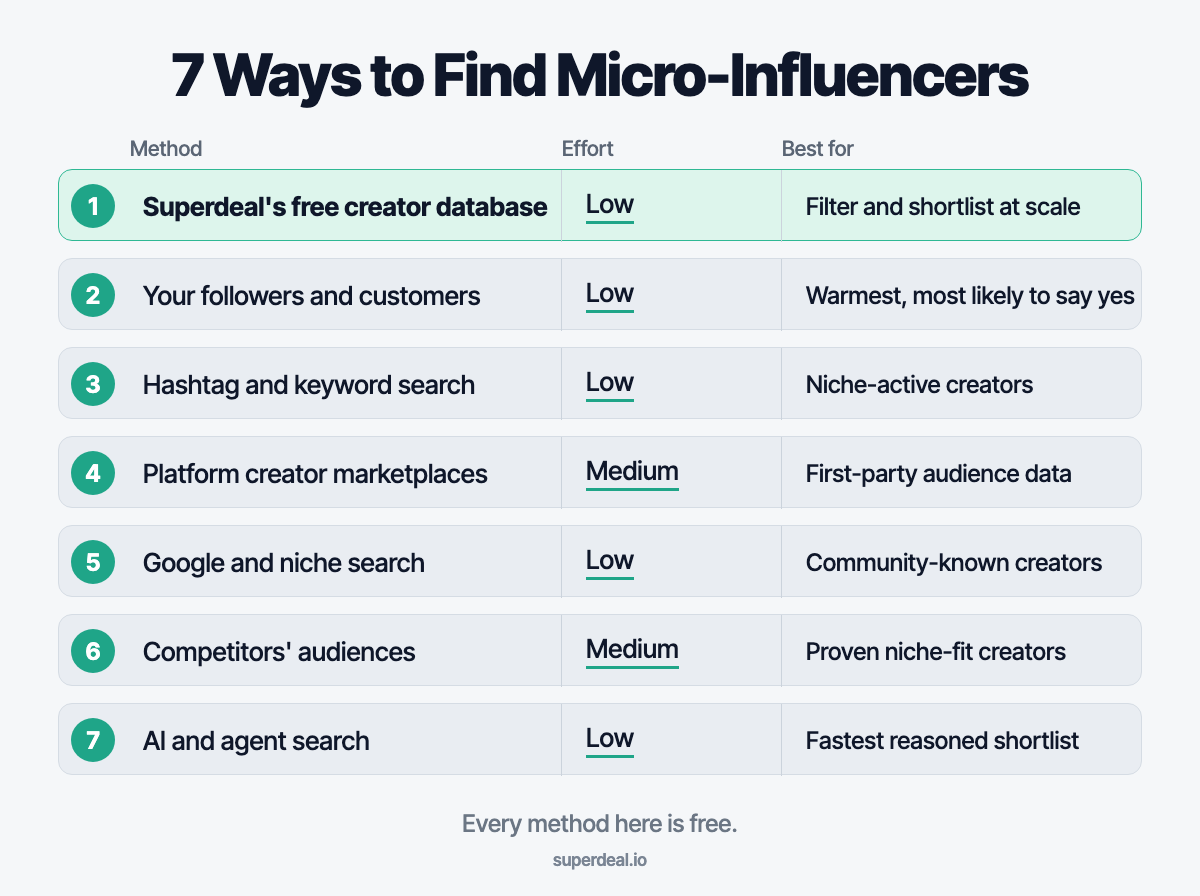
The best discovery method is the one that surfaces creators who already fit your niche and audience — not just anyone with the right follower count. The seven methods below start with the fastest. Start at the top: most brands find their first creators in the free database before they ever need the other methods.
1. Free creator databases like Superdeal
A searchable creator directory turns discovery from hours of scrolling into a filtered search. Instead of hopping between hashtags and profiles, you filter by niche, platform, follower tier, and location in one place, then shortlist. Superdeal's creator database is free and indexable on purpose — you can browse creators for free without an account, filter to the micro tier, and see who is open to deals right now. Every profile carries the stats you need to vet, so you move from "found them" to "can I work with them" without leaving the page. For the full stack, see the best influencer marketing tools.
2. Search your own followers and customers
The creators most likely to say yes are the ones who already follow you, buy from you, or tag you. They know the product, so the pitch is warm and the content is authentic. Export your follower list and scan for accounts in the 10K–100K range, check who has tagged your brand or used your product on camera, and look through customer emails for handles that suggest a creator account. This method costs nothing and skips the trust-building stage entirely, which is why most guides overlook it.
3. Hashtag and keyword search on Instagram and TikTok
Micro-influencers cluster around the hashtags and search terms of their niche. On Instagram and TikTok, search your category hashtags — #skincareroutine, #homecoffee, #budgettravel — and filter for accounts in the micro range; add location tags if you need regional creators. On TikTok, the search bar surfaces creators by keyword in the caption and on-screen text, not just the hashtag, so "protein recipe" pulls creators the hashtag misses. Save every promising account to a shortlist as you go. The same logic works platform by platform — see how to find YouTube influencers for the video-search version.
4. Platform creator marketplaces
Both major platforms run official tools that let brands find creators by audience and category. TikTok Creator Marketplace filters creators by follower range, audience demographics, region, and engagement, with data pulled straight from the platform (TikTok Creator Marketplace). Meta offers brand-collaboration and creator-discovery tools inside its business surface for Instagram partnerships (Meta for Business). These give you first-party audience data you cannot get by scrolling, which makes vetting faster. The trade-off: they only cover their own platform and skew toward creators who have already opted in. Once you have your creators, our guides to Instagram influencer marketing and TikTok influencer marketing cover running the campaign.
5. Google and niche search
A plain search often beats a tool. Query "{your niche}" + "micro influencer", "{niche}" + creator, or best {niche} creators to follow and you surface roundup posts, "top creators" lists, and niche blogs that have already done the curation for you; add a year or region to tighten results. This one is unbeatable for finding creators who are known inside a community but invisible in follower-sorted tools — the recipe creator a food blog keeps citing, the reviewer a subreddit trusts. It costs nothing but time.
6. Check who your competitors' audiences follow and tag
Your competitors have already found creators in your exact niche. Look at who tags or mentions competing brands, who appears in their collaborations, and which creators their audience follows in common. On Instagram, the "suggested accounts" on a creator's profile point you to adjacent creators in the same niche. This is not about copying a roster — it is about mapping the creator neighborhood your customers already live in, then finding the ones not locked into an exclusive deal.
7. AI and agent search
The newest method: ask an AI assistant to find creators for you. LLMs and AI agents can now surface creators from indexable, structured directories and return a reasoned shortlist — "find me 10 micro fitness creators in Texas who post Reels." This only works when creator data is public and machine-readable, which is exactly why Superdeal keeps its database free and indexable: the goal is to be the reference point an AI agent reaches for when it searches for creators. As agent-driven discovery grows, creators in agent-friendly directories get surfaced; those behind paywalls do not.
How to Vet a Micro-Influencer Before You Reach Out
Follower count tells you almost nothing — engagement rate, audience quality, and brand fit tell you whether a creator will actually move your product. Run every shortlisted creator through the four checks below before you spend a minute on outreach. It takes about five minutes per creator and saves you from paying for reach that does not convert.
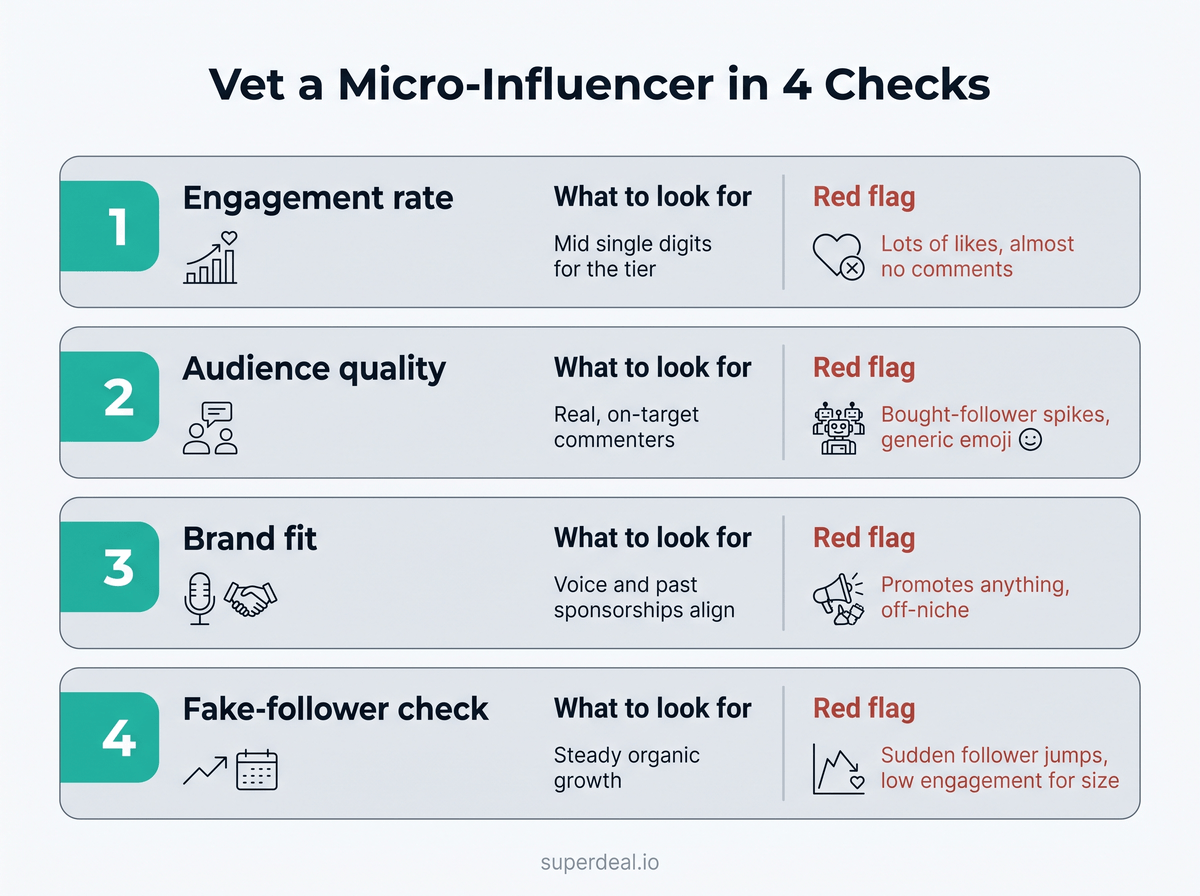
Engagement rate. Divide average likes-plus-comments by follower count. For micro creators, a mid-single-digit rate is common and healthy; the tier runs higher than macro accounts, which is much of its value. Representative range only — verify against recent posts. Red flag: a large following with a handful of likes and near-zero comments.
Audience quality. Look at who actually engages. Real people writing specific things, or one-word praise from empty accounts? Confirm the audience location and language match your market. Red flag: follower spikes with no matching jump in engagement, which suggests bought followers.
Brand fit. Read the last twenty posts. Do the creator's voice, values, and existing sponsorships fit your brand? Someone who already posts organically about your category beats a bigger account in an unrelated niche. Red flag: recent promotions for a direct competitor.
Disclosure and compliance. Confirm the creator marks paid partnerships clearly. The FTC requires influencers to disclose material connections to a brand, and one who already does this is lower-risk to work with (FTC Disclosures 101 for Social Media Influencers). Red flag: past sponsored posts with no disclosure.
Clear all four and the creator goes on your outreach list. Fail on audience quality or brand fit and you drop them — a strong-looking follower count does not survive a bad audience.
How to Reach Out and Close the Deal
Once a creator clears vetting, the deal is won or lost on how you reach out — a specific first message beats a copy-paste template every time. Lead with why you picked them, name the deliverable and rate, and make the next step a single click. Do not open with "we'd love to collaborate" and no details; creators skip vague pitches. Harvard Business Review has noted that influencer partnerships work best when the brand-creator fit is genuine rather than transactional — which starts with a message that shows you did the homework. For the full message structure, subject lines, and follow-up cadence, see influencer outreach. Before you send a number, check current pricing so your offer lands in range — the influencer rate card has 2026 benchmarks by platform and tier.
The standard path is slow: find a creator, hunt for an email, pitch cold, negotiate over days, chase an invoice, wait for delivery. Superdeal collapses that. You browse the database, send a deal offer at or above the creator's stated rate, and payment is held in escrow the moment the deal is accepted, then released automatically when the deliverable is approved. No cold DM, no price back-and-forth, no invoice chase.
Search Superdeal's free creator database → · Send a deal in minutes →
Frequently Asked Questions
1. How do I find micro-influencers?
Start with a free creator database like Superdeal's, which lets you filter by niche, platform and tier in one place. Then add people who already know your brand (your followers, customers and anyone who has tagged you), hashtag and keyword search on Instagram and TikTok, platform creator marketplaces, and Google niche searches.
2. How do I find micro-influencers on Instagram or TikTok?
Search your niche hashtags and keywords, then filter for accounts in the 10K–100K range. On TikTok, the search bar surfaces creators by caption and on-screen text, not just hashtags. Both platforms also run official creator marketplaces that let you filter by audience demographics, region, and engagement using first-party data.
3. Where can I find a free list of micro-influencers?
Superdeal's creator database is free and indexable — you can browse creators without an account at superdeal.io/all-creators, filter to the micro tier, and see who is open to deals now. Because it is built for discovery, each profile shows the stats you need to vet a creator on the spot.
4. How do I know if a micro-influencer is worth working with?
Run four checks: engagement rate (mid single digits is healthy for the tier), audience quality (real, on-target commenters, no bought-follower spikes), brand fit (voice and past sponsorships align with yours), and disclosure compliance. Follower count alone is not a signal. A creator who clears all four goes on your outreach list.
5. How many followers should a micro-influencer have?
Roughly 10,000 to 100,000 followers. That range keeps the high engagement and niche trust of smaller creators while giving you meaningful reach, at a fraction of macro pricing. For the full tier breakdown and engagement benchmarks, see what is a micro-influencer.
6. How do I contact a micro-influencer?
Lead with why you picked them, name the deliverable and rate up front, and make the next step one click. Skip vague "let's collaborate" openers. See influencer outreach for message structure and follow-up cadence. On Superdeal, you send a deal offer directly and skip the cold DM entirely.
7. Are micro-influencers better than macro-influencers?
For direct-response and niche campaigns, often yes. Micro creators typically post higher engagement rates and cost far less, so return per dollar can beat a macro deal. Macro creators still win for broad awareness. The right choice depends on your goal, budget, and how tightly the audience must match your customer.