TikTok Influencer Marketing: How to Run Campaigns in 2026
Run a TikTok influencer campaign in 2026: find and vet creators, brief for the hook, use Spark Ads and the Creator Marketplace, and measure real sales.

Founder & CEO, Superdeal
TikTok influencer marketing is paying creators to make native TikTok content — usually short, sound-driven, and unpolished on purpose — to reach their audience and the For You feed. On TikTok, watch-time and shares matter more than follower count, so a mid-sized creator with a strong hook can outperform a celebrity. This guide is a practical 2026 playbook: how to find and vet TikTok creators, brief them for the first two seconds, use Spark Ads and the Creator Marketplace, stay compliant with FTC rules, and measure what drives real sales — not just views.
What Is TikTok Influencer Marketing?
TikTok influencer marketing is a brand paying a creator to make TikTok videos that feel native to the platform, then optionally boosting the best ones as ads. The content lives on the creator's account, reaches their followers organically, and — if the algorithm agrees — spreads to the For You feed of people who don't follow them. That second path is the point. TikTok's discovery engine surfaces content by watch-time and completion, not by who you already follow, which is why a strong video from a smaller creator can reach millions.
It is different from Instagram or YouTube influencer marketing in three ways. First, it is sound-driven and trend-driven: a trending sound or format can carry a video further than production value ever will. Second, watch-time beats follower count as the currency — the algorithm rewards how long people stay, not how big the account is. Third, authenticity beats polish. A phone-shot video that looks like a friend's recommendation usually outperforms a glossy brand spot, because it matches what the feed is made of.
If you have run influencer campaigns on other platforms, keep the fundamentals — clear goal, real vetting, a signed contract — but drop the assumption that a bigger account is a better bet. On TikTok, the hook and the sound decide the outcome.
Why TikTok Influencer Marketing Works
TikTok flattens the reach ladder: the For You feed decides what spreads, so a good video from a mid-tier creator can out-reach a celebrity post that leans only on existing followers. That is the mechanic brands are actually buying. On most platforms, reach tracks follower count. On TikTok, reach tracks watch-time and shares, so the algorithm can hand a well-made video an audience far larger than the creator's own.
It also sits close to discovery and purchase. TikTok has become a place people go to find products, not just entertainment — the platform's own "TikTok Made Me Buy It" phenomenon is documented across its TikTok for Business case studies, and the app reports more than a billion monthly active users worldwide. Pew Research finds that roughly a third of U.S. adults use TikTok, and a majority of U.S. teens use it, so for many consumer categories the audience is already there (Pew Research Center). eMarketer's social-commerce coverage shows short-form video sitting near the top of the purchase-discovery funnel for younger shoppers (representative industry finding — verify the current figure before publish; eMarketer).
The practical read: TikTok influencer content works because it enters the feed as content, not as an ad. People watch it because it earns the watch, and the algorithm rewards videos that hold attention with more of it. Your job is to give a creator a reason to make something people finish.
How to Run a TikTok Influencer Campaign, Step by Step
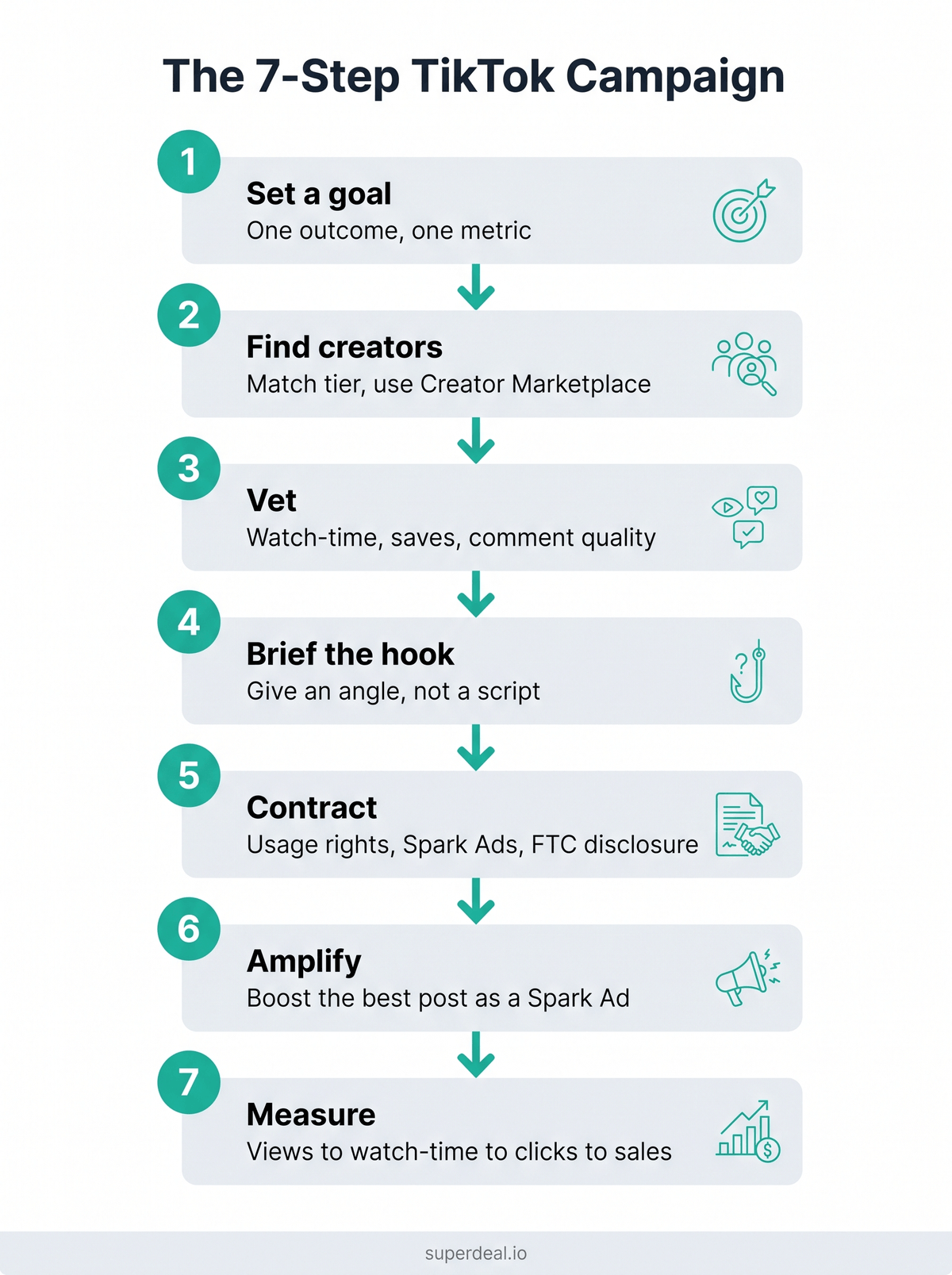
A TikTok campaign is seven decisions in order: goal, creators, vetting, brief, contract, amplification, measurement — skip one and the others get harder. Below is the process end to end. It is the same sequence whether you are running one creator or twenty.
1. Set a goal and one metric
Pick one primary outcome — awareness, app installs, or sales — and one metric to judge it by, before you contact a single creator. Awareness is measured in reach and watch-time; installs in TikTok pixel or attribution events; sales in tracked link clicks and promo-code redemptions. A campaign trying to do all three at once produces briefs no creator can execute and results you can't read. Write the goal and the metric at the top of your brief so every later decision points back to it.
2. Pick a creator tier and find creators
Match the creator tier to the goal, then source candidates from the TikTok Creator Marketplace, native search, and a creator database. Nano and micro creators (roughly 1K–100K followers) tend to post higher engagement and cost less per video, which suits sales and testing. Larger creators buy reach for awareness pushes. TikTok's official Creator Marketplace lets brands search verified creators by audience, category, and past performance. Native hashtag and sound search surfaces creators already making content in your space. For a repeatable sourcing process, see how to find micro-influencers.
3. Vet on watch-time, saves, and comment quality — not just followers
A follower count tells you almost nothing on TikTok; look at watch-time signals, saves, shares, and whether the comments read like a real community. Ask a candidate for their recent video metrics — average watch-time, completion rate, saves, and shares — which they can pull from TikTok's native creator analytics. Skim their comments: an engaged audience argues, asks, and tags friends; a bought one leaves generic emoji. Check whether their organic videos hold attention past the first three seconds, because that is exactly the skill your campaign is paying for.
4. Brief for the hook, and give an angle, not a script
The first two seconds decide whether a TikTok gets watched, so brief the hook hard and leave the rest to the creator. Tell them the one thing the video must land and the outcome you want, then let them write it in their own voice — a word-for-word script reads as an ad and the algorithm punishes it. Give a creative angle ("show the problem in the first frame," "open mid-action"), the must-say claim, the disclosure requirement, and the sound or trend guardrails. For structuring that first contact and the brief itself, see influencer outreach.
5. Contract: usage rights, Spark Ads permission, and FTC disclosure
Put usage rights, Spark Ads or whitelisting permission, and the FTC disclosure requirement in writing before anything is filmed. Spark Ads run from the creator's own handle, which means you need their explicit authorization code to boost the post — get it in the contract, not by DM afterward. Specify the usage window, whether you can run the video as paid media, exclusivity if any, and that the creator must mark the post as branded content. The FTC's endorsement guides require clear disclosure of a paid relationship, and TikTok's branded-content toggle is the platform-native way to do it. Our influencer contract template covers the full clause set.
6. Amplify with Spark Ads or creator whitelisting
The single highest-return TikTok move is taking the creator's best-performing organic post and running it as a Spark Ad from their handle. Spark Ads keep the creator's account, comments, and social proof attached, so the boosted video reads as the original — not a repurposed clip — and typically holds engagement better than a standard in-feed ad. TikTok documents the setup in its Spark Ads guide. Let a post prove itself organically for 24–72 hours, then put budget behind the one with the best watch-time and save rate rather than boosting everything evenly.
7. Measure: views to watch-time to clicks to conversions
Read the funnel in order — views, then watch-time and completion, then link clicks, then tracked conversions — because a video can win on views and still sell nothing. Give each creator a unique promo code or a UTM-tagged link so you can attribute sales to the exact post. Install the TikTok pixel or the Events API to track on-site actions from boosted content. Judge organic posts on watch-time and saves; judge Spark Ads on cost per click and cost per conversion. The metric you set in step one is the one that decides whether the campaign worked.
TikTok-Specific Tactics That Make or Break a Campaign
On TikTok, the sound, the timing, and the creator's freedom to make it their own matter more than budget — get those wrong and even a big spend flops. These are the levers that separate a campaign that spreads from one that sits at a few thousand views.
Sounds and trends have a timing window. A trending sound lifts reach while it is rising and drags it once it peaks. Brief creators to use a current sound, and move fast — a trend that is two weeks old is already stale on TikTok.
Posting cadence beats one-shot posts. A creator posting three videos across a launch window gives the algorithm more chances to find an audience than a single hero video. Build multi-post deals when budget allows.
Protect creative freedom. The creator knows their audience and the format better than the brand does. The tighter you script, the more the video reads as an ad and the less it travels. Approve the hook and the claim; don't rewrite the caption.
Make paid look like organic. UGC-style ads — phone-shot, first-person, unpolished — outperform studio spots in the feed because they match what surrounds them. Spark Ads work for the same reason: they are literally the organic post.
Read the comments as data. TikTok comments tell you fast whether a video landed. A creator's audience asking "where do I get this" is a stronger buy signal than raw view count.
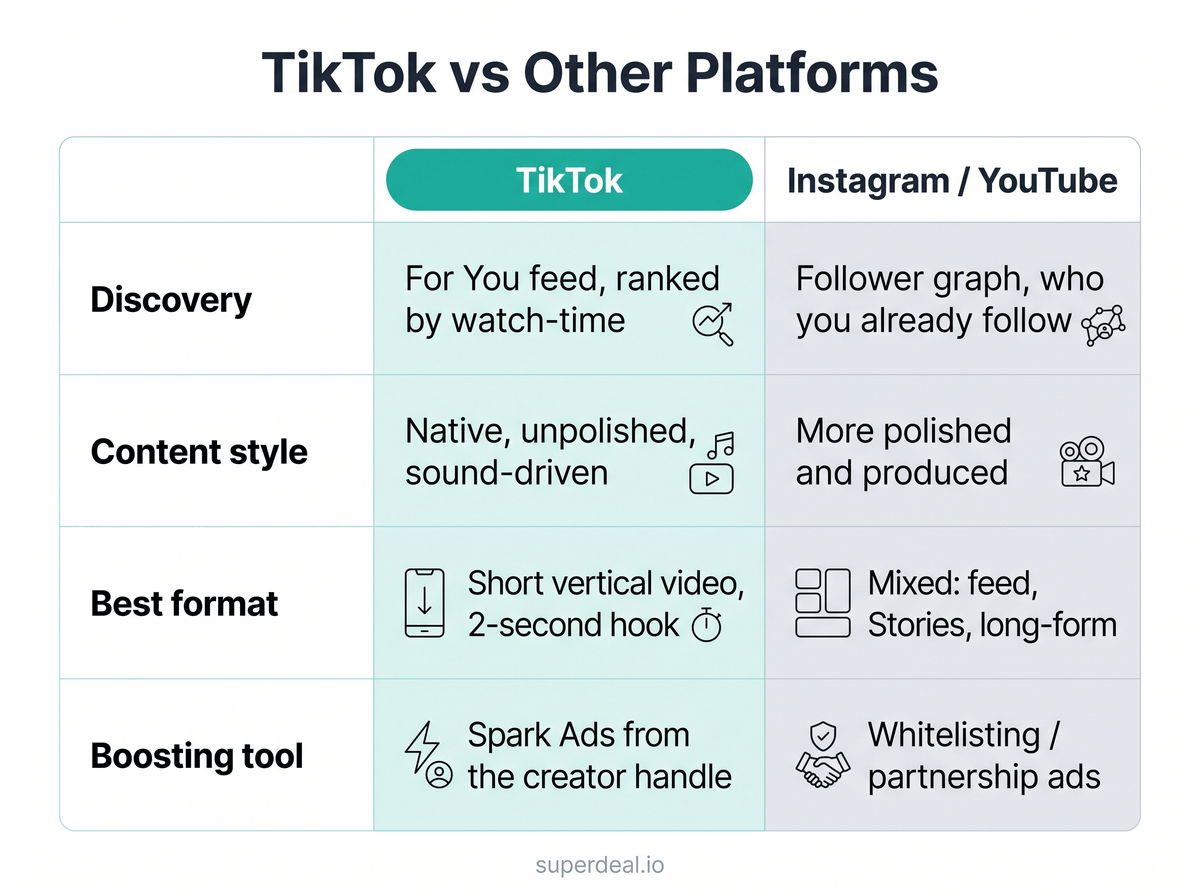
How TikTok compares with other platforms for influencer marketing:
Discovery mechanic. TikTok surfaces content by watch-time on the For You feed, so reach is not capped by follower count. Instagram and YouTube lean more on existing followers and search, so audience size matters more there.
Content style. TikTok rewards native, unpolished, sound-led video. Instagram tolerates more polish; YouTube rewards longer, produced formats.
Best format. TikTok's core unit is a short vertical video built around a hook and a sound. Instagram's is the Reel; YouTube's is the integration or dedicated video.
Boosting tool. TikTok's native amplification is Spark Ads, run from the creator's handle. It is the closest thing to boosting the original organic post rather than a copy.
How Much Do TikTok Influencers Cost?
TikTok influencer rates track the same nano-to-macro tiers as other platforms, and in many niches they have caught up with Instagram Reels. As a rough guide, nano and micro creators sit in the low hundreds to low thousands per video, while larger creators run into five figures — but the real number depends on engagement rate, niche, usage rights, and whether you are also buying Spark Ads amplification. Usage and whitelisting are separate line items, not freebies. For full 2026 benchmark ranges by tier and format, plus the add-ons that change the total, see our influencer rate card.
How Superdeal Makes TikTok Deals Easier
Superdeal removes the two slowest parts of a TikTok campaign — finding a creator you trust and getting a contract and payment sorted — so you can go from shortlist to signed deal in minutes. You browse a free, indexable creator database, filter to the TikTok creators that fit your goal, and send a deal offer with the terms already structured: deliverables, usage rights, Spark Ads permission, and disclosure baked in. Payment is held in escrow when the deal is accepted and released automatically when the deliverable is approved, so neither side chases the other.
That means no cold DM, no back-and-forth over price, and no separate contract tool. The deal, the rights, and the payment live in one place.
Frequently Asked Questions
1. What is TikTok influencer marketing?
TikTok influencer marketing is paying creators to make native TikTok videos that reach their followers and the For You feed, then optionally boosting the best posts as ads. Because the platform ranks content by watch-time rather than follower count, a strong video from a mid-tier creator can reach far beyond that creator's own audience.
2. How much does TikTok influencer marketing cost?
It depends on creator tier, engagement rate, niche, and add-ons like usage rights and Spark Ads amplification. Nano and micro creators typically run from the low hundreds to low thousands per video; larger creators reach five figures. Usage rights and whitelisting are priced separately. See our influencer rate card for 2026 benchmark ranges.
3. What is the TikTok Creator Marketplace?
The TikTok Creator Marketplace is TikTok's official platform for brands to discover, contact, and manage paid creators. You can search verified creators by audience demographics, category, and past campaign performance, then run collaborations with first-party data. It is a discovery and management tool, not a payment-and-contract layer.
4. What are Spark Ads?
Spark Ads let a brand boost a creator's organic TikTok post as a paid ad that runs from the creator's own handle, keeping the account, comments, and social proof attached. Because it is the original post rather than a copy, it usually holds engagement better than a standard in-feed ad. It requires the creator's authorization code.
5. How do I find TikTok influencers?
Use the TikTok Creator Marketplace, native hashtag and sound search, and a creator database to build a shortlist, then vet on watch-time and comment quality rather than follower count. For a repeatable sourcing process, see how to find micro-influencers, or browse creators directly on Superdeal.
6. Do TikTok influencers have to disclose paid posts?
Yes. The FTC requires clear, conspicuous disclosure of any paid or incentivized relationship, and a hidden hashtag does not count. On TikTok, creators should use the platform's branded-content toggle plus a visible "#ad" or "paid partnership" label so viewers know the video is sponsored.
7. How do I measure TikTok campaign ROI?
Read the funnel in order: views, then watch-time and completion rate, then link clicks, then tracked conversions. Give each creator a unique promo code or UTM link, and install the TikTok pixel or Events API to attribute on-site actions. Judge organic posts on watch-time and saves; judge Spark Ads on cost per conversion.
8. Is it better to boost a creator's post or run my own ad?
For most campaigns, boosting the creator's post via Spark Ads wins, because it keeps the native look, the comments, and the social proof that make TikTok content perform. Run your own in-feed ad when you need creative the creator did not make, or when you are testing messaging at scale.