UGC Contract Template (Free, With Usage Rights)
Copy a free UGC contract template with usage rights, paid ads, exclusivity and a kill fee, see a filled-in example, and check the clauses creators most often forget.

Founder & CEO, Superdeal
Updated October 22, 2026.
TL;DR. A UGC contract sets what you will make, when it is due, what it costs and how the brand may use it. The clauses that protect you most are usage rights with an end date, a separate fee for paid ads, and a kill fee. Copy the template below and fill in the brackets.
👉 Create a free creator profile on Superdeal. Brands send offers with the contract built in, you e-sign on the offer, and you get paid when the brand approves your content.
A UGC contract template puts the deal in writing before anyone films. Brands post UGC (user-generated content) on their own channels or run it as ads, so the contract has to say where, how and for how long they can use it.
UGC Contract Template (Copy and Paste)
Copy this, replace everything in [brackets], and delete any line that does not apply. This template is a starting point, not legal advice. Have a lawyer review it if the deal is large or complicated.
📄 Get this contract as a Google Doc. Open it, then File > Make a copy to edit. The doc also has the filled-in example.
UGC CONTENT AGREEMENT
This agreement is made on [date] between [Creator name] ("Creator") and [Brand name] ("Brand").
1. Deliverables
Creator will produce [number] videos and [number] photos for [product or campaign]. Each video will run about [length] seconds in [9:16 vertical] format. Raw footage is [included / not included] in the fee.
2. Deadlines
Brand will ship the product by [date]. Creator will send a first draft by [date] and final files by [date]. If Brand ships late or sends feedback late, Creator's deadlines move back by the same number of days.
3. Revisions
The fee includes [two] rounds of revisions. Brand will send all feedback for each round in one message within [three] business days. Extra rounds, or changes to the original brief, cost [$ amount] per round.
4. Payment
Brand will pay Creator [$ total]. [50%] is due when this agreement is signed and [50%] is due within [7] days of final delivery. Late payments add a fee of [1.5%] per month, or the highest rate the law allows, if that is lower. Payment does not depend on how the content performs. Brand pays for the product, shipping, and any expenses agreed in writing.
5. Usage rights
Creator owns the content. Creator grants Brand a non-exclusive license to use the final content on [Brand's organic social accounts, website, and email] for [90 days], starting on the final delivery date. Any other use, or use after that date, needs a written extension and an added fee. When the license ends, Brand will stop making new posts with the content.
6. Paid ads and whitelisting
Organic use does not include paid ads. If Brand wants to run the content as a paid ad, either from Brand's own ad account or through Creator's handle (also called whitelisting), both parties will sign a paid usage add-on first. The add-on fee is [$ amount] for each [30-day] period on each platform. Brand will not change the message of the content or add claims Creator did not make.
7. Exclusivity
For [30 days] after final delivery, Creator will not make content for these competitors: [list brands]. Exclusivity applies only to the brands listed, and its fee is [included in the total / an extra $ amount].
8. Cancellation
If Brand cancels before Creator starts work, Creator keeps the deposit. If Brand cancels after work has started, Brand pays for the work completed, and no less than [50%] of the total fee. If Creator cancels, Creator returns any deposit for work not delivered. Either party may end this agreement if the other breaks it and does not fix the problem within [5] days of written notice.
9. Disclosure and credit
Creator will follow FTC rules and clearly label any sponsored post Creator publishes about Brand. When Brand reposts the content, Brand will tag Creator's account.
10. Signatures
Creator: [name, signature, date]
Brand: [name, title, signature, date]
Example: A Filled-In UGC Contract
Key terms for a made-up creator and brand. The numbers are an example, not a rate guide.
UGC agreement: Jess Rivera x Trailmix Bottle Co.
Deliverables: 3 vertical videos of about 30 seconds, plus 5 photos. No raw footage.
Deadlines: Product by March 3, drafts by March 14, final files by March 21.
Payment: $900. $450 on signing, $450 within 7 days of final delivery.
Usage rights: Brand's Instagram, TikTok, website and email for 90 days.
Paid ads: Not included. $150 per 30 days per platform, signed separately.
Exclusivity: Two named rival brands for 30 days, included in the total.
Cancellation: Once work starts, at least $450 is owed.
Every number has a date or a limit next to it. That keeps a $900 job from turning into a year of free ads.
What Each Section Means
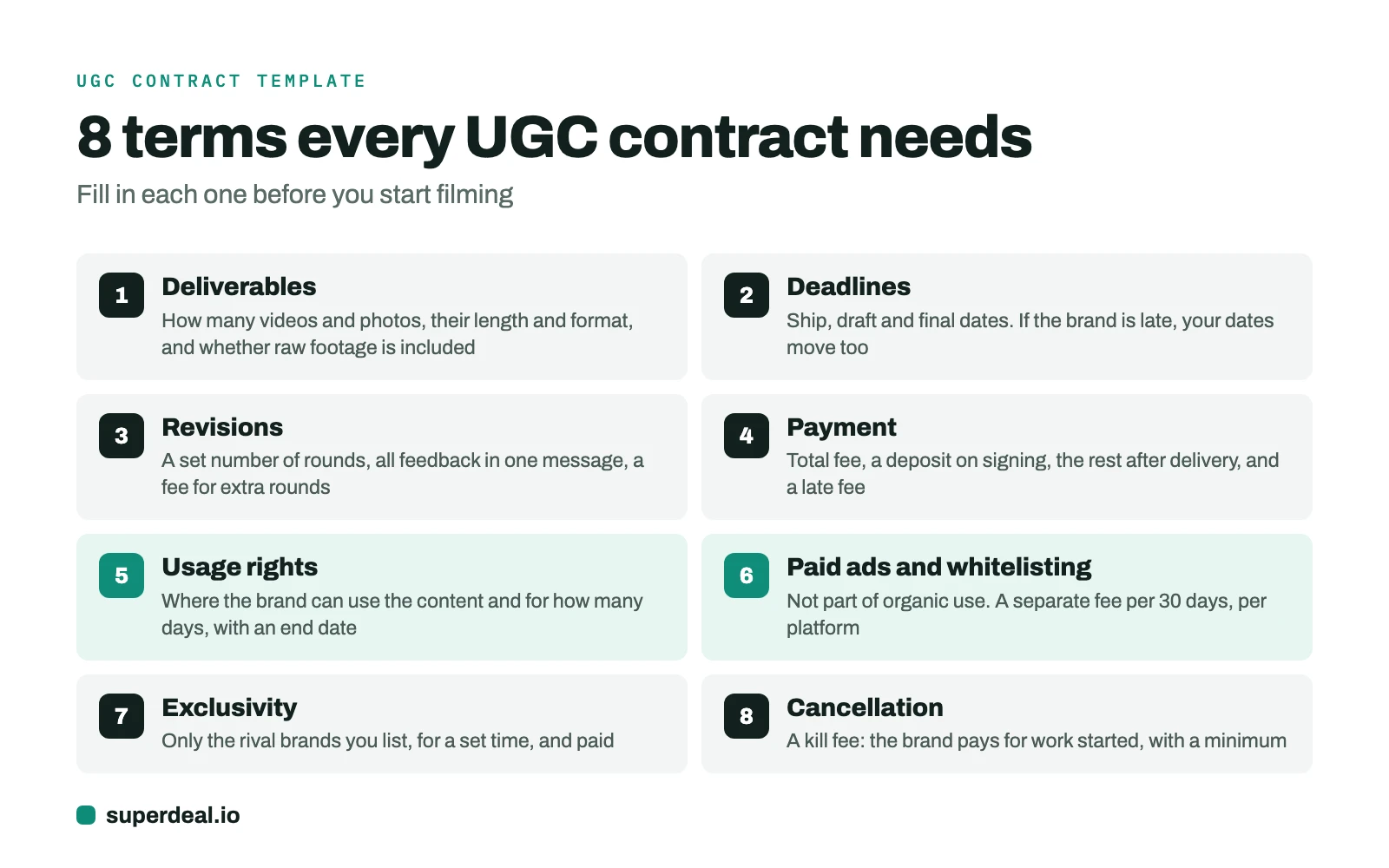
Deliverables are the exact list of what the brand gets. The more specific the number, length and format, the fewer arguments later. Deadlines keep both sides on schedule. The late-shipping line stops a brand that ships a week late from blaming you for a late video.
Revisions put a fence around the back-and-forth. Two rounds is a common limit, and asking for all feedback in one message stops the slow trickle of "one more tiny tweak."
Payment spells out how much, when, and what happens if the money is late. A deposit up front is a good habit because it shows the brand is serious. Our influencer invoice template helps you bill each payment.
Usage rights are the heart of any UGC contract. You are not selling your video, you are renting it out for a set time and set places. A shorter license usually means a lower price, and a longer one should cost more.
Paid ads are priced separately because an ad can earn the brand far more than an organic post. Whitelisting means the ad runs from your handle, which is a bigger ask, so it deserves its own fee. On Instagram and Facebook this is usually a partnership ad, and on TikTok a Spark Ad. Both need your permission, so match the access period to your contract.
Exclusivity keeps you away from competitors for a while, which limits your income, so it should be paid. Cancellation covers the "we changed our minds" situation, so you are not left with unpaid work.
Disclosure is a legal duty. If you post about the brand on your own account, the FTC expects a clear label such as "ad" or "sponsored" in the post itself, and inside a video, not only in the caption. Free products count too. See the FTC's Disclosures 101 for Social Media Influencers.
Clauses Creators Most Often Forget
Even creators who use a UGC contract template tend to leave these out.
A clear end date for usage rights. "Unlimited use," or no line at all, can let a brand run your face for years at no extra cost. Put a number of days or months on it.
A kill fee. If a brand cancels after you have shot and edited, you still spent the time. A minimum payment for work started covers it.
A late payment fee. A small monthly charge gives brands a reason to pay on time.
Rules about editing and AI. Say whether the brand can cut your footage, change your voice, or use AI tools to alter your face or words.
Raw footage. Unedited clips are extra work and extra rights, so price them as their own line item.
When paid ad access ends. If a brand gets access to your handle for whitelisting, write down when that access ends and who on their team can use it.
Music and product claims. The brand should supply licensed audio and approve any product claims, so the risk does not land on you alone.
Before You Send It
Send the contract before you start filming, and get both signatures. To compare formats, see our influencer contract template, then run through the influencer contract checklist to catch anything you missed. For an ongoing partnership instead of one batch of videos, use a brand ambassador contract template. New to this work? Start with how to become a UGC creator.
Skip the PDF: UGC Deals With the Contract Built In
A template still means filling in brackets, emailing a PDF, and chasing signatures and payments. On Superdeal, each offer carries the deliverables, dates and price on standard terms, with the contract built in. Creators e-sign on the offer, no PDFs. Payment goes out when the brand approves the content, so nothing is paid for work that isn't delivered.
Creators pay $0 and keep 100% of the agreed rate, minus standard payment processing. Brands browse creators for free and pay a flat fee only when a deal closes.
👉 Get started on Superdeal for free. Create your creator profile, or find UGC creators for your next campaign.
UGC Contract Template FAQ
What is a UGC contract?
A UGC contract is a written agreement between a creator and the brand that hires them to make videos or photos. It sets the deliverables, deadlines, revisions, payment, and how and for how long the brand may use the content.
Who owns UGC content?
Under US copyright law, the creator usually owns it, unless they work for the brand as an employee or both sides sign a written agreement that hands the copyright to the brand. This template keeps ownership with the creator and licenses the content to the brand.
How long should UGC usage rights last?
Common choices are 30, 60 or 90 days, with a fee to extend. Always write an end date. Unlimited or "perpetual" use should cost much more, or be a no.
Do I need a lawyer to use a UGC contract template?
Not always. A template is a starting point, not legal advice, and it works for many small deals. Have a lawyer review it if the fee is large, the license is long, or the brand wants exclusivity or ownership.