What Is a PR Package? Meaning, Examples, and What Brands Expect Back
A PR package is free product a brand sends creators around a launch, hoping you will post. What is inside, how it differs from a paid deal, and what you actually owe.

Founder & CEO, Superdeal
A PR package is a box of free products that a brand sends to a creator, usually just before or around a launch, in the hope that you will show it to your followers. PR stands for public relations. Nobody pays you for it, and unless you agreed to something before it shipped, you do not owe the brand a post. That is the short answer. Below is what is usually inside, how a PR package differs from a paid deal, why brands send them, and what they quietly expect back.
What Is a PR Package?
Brands send PR packages to creators, journalists and other people with an audience to earn coverage they do not pay for. Before social media, the same idea went to newsrooms as press kits. Today most of it goes to creators, and you have seen the result: unboxing videos and "PR hauls" on TikTok, YouTube and Instagram.
A "PR box" means the same thing. So does "influencer seeding" or "product seeding", which is what marketers call it inside the company.
A typical case: a beauty brand releases a new collection and ships custom boxes with the whole line to a list of Instagram and TikTok creators a week or two before it goes on sale.
What Is Usually Inside a PR Package?
Most packages have the same four parts:
The product. Often the full new line or every shade, sometimes before it is in stores.
A note. A printed card or a handwritten one, with the launch date, the brand's handle and sometimes a hashtag. Good brands say there is no pressure to post.
Packaging made for the camera. A custom box, tissue paper, the brand's colors. The box is part of the content.
Extras. A product info sheet, a discount code for your followers, sometimes merch.
What is inside depends on the niche. A beauty brand sends a shade range. A tech brand sends a review unit, which is sometimes a loan you send back. A snack brand sends a tasting box. A fitness brand sends apparel in your size, which is why they ask for it first. High-value items, such as fine jewelry or a car for a test-drive video, are almost always loans with a return date.
One well-known example: when Rhode, Hailey Bieber's beauty brand, launched its lip case in 2023, a phone case with a slot on the back for a lip treatment, creators showing it off on TikTok and Instagram drove much of the attention around it.
PR Package vs. Gifting With Obligations vs. Paid Deal
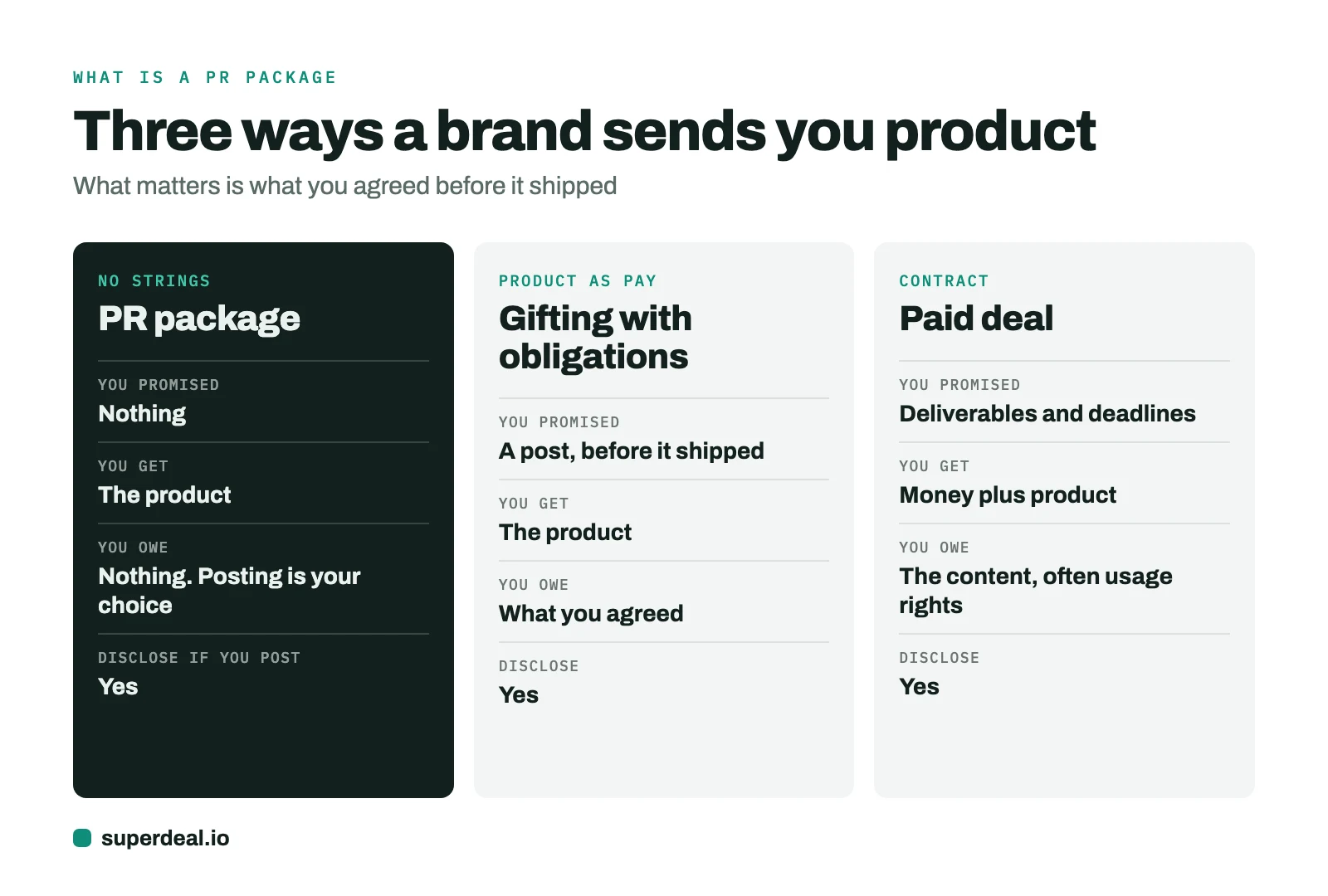
People use "PR" and "gifted" loosely, so the label on the box tells you little. What matters is what you agreed to before it shipped.
PR package. You keep the product. You promised nothing, you get no money, and you decide whether to post.
Gifting with obligations. Before it shipped, you agreed to post something in exchange for the product. The product is your pay, and you owe what you agreed.
Paid deal. Money plus product, under a contract with deliverables, deadlines and often usage rights, so the brand can run your video as an ad. These are usually set up as UGC deals or sponsored posts.
The difference matters for one more reason: a PR package leaves your creative control with you. Once money and usage rights come in, the brand gets a say in what you make and where it runs.
Why Do Brands Send PR Packages?
For the brand, a PR package is cheap, low-risk promotion. A box of product costs far less than an ad campaign, and an unboxing by someone your audience trusts reads as a real reaction, not an ad. That works best with niche audiences that ads reach badly.
Think of a small shop that sells specialty Warhammer 40K miniatures. Ads to that crowd are hard to target. A few hobby creators who paint and review miniatures can show the craftsmanship to exactly the people who buy it, and the shop earns goodwill in a community that talks to each other.
Brands also get a look at how real people use the product: the packaging, the texture, the first reaction. They cannot reuse your video in their own ads without your permission, though. That takes a paid deal with usage rights. And when you tag the brand or link to it, it picks up a little search and social visibility too.
How a Brand Puts a PR Package Together
Product choice. The hero product of the launch, or a set that makes a good video.
The list. Creators whose audience matches the product. Follower count matters less than fit.
The note. Who it is from, the launch date, the handle to tag. The better notes say there is no obligation.
Packaging. Designed to be opened on camera.
Timing. Shipped to arrive shortly before the launch, so posts land in launch week.
Follow-up. Some brands email to check it arrived. Many never do.
What Is In It for You?
The obvious part: free products that fit what you already make. Most brands write PR stock off and do not expect it back, except for the loans above.
The bigger part is content. Each package is a ready-made video idea: an unboxing, a first impression, a tutorial, a week-later honest review, a "day in my life" clip. How-to content does especially well, because people searching for tutorials are close to buying, which makes that audience valuable to brands and to you.
Early access helps too. If you regularly show new launches before they hit stores, people start coming to you for first looks. Strong engagement on PR content is also how many creators get noticed by brand managers for paid campaigns, ambassador programs and UGC work. Whole channels, Unbox Therapy being the best known, were built on unboxing.
Who Gets PR Packages?
Not only big accounts. Plenty of creators with a few thousand followers get boxes, especially in beauty, food, fitness and from small direct-to-consumer brands. Brands look at:
How well your niche fits the product
Whether your comments look like real conversations
How good your photos and videos look
Where your audience lives, since most US brands only ship in the US
Getting onto the lists is a separate topic, and we cover the steps in our guide on how to get PR packages. In short, make it easy for a brand to say yes: a clear niche, a current media kit and a business email on your profile.
What Do Brands Expect Back?
Officially, nothing. Unless you signed a contract or accepted a deal beforehand, an unsolicited PR package comes with no legal requirement to post. Some brands never contact you first and simply ship to the address in your media kit or bio.
Unofficially, they hope for an unboxing or a first-impressions post, a tag, a story around launch day, and maybe your discount code shared with followers.
If you never post, usually nothing happens. The most likely result is that you drop off the next list. You will not be asked to pay for the product or send it back, unless it was a loan.
Do You Have to Post? Do You Have to Be Positive?
No, and no. If you agreed to nothing, posting is your choice. If you do post, be honest. Your audience follows you because you tell them when something does not work, and one fake rave costs more trust than a free box is worth.
If you do not like the product, you have two fair options: skip the post, or post an honest take. Some creators also send the brand a short private note with their feedback, which brands tend to appreciate.
If you did agree to post in advance, deliver what you agreed. Honesty still applies there too: under the FTC's rules, an endorsement has to reflect your real opinion, so no deal can require you to say you love something you do not.
Disclosure: Free Product Counts
In the US, the Federal Trade Commission treats free product as a "material connection" between you and the brand. That means you have to disclose it, even if nobody paid you and even if your review is negative.
Say it in plain words where people will see it, at the start of the caption or out loud in the video: "Brand X sent me this for free" works. Do not bury it in a pile of hashtags at the end. Use the platform's branded content tools too, but they do not replace a clear disclosure. The FTC explains the rules in Disclosures 101 for Social Media Influencers.
Taxes: Free Product Can Count as Income
In the US, products you receive in exchange for creating content can count as taxable income at their fair market value, the same way bartering does. Unsolicited packages with no strings attached are a grayer area. Keep a simple list of what you receive and what it is worth, read the IRS page on bartering income, and ask a tax professional how it applies to you. This is not tax advice.
Red Flags: When a "PR Package" Is a Scam
Real PR packages cost you nothing. Walk away if you see any of these:
You are asked to pay for shipping or "handling" on your free package.
You have to buy something with a discount code to "join" an ambassador program.
The email comes from a free mail address or a lookalike domain but claims to be a big brand. Check the brand's website and official accounts before you reply.
You are asked for card details, a login or a "verification" click.
A contract asks for usage rights to your content forever in exchange for one free product.
Frequently Asked Questions
What does PR stand for in PR package?
Public relations. It is the part of a company that earns attention from the media and the public, as opposed to buying it with ads.
What is a PR package example?
A beauty brand shipping its new collection to creators before launch is the classic case. A well-known one is Rhode's 2023 lip case, a phone case with a slot for a lip treatment, which spread through creators showing it off on social media.
What does PR box mean?
The same thing as a PR package. It can be a box, an envelope, a gift set or a basket.
What is the difference between a PR package and a gifted package?
In everyday use, almost none, and people swap the terms. The real line is whether you agreed to post before it shipped. If you did, it is a deal and you owe what you promised. If you did not, you owe nothing, though the brand is hoping for a post.
Do you have to give a PR package back?
No, except for loans. Expensive items like cars, fine jewelry and some tech review units come with a return date, and the brand will tell you up front.
Do you need a lot of followers to get PR packages?
No. Brands care more about niche fit, real engagement and content quality. Many send boxes to creators with a few thousand followers. Our guide on how to get PR packages walks through the steps, and you can create a free creator profile on Superdeal so brands can find you.