How to Become an Influencer in 2026: What Actually Works Starting From Zero
Starting from zero followers? Pick a niche you can sustain for a year, start on one platform, post on a weekly routine, and expect brand interest in 6 to 12 months, not weeks.

Founder & CEO, Superdeal
Being an influencer has become a legit job, but starting out as an influencer from zero can seem like a daunting task. You need to build a following on at least one platform, but how does that even happen? Even if everything goes your way perfectly from the start, it takes months before you can expect anything like a brand deal with money or gifts. This guide covers what you need to do to get your following from zero into the hundreds in a fashion that lets you keep building into the thousands.
What Is the Definition of an Influencer in 2026?
An influencer is someone a specific group of people trusts on a specific subject, enough that they act on that person's recommendations online. If you've ever watched a beauty video on TikTok or a gaming stream on Twitch, there's a good chance you've seen an influencer in action. Brands often compensate influencers in the form of gifts or cash in exchange for providing product launch news, reviews, and other forms of information.
Take, for example, a classic influencer angle involving tech YouTubers. A company launching a new graphics card aimed at gamers might gift a card to an influencer known for doing benchmarks. They then show the card running various games, talk up the numbers, and explain who the card is most suited to.
Influencer Classes by Follower Count
Brands often classify influencers' channels as nano, micro, or macro with an eye on their total follower counts. Most brands classify someone as a nano influencer if they have 1,000-10,000 followers. This is the range where gifting is likely to become common.
What counts as a micro-influencer varies among different brands. Most put micro-influencers at 10,000-100,000 followers, though some start the tier as low as 5,000. Over 100,000 is a macro-influencer, and anyone with over a million is close to just being at least a minor celebrity.
A Note on Bots
Notably, the quality of the following matters. Brands watch how follower counts drop after bot bans hit, because this tells them which influencers are buying follower counts. An influencer can also just attract a lot of bots if their niche is attractive to larger influence campaigns. For example, unsolicited bot followings often accumulate around political influencers.
What Should You Build First?
More than anything, you want to build a brand. What is the content that will regularly be on your channel? Followers follow because they want to keep up with a topic. It's hard to be a milblogger one day and a beauty influencer the next; people will find constant topic shifts weird.
In the early days, you also want to establish what your tone, voice, and name are going to be moving forward. Suppose you want to do movie reviews. You have to decide how critical your voice is going to be. There's nothing wrong with a more caustic approach, but that's going to become your brand and the expectation of your following as you go forward.
Choosing a Niche
It is tempting to target a niche that seems like it's currently popping off. However, there are several reasons to avoid that.
Authenticity: Viewers will figure out quickly whether you know and love the topic.
Commitment: It may take a year or more to build your following. If you focus on a niche you know, it will be easier to stay the course.
Focus: Brands want to know what your identity is. They also want to know who your followers are. It's easier to package a focused brand.
Idea Generation: If you can't come up with 50 post ideas right now for your niche, consider another niche. Idea generation only gets harder as you exhaust ideas.
Develop Your Lane
Your niche has to be narrow enough that you can own it. The broad lifestyle and fitness influencers, for example, already own those lanes. A fitness influencer might instead focus on something narrow and personal. For example, they may have had to rehab from a knee reconstruction, so they post about the specifics of fitness for individuals who are rehabbing. They can also provide long-term perspective, which often provides reassurance right when followers need it the most. People will say "follow this guy" and then stay loyal because they valued the information.
Be careful about going too narrow. A following that loves a narrow niche can also disappear quickly. The content might become repetitive. Also, cultural trends can move against you. Folks who came for the creatine and lean muscle building for weight loss, for example, are bailing in the age of GLP-1s.
Develop Your Lens
How you view the world is as important as your niche. Someone doing book reviews, for example, can build a fiercely loyal following by focusing on the cozy niche rather than being combative or literary. It's not enough for people to say "oh, they cover X, Y, and Z." People want to know if you're funny, warm, aggressive, persuasive, chill, or some other vibe.
In fact, your lens on the world can attract followers who don't even care about your niche. Some sports influencers have as many followers who come for their breakdowns over their favorite team losing as they do for any analysis.
Start with One Platform
One of the easiest mistakes to make is trying to maintain a presence on more platforms than humanly possible. The creator who helped us write this guide had 300 followers on X before a single one on TikTok. It's fine to focus on developing your voice on a platform where your perspective resonates.
Secure Your Brand on Other Platforms Anyhow
Even if a platform doesn't seem like a good fit for your brand, at least secure your name while you're still at zero. It's easy to grab your handle on Instagram, TikTok, Twitch, and YouTube now. The second anyone thinks it might be worth riding your coattails, it will get harder. That same creator even signed up for Bluesky and Mastodon accounts they will probably never use.
Develop backup accounts, too. Platforms are prickly creatures that take down accounts for unknowable reasons. Never assume your niche is too innocent for something like a copyright strike. They were glad to have a backup channel on YouTube (think my_name2), because it doesn't take many strikes to render an account unusable.
Branch Out Strategically
Early on, you don't have the resources to maintain highly variable forms of content. If you're doing long-form content on YouTube, you might consider clipping to build your presence on TikTok and Reels. This allows you to strategically reuse existing materials from longer formats. It also makes it easier to do A/B testing on new platforms to see what attracts followers.
Know What Platforms Reward
Different platforms reward different content. The reality is that X (formerly Twitter) rewards punchy writing and political combativeness. Someone who wants to do funny clips is probably better off doing TikTok with short-form videos. If you have a lot to share, you might go for YouTube and do 8-to-20-minute videos.
Folks who are better at presenting an image in both stills and short videos may angle toward Instagram. Conversely, someone who can talk all day on a stream while gaming probably wants to be on Twitch.
If you're unsure about a platform, check it out. See what performs. Consider whether you could produce this kind of content several times a week for a whole year.
Account Setup Matters
Nearly all platforms have some kind of specific account type for professionals or creators. These accounts usually have access to analytics and insights, which can be invaluable as you tune your content. Many allow you to flag which categories match your niche.
It is also a good idea to configure a business-only email. Just use a Gmail account with a name that tracks with your overall channel presence. Direct anyone making inquiries here. Set up your free creator profile to ensure you have a professional presence for the day that first brand comes knocking.
Develop your bio, too. You want a short and punchy explanation of what you talk about, who you are, and what your personality is. Your bio should read authentically to followers while telling brands what your niche is.
Your First Month of Content
Three types of content are valuable in your first month. Informative and useful content gets people to save and share. Opinions drive comments. Personal sharing instills trust.
Posting 3-5 times per week is the standard schedule. This is the conventional wisdom of "be consistent." However, don't mindlessly post just to keep a schedule. Keep an eye on what's trending in your niche, and be prepared to strike with several posts if a topic goes off. Three strong Reels on a topic of serious interest are going to outperform seven Reels that were pushed out on schedule using a formula.
If your niche has evergreen topics, try to develop a few standard pieces and save them for slow times. This also helps when the current vibe doesn't track with your brand. It's often better to stay above the fray if a current issue runs contrary to your following's interests.
Have a Realistic Schedule
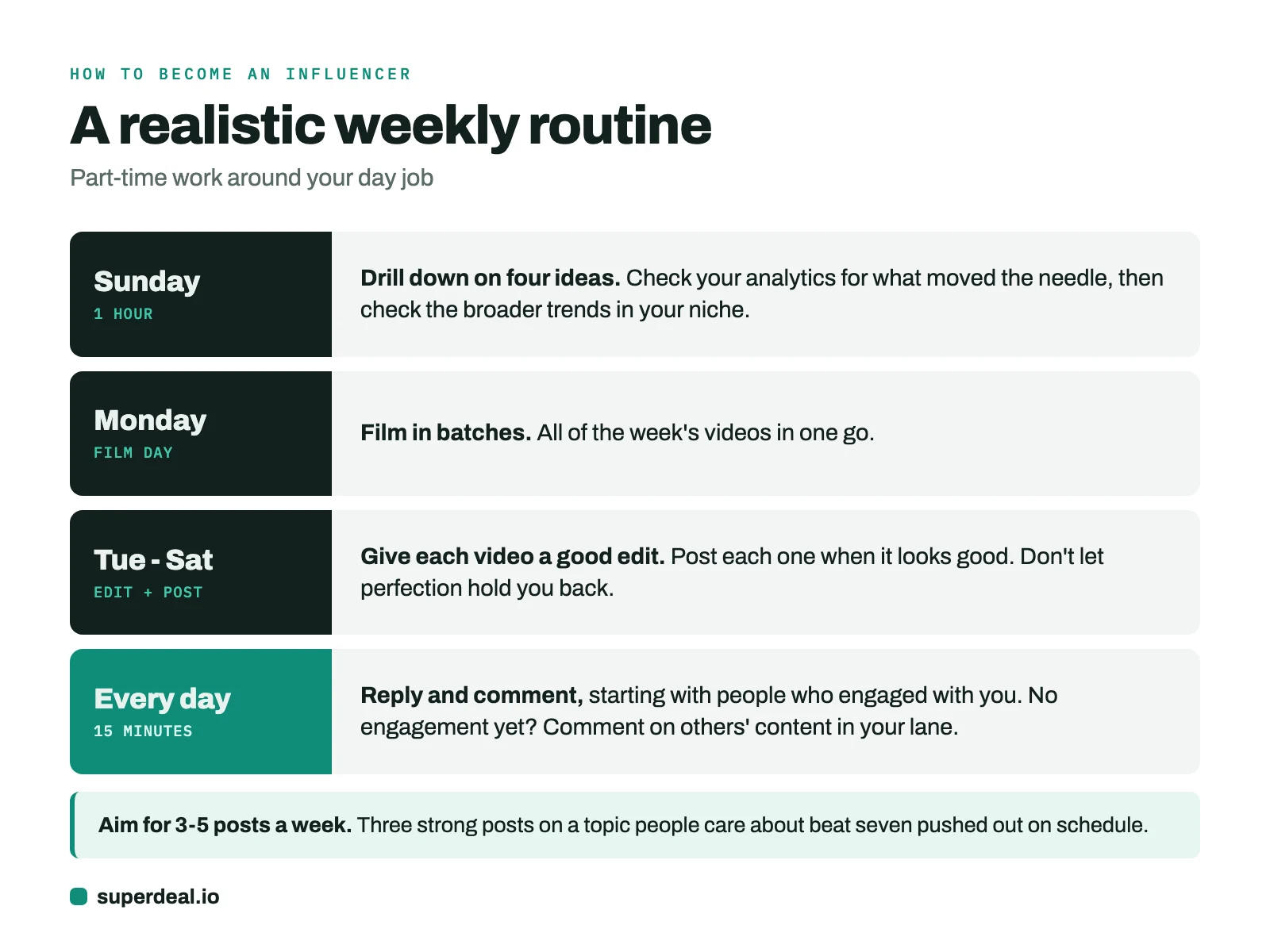
This is a job, and you should treat it as part-time work that unfolds over the week. Unless you have a fortune to fall back on for a while, keep your day job.
Start your week on Sunday with the goal of drilling down on four ideas in an hour. Check the analytics for your channels and note what moved the needle. Check the broader trends to see where the conversation is at. If your instinct says a topic is about to pop off, target it with one video and see how it goes.
Film in batches on Monday. Give each video a good edit through Saturday. Post each when they look good, but don't let perfection hold you back. Spend 15 minutes every day replying and commenting, starting with folks who've engaged with your content. If there is no engagement, go comment on content others have done in your lane.
How Growth Actually Happens
Understand that growth is uneven. The top influencers often openly post and laugh about how three of the most ridiculous things they ever said attracted the biggest jumps in their followings. Look at your top three posts and ask how you can build on them with variations. Also, absorb lessons learned from big moments when followers came to you to understand something.
Look at sharing, sending, and saving more than likes. The stuff that folks share with others is where follower counts go up. Check the engagement rate. Also, beware of engagement that's low quality. Lots of bots and even other influencers post low-quality comments. Also, keep an eye on total views, because some channels do good numbers without ever attracting huge followings, especially on platforms that have unpredictable promotion patterns.
First Contact with a Brand
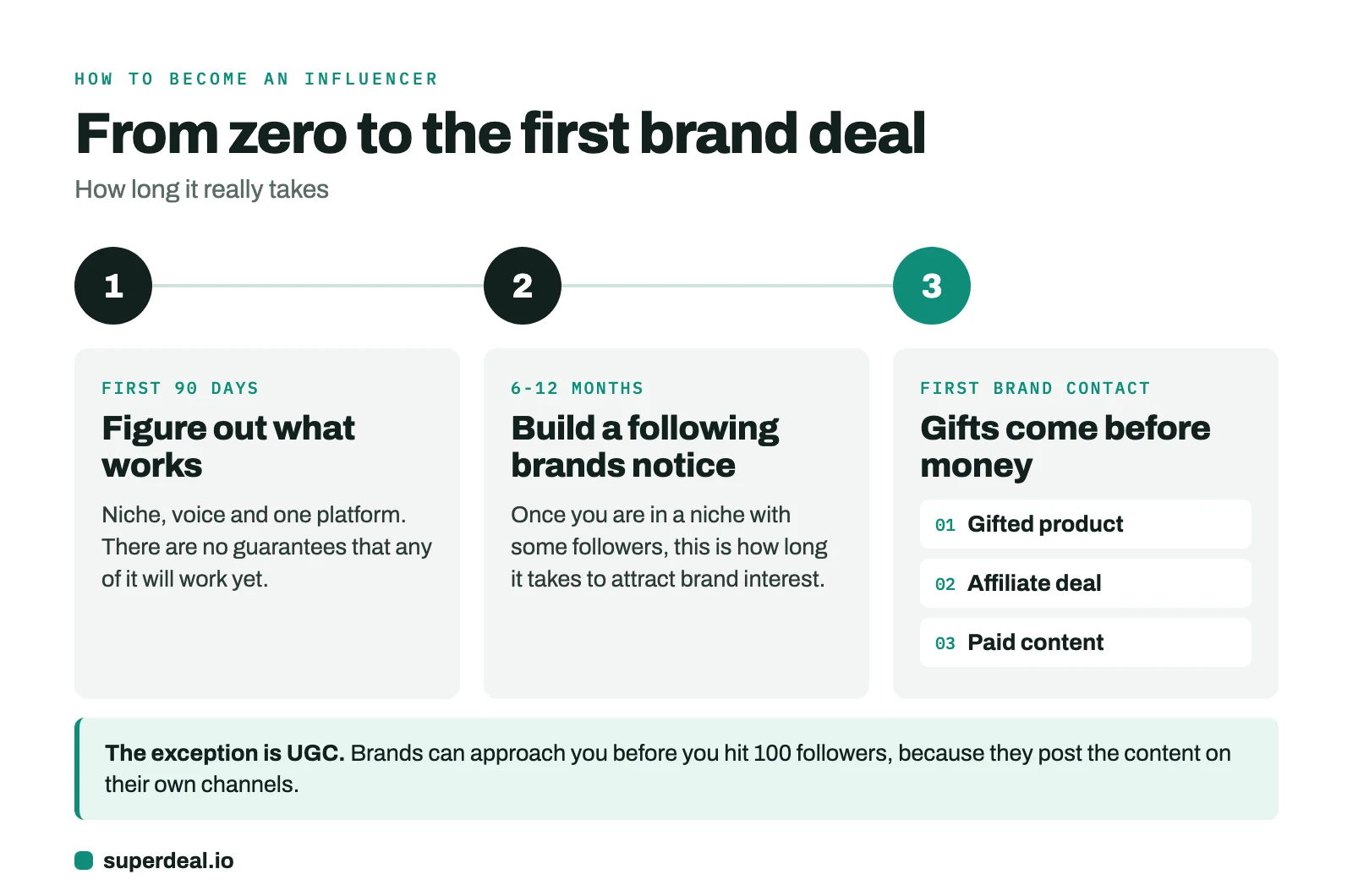
As your follower count rises, a brand may contact you. The pattern usually progresses initially from gifting to an affiliate structure and then onto straight-up payment. You can also consider pitching smaller brands and seeing how they respond. Many companies now have direct influencer contacts for exploring opportunities.
Treat anything you have to pay for as a red flag. Be prepared to say no. Sometimes, even a legit brand may not be a good fit for your audience or voice. Here is a closer look at how to get brand deals.
User-generated content is a growing area. This is where you make content that the brand posts on its own channels and ads, so your follower count matters far less. Our contributing creator runs a writing channel separate from their other work and was approached about UGC before it hit 100 followers. They passed, but brands can be surprisingly willing to go nano these days.
Have a Package Ready
Know how to build an influencer media kit. You want to have an explanation of what your channel is, who you are, and who your followers are. Have your package ready to go the moment a brand contacts you. This is one of the best ways to make money as a content creator. Be able to say what your audience's views are and how your content performs. Also, have a contact ready so you can direct all business to it.
Disclosure
Check out the FTC's Disclosures 101 for Social Media Influencers to learn about disclosure rules. Gifted, free, or discounted products usually count as payment just as much as cash does. Know the rules for tagging paid content on your platforms of choice.
FAQs
What Doesn't Work?
Copying from a bigger influencer nearly never works. Audiences have seen it done better. Engagement pods often break platform rules and tend to just confuse algorithms. Also, never chase a trend outside your lane. It's okay to sit out whatever is this week's Story of the Century if it's not a fit for you.
Never buy followers. They will just get wiped out during platform purges, making you look bad to brands.
How Long Does It Take to Become an Influencer?
You will spend the first 90 days just figuring out what works, and there are no guarantees that any of it will work. If you get into a niche with some followers, expect 6-12 months to develop a large enough following to attract brand interest.
How Many Followers Does It Take to Get Paid?
A common rule of thumb is 1,000 followers. However, some niches are very attractive for sub-nano accounts. For example, a small and loyal financial account following can attract interest with a few hundred followers. Conversely, a gaming streamer might need to push into the tens of thousands before interest materializes because the niche is so competitive.
How Do I Handle a Growth Stall-Out?
Growth can be very uneven. If things feel slow, dig into your analytics and check your top three all-time posts. Consider what they have in common and apply the lessons learned to at least one of this week's planned posts.
Which Platform Is the Right One for a Beginner?
Platform match has more to do with your preferred content. Someone who can produce great graphics and long-form voiceovers should probably be on YouTube. Conversely, a person who has a gift for punchy humor might want short clips on TikTok. Study each platform and see which influencers are performing well in your niche and voice. Whatever platform they favor is probably a good starting point for you.