Best Influencer Marketing Tools in 2026 (Free + AI Picks)
The best influencer marketing tools in 2026, sorted into seven categories: discovery, deal management, contracts, escrow, analytics, and AI. Free and paid picks, written for creators who run their own brand deals.

I have spent more than fifteen years buying growth for startups and brands, and a large share of that budget went to creators. I have paid for the enterprise platforms and then not used two thirds of what they did. I have run campaigns on nothing but a spreadsheet and a Gmail thread. I sit on the Global Grand Jury of the Effie Awards, which means once a year I read the cases where creator work genuinely moved a business, and the ones where it did not. So I have opinions about which of these tools deserve money.
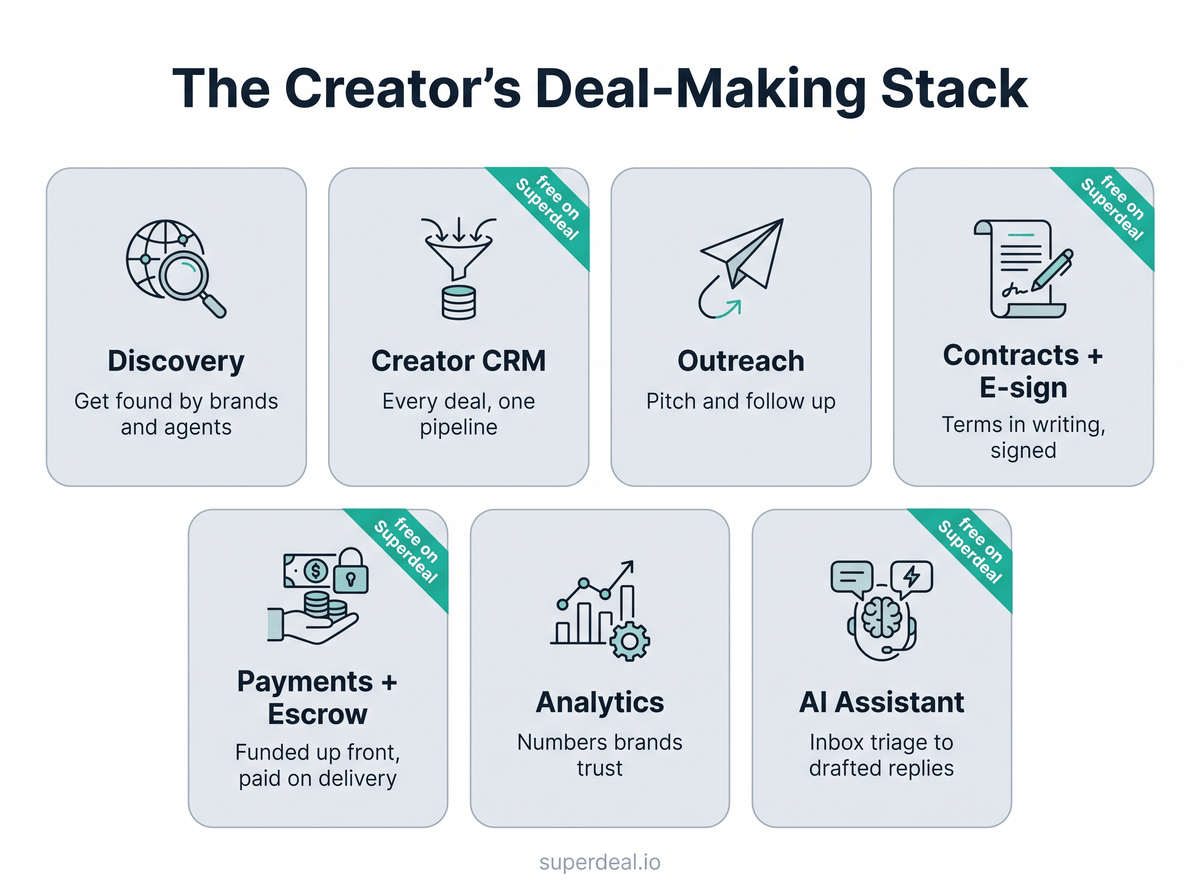
Here is the frame. The best influencer marketing tools in 2026 each do one of seven jobs: find creators, manage deals, send outreach, sign contracts, move money, report on results, or hand the busywork to AI. Most roundups only cover my side of the table, the brand running campaigns across hundreds of creators. This one covers that, but I have written it just as much for the person on the other end of my emails: the creator sorting brand offers in a crowded inbox and trying to get paid without a manager taking a cut.
Two things you should know before you weigh my picks. I advise Superdeal on growth, so read what I say about it as informed and interested. And every named tool below is an example of its category, not an endorsement.
What to Look For in an Influencer Marketing Tool
Before you compare named tools, settle two questions: which side of the deal you are on, and which manual task you most want gone. Those answers rule out most of the market.
Every bad tool purchase I have made came from skipping that step. You buy the platform with the best demo, then find out it was built for a roster of 300 creators when you work with 12, or built for brands when you are the creator.
A brand managing a roster needs discovery plus a CRM. A creator managing their own deals needs close to the opposite: one place to handle offers, contracts, and payment without hiring anyone. Very few tools serve both sides well, so role is the first filter.
After role, I weigh three things:
The job it removes. Buy for the task that hurts most right now - finding creators, negotiating, chasing signatures, or chasing payment. Not for the feature list.
Free versus paid, and AI that acts. Plenty of free tiers are trials wearing a costume, so check what you keep when it ends. I have stopped paying for AI that summarizes; I pay for AI that takes an action.
Fees and lock-in. How the tool makes money - a cut of your fee, payment processing, or a subscription - is your real cost. A 20 percent cut on a $3,000 deal is $600, which is more than most annual subscriptions.
The Best Influencer Marketing Tools by Category (2026)
Here is the stack, one category at a time, with a note on where Superdeal fits for creators running their own deals.
Creator discovery and search
Discovery tools help brands find creators and help creators get found, and the good ones rank by audience quality, not raw follower count.
For brands, this is a searchable database: filter by niche, platform, audience, and engagement, then screen for fake followers. Discovery platforms such as Modash, Heepsy, and Klear index millions of profiles, marketplaces like Collabstr let brands browse and book creators by category, and Upfluence serves larger teams.
I have bought in this tier, and the honest read is that these tools are worth their price when you are shortlisting dozens of creators a month and worth very little when you are booking three. The number I check first is never follower count. It is whether the comments are sentences from people, because a 400,000-follower account whose comments are all emoji has cost me more money than any small account ever did.
For creators, discovery runs the other way: the goal is to be findable. Superdeal's creator database is free and public on purpose, so a profile can be surfaced by brands and by the AI agents that increasingly do the searching. Browse the open , and if you take content-only work, list yourself as too.
Creator CRM and deal management
A creator CRM keeps every brand conversation, deliverable, deadline, and payment in one view instead of scattered across DMs, email, and memory.
What to look for: a pipeline of active and pending deals, deliverable and deadline tracking, and one record of the agreed terms. For companies, this is the heart of platforms like Grin, Aspire, and CreatorIQ, which are built for large rosters and priced for brands rather than individuals.
This category is where I have watched the most money quietly leak. Not on fraud, on drift: a deliverable that shipped two weeks after the promotion it was meant to support, a usage window nobody tracked, an invoice paid twice because two people in the same team were talking to the same creator. A CRM does not make the campaign better. It stops it from decaying.
On the creator side, most people improvise with a spreadsheet or a Notion board, which works until three deals overlap and one slips. Superdeal's AI manager fills that gap: it reads your inbox, flags genuine offers, and keeps each deal moving from offer to signed to paid. For the manual version, see .
Outreach and pitching
Outreach tools help you send a clear pitch and follow up without losing the thread, and for creators the pitch is usually a media kit plus a short, specific email.
What to look for: reusable templates, follow-up tracking so nothing goes cold, and enough personalization that it does not read as a mass blast. Brand teams usually run outreach from inside their discovery platform. Creators do fine with Gmail and a strong media kit.
I am on the receiving end of these pitches, so let me be useful here. The ones I reply to are three lines long, name the product, say what the creator would make and why it fits their audience, and attach real numbers. The ones I delete open with "I love your brand" and never mention a rate. A tool cannot fix a pitch like the second one, and no amount of automation compensates for having nothing to say.
The asset that carries the pitch is the media kit: your audience, rates, and best work on one page. If you do not have one, start with . Superdeal flips the direction for creators who are already listed: instead of pitching cold, you receive offers, and the AI drafts a reply with your rate.
Contracts and e-signature
A contract tool turns a verbal yes into a signed, enforceable agreement, and the ones worth using cover e-signature, usage rights, and a template you can reuse.
What to look for: legally binding e-signatures, clear usage-rights and exclusivity language, and a reusable template. General e-signature tools such as DocuSign, Dropbox Sign, and PandaDoc handle signing for any industry but know nothing about influencer terms, so you supply the clauses on deliverables, revisions, and usage.
The clause that causes the most trouble in my experience is usage. A brand assumes it can run the creator's video as a paid ad for a year; the creator assumed they were paid for one organic post. Both of them are being reasonable and neither wrote it down. Settle usage, duration, and paid-media rights before anyone films anything, and price them separately.
Two Superdeal resources cover the language: a ready and an of terms a creator deal should never skip. Contracts are also where disclosure belongs, since the require creators to label paid partnerships. On Superdeal the contract is generated inside the deal, so signing is not a separate tool at all.
Payments and escrow
Payment tools get you paid, and for brand deals the feature that matters most is escrow - funds held before you create anything, released when the work is approved.
What to look for: an escrow or hold-and-release option, low fees, and clear timing on payout. Standard processors like PayPal, Stripe, and Wise move money reliably but protect neither side if a deal goes wrong. A dedicated escrow service adds protection and also adds steps. Creators who invoice after delivery end up chasing payment for months, usually through no fault of the person they are emailing: the money is stuck behind a vendor-onboarding form and a 60-day payment term.
Worth saying from the buyer's seat: escrow is not a concession brands make to creators. It removes the most awkward part of the negotiation. Nobody has to argue about who trusts whom, and I stop being the person a creator has to chase.
Superdeal builds hold-and-release into the deal: when the brand signs, the payment is held; when the deliverable is approved, it releases to the creator, who keeps the full amount. Superdeal earns from the transaction, not from a percentage of the creator's fee.
Analytics and reporting
Analytics tools show what a post did - reach, engagement, saves, clicks - and package it into the report a brand expects after a campaign.
What to look for: start with native analytics, which are free and authoritative. and give you real numbers straight from the platform, and YouTube Studio does the same for video. If you post across platforms, schedulers such as Later, Hootsuite, and Sprout Social add a combined dashboard, which is convenient but rarely essential when you are solo.
What I actually opened as the buyer was a much shorter list than the decks I received: saves and shares rather than likes, watch-through on the first three seconds, and the click-through on the link. Reach told me almost nothing. And for renewals, the thing that decided it was not a metric at all, it was whether the creator delivered on the agreed date.
For deal-making, what moves a negotiation is your engagement rate and your delivery record, and both belong next to the deal itself.
AI assistants
AI assistants now handle the writing, sorting, and pricing work that used to eat a creator's week, and the ones worth adopting take an action rather than just answering questions.
What to look for: does the assistant do the job or describe it? General tools like ChatGPT and Claude are excellent for drafting pitches, captions, and rate justifications, but you still paste, edit, and send. On the brand side, several campaign platforms have bolted AI onto search and reporting, and a fair amount of it is a summary of a dashboard you already had.
Superdeal's AI manager is narrower and more concrete: it is built for one workflow, your brand deals, and it acts on them. It reads the inbox, separates real offers from noise, drafts a reply at your rate, and routes the signed deal into escrow.
The Best Free Influencer Marketing Tools
The best free influencer marketing tools in 2026 are the native platform analytics, a free and indexable creator database, a solid contract template, and any deal tool that does not charge until money changes hands.
Free, and genuinely useful without a credit card:
Native analytics in Instagram, TikTok, and YouTube - the most accurate numbers you can get, at no cost.
A free creator database for discoverability. Listing on Superdeal is free, and it doubles as your deal-management workspace.
A contract template so a first deal does not stall on wording. Start from the .
Email plus a media kit for outreach. No paid tool is required to send a good pitch.
One warning on the word free, and I have been caught by it: most brand-side discovery platforms advertise a free plan that is really a limited trial, and the limit is usually the number of profiles you can actually export. Check what you keep on day 31.
AI Tools for Influencer Marketing
AI tools for influencer marketing crossed from novelty to default in 2026, and the sharpest change is on the creator side, where an AI manager can run the deal flow a human manager used to charge 15% to 20% to handle.
On the brand side, AI mostly speeds up work that already existed: smarter creator search, fake-follower detection, and automatic campaign reports. Useful, not structural.
On the creator side it changes who needs a manager at all. An AI manager triages the inbox, catches real offers, drafts replies with your rate, and pushes signed deals into escrow, which is close to the exact task list a human manager took a percentage for. Superdeal's founder, Eric Dahan, frames the bet plainly: the database is free and indexable on purpose, because the business earns on transactions rather than on hoarding data, and the goal is to be the place both brands and AI agents look for creators. Having bought from both sides of that market, I think the second half of that sentence is the part most people are underrating.
Which Influencer Marketing Tool Should You Actually Use?
Choose by your role: a brand managing many creators needs a discovery-plus-CRM platform; a creator managing their own deals needs one tool for offers, contracts, and payment.
Brand or agency at scale. A full platform, the Grin, Aspire, CreatorIQ, or Upfluence tier, earns its price across dozens of creators and client reports. Below that volume you are paying for seats you do not fill.
Small brand or occasional campaign. A marketplace, a general e-signature tool, and a standard payment processor do the job without a heavy subscription. This is where most of the companies I work with actually sit.
Creator running your own deals. One tool that handles offers, generates the contract, and holds payment in escrow beats stitching five apps together, which is the slot Superdeal is built for, free to start. .
Frequently Asked Questions
1. What are the best influencer marketing tools in 2026?
They fall into seven categories: discovery, creator CRM and deal management, outreach, contracts, payments and escrow, analytics, and AI assistants. The best pick depends on your role - brands use platforms like Grin, Aspire, or Upfluence, while creators managing their own deals want one tool that bundles offers, contracts, and escrow, such as Superdeal.
2. Are there free influencer marketing tools?
Yes. Native analytics in Instagram, TikTok, and YouTube are free and the most accurate numbers available, listing on a free creator database like Superdeal costs nothing, and email with a media kit handles outreach. Watch out for discovery platforms whose free plan is really a limited trial.
3. What AI tools are used for influencer marketing?
On the brand side, AI powers creator search, fake-follower detection, and campaign reporting. On the creator side, an AI manager like Superdeal's reads your inbox, flags real offers, drafts replies with your rate, and moves signed deals into escrow. ChatGPT and Claude also help draft pitches and captions.
4. What tools do creators use to manage brand deals?
Many start with a spreadsheet or a Notion board, which works until several deals overlap. Purpose-built deal management keeps the conversation, contract, and payment in one place. Superdeal's AI manager runs the flow from offer to signed contract to escrow, so a creator can manage deals without hiring a manager.
5. Do I need separate tools for contracts and payments?
You can - DocuSign for the contract, PayPal or Wise for payment - but that leaves gaps, especially around getting paid. Escrow, where the brand's money is held before you create and released on approval, closes the biggest one. A tool that bundles contract and escrow removes the handoffs.
6. What should a creator look for in an influencer marketing tool?
Start with your role, since most tools are built for brands or creators, not both. Then favor escrow, a ready contract template, real free access rather than a trial, and AI that takes an action rather than just answering. For a creator, one tool covering offers, contracts, and payment beats a stack of five.
About these picks: the named tools are representative examples of their category, not endorsements, and features and pricing change often. Confirm current details on each tool's site before you commit. I advise Superdeal on growth, which is disclosed at the top of this piece as well.